ⓘYou can now search across every topic, entity and event.What's new
25JUN
Day 118: Three flags over Hormuz, none enforced
4 min read
14:30UTC
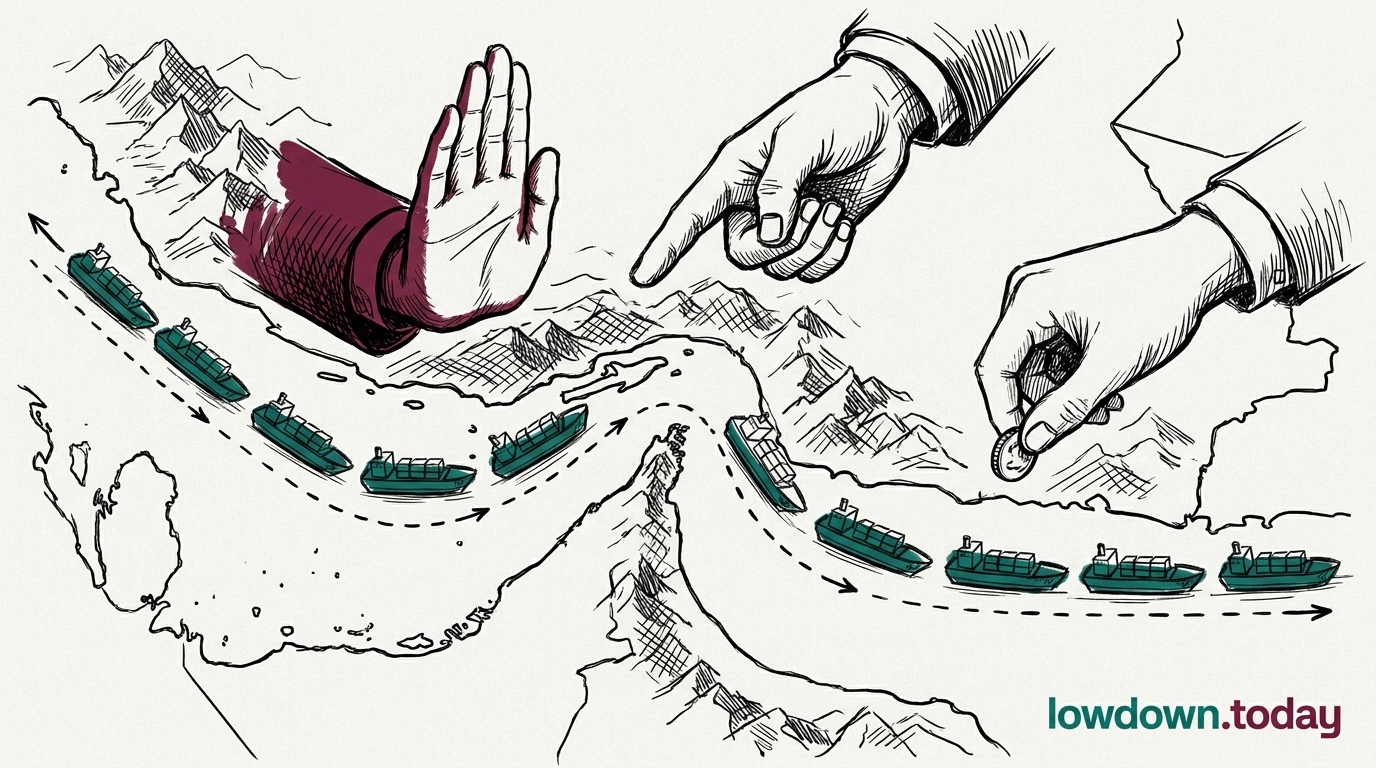
The IRGC rejected the new Oman-IMO Hormuz corridor on Thursday, the third authority to claim the same 33km of water after the GCC and the Iran-Oman fee committee. Five more South Korean ships transited anyway, ignoring all three. Brent fell below its pre-war level, the war premium fully priced out, while Lebanon's Round 5 collapsed and kept the gate to nuclear talks shut.
Iran's Revolutionary Guard declared the new Oman-IMO Hormuz corridor 'unacceptable and dangerous' on 25 June, ordering every vessel to coordinate on Channel 16 or face enforcement, the third authority to claim the same 33 kilometres of water.
Sources profile:This story draws on neutral-leaning sources from Iran
Iran's Islamic Revolutionary Guard Corps Navy declared the new Oman-IMOStrait of Hormuz corridor 'unacceptable and dangerous' on 25 June, ordering every vessel to coordinate with the IRGC Navy on Channel 16 or face 'enforcement measures', directly rejecting the toll-free route announced by Oman in coordination with the IMO.
Three incompatible governance claims now cover the strait of Hormuz on the same day, and the IRGC's is the only one asserting enforcement it has not performed.
Rubio and the six GCC foreign ministers issued a Manama communique on 25 June welcoming free Hormuz navigation with no tolls, while GCC member Oman had co-signed an Iran fee committee two days earlier.
Sources profile:This story draws on centre-left-leaning sources from Qatar
The GCC-US ministerial in Manama on 25 June produced a communique welcoming the end of hostilities and the 'restoration of free and secure navigation' through the strait of Hormuz with no tolls and no fees. Marco Rubio told the six GCC foreign ministers there was 'zero support among Gulf countries for any toll or fee' on the strait, and confirmed the Bahrain session did not discuss any Iran reconstruction fund. The GCC tied lasting security to three Iranian concessions: an end to missile and drone attacks, a halt to militia support, and no interference in state sovereignty. Oman, a GCC member, had co-signed the Iran-Oman Muscat fee committee two days earlier.
The bloc's united no-fees front already contains a coastal member co-governing the very tolls it claims to oppose.
Five more South Korean-operated vessels cleared the Strait of Hormuz on 25 June, 11 of roughly 24 stranded, sailing under a toll-free window and ignoring the IRGC's compulsory Channel 16 mandate declared the same day.
Sources profile:This story draws on neutral-leaning sources
Five more South Korean-operated vessels cleared the strait of Hormuz on 25 June, bringing the total to 11 of roughly 24 stranded since the IRGC closure, sailing under the MOU's 60-day toll-free window without coordinating with the IRGC's Channel 16 mandate that had just been declared compulsory. Twenty-one South Korean sailors were aboard the departing vessels; South Korea's Ministry of Oceans and Fisheries confirmed the ships were 'passing through the strategic waterway and sailing normally.'
The Korean transits are the physical test of the IRGC's verbal authority, and the ships passed it by simply not coordinating.
Brent crude fell more than 4% to a $72.64-$73.72 range on 25 June, dropping under its pre-war February level and erasing the war premium that had pushed it past $116 at the height of the IRGC closure.
Sources profile:This story draws on centre-right-leaning sources from United Arab Emirates
Brent Crude settled at $72.64 to $73.72 on 25 June, its lowest in nearly four months and below the price that prevailed before 28 February. The benchmark has surrendered the entire risk premium that accumulated during the conflict, with traders treating the Islamabad memorandum as a durable settlement. The repricing ran well ahead of any verified return of supply, leaving investors positioned for a calm not yet delivered on the ground.
The oil market has priced the Iran conflict as over while the strait stays mined, uninsured and contested, leaving no cushion against a reversal.
London hull war-risk premiums halved to around 2% of vessel value over six days, yet the $40 billion US-backed Hormuz reinsurance facility has had zero uptake, blocked by a sanctions-compliance trap no price cut can fix.
Sources profile:This story draws on neutral-leaning sources from Australia
London hull war-risk premiums halved over six days to around two per cent of vessel value, down from a five per cent peak but still twenty times the pre-conflict 0.1 per cent baseline. The US Development Finance Corporation's $40 billion Chubb-backed Hormuz reinsurance facility has had zero uptake since its launch, with not one ship using it. London underwriters cut the price without restoring the cover, blocked by the conflict between PGSA registration requirements and OFAC compliance obligations for London P&I clubs.
Underwriters are lowering Hormuz premiums while refusing to actually cover the route, exposing a structural conflict between Iranian and US compliance rules.
Grossi said IAEA inspections of Iran 'going to happen' on 24 June; Gharibabadi tied access to sanctions relief first; Trump claimed Iran 'completely agreed', and Tehran denied it within hours.
Sources profile:This story draws on centre-left-leaning sources from France and United States
IAEA Director-General Rafael Grossi said in Japan on 24 June that inspections of Iran's enrichment sites are 'going to happen' and the agency would work on 'the modalities, dates, procedures, places, very soon', moving to procedural language for the first time since the MOU. Iran's Deputy Foreign Minister Kazem Gharibabadi on the same day said access would follow only a final deal and practical sanctions relief, not precede them, directly contradicting General License X's assumed access. Donald Trump then told Fox News on 25 June that US inspectors would join the IAEA mission and Iran had 'completely agreed' to inspections; Iran's foreign ministry denied any such agreement within hours, repeating the same denial sequence as his 23 June claim. The IAEA remains locked out after more than 100 days, with 440.9 kilograms of 60 per cent enriched uranium unverified since February.
Three actors describe three incompatible inspection futures, and not one signed instrument exists to adjudicate between them.
The fifth round of Lebanon-Israel talks in Washington ended on 25 June with no Litani map and no joint statement, keeping Iran's nuclear precondition, a Lebanon ceasefire, unmet.
Sources profile:This story draws on mixed-leaning sources from Israel and United States
The fifth round of Lebanon-Israel talks in Washington ended on 25 June without an agreed Litani model-zone map, the deliverable both sides had been expected to produce. Sources briefed on the negotiations told Axios there was 'more regression than steps forward'. The parties left Washington without a joint statement. Lebanon wanted the pilot Lebanese Armed Forces deployment in areas Israel currently holds; Israel wanted it in areas free of Israel Defense Forces troops. President Joseph Aoun said the model areas remained pending Israeli approval. Israel's refusal to withdraw south of the Litani keeps Iran's nuclear precondition — a Lebanon ceasefire with LAF handover — unmet.
Israel's refusal to withdraw south of the Litani is, in effect, the most reliable block on the memorandum's nuclear verification clause.
Direction: sideways, with a compressed upward tail at 21 August 2026. The action-versus-words gap has held across the IRGC's three closure declarations since 11 June and 11 successful Korean transits without Channel 16 coordination. The most concrete near-term trigger is the 13 remaining Korean vessels: one IRGC boarding would collapse Brent from its fully-discounted $72-73, reprice the curve from zero cushion, and produce a Seoul-Tehran diplomatic crisis with no de-escalation mechanism.
The structural trigger is the August convergence: GL X expires 21 August at the same moment PGSA mandatory fees activate and Shetab-Mir Stage 3 completes Iran's alternative dollar-settlement rail. If GL X lapses without a final deal, Iranian oil sales lose their dollar-clearing licence precisely when the PGSA's fee infrastructure becomes compulsory, removing the financial incentive that has kept the corps in verbal-only mode since 11 June.
AI-assisted, human-edited under the editorial responsibility of Bannermedia Ltd. Reviewed by Ed Woodcock on 25 June 2026. Editorial standards.
Different Perspectives
IRGC / Iran
The IRGC declared the Oman-IMO corridor unacceptable and mandated Channel 16 coordination, the corps's third governance assertion over the strait since 11 June, while watched five Korean ships transit unhindered. The pattern of declaration without interdiction preserves Iran's legal claim while deferring the diplomatic cost of enforcement.
United States / Marco Rubio
Rubio told the GCC in Manama there was 'zero support' for any Hormuz toll or fee, issuing a position the PGSA-OFAC compliance trap makes unenforceable by Western insurers regardless of its diplomatic weight. The Bahrain session produced no reconstruction fund discussion and no mechanism to resolve the insurance impasse.
South Korea
South Korea's Ministry of Oceans and Fisheries confirmed five more vessels were 'passing through the strategic waterway and sailing normally', a deliberate non-acknowledgement of the IRGC's Channel 16 mandate that treated the Oman-IMO corridor as operative without endorsing it. Thirteen vessels and their crews remain inside the Persian Gulf.
Oman
Oman co-announced the IMO corridor while its Sultan had signed the Iran-Oman fee committee in Muscat two days earlier, placing it simultaneously inside the GCC's zero-fees communique and inside the Iranian fee architecture the communique rejects. The contradiction has not been publicly addressed by Muscat.
IAEA / Rafael Grossi
Grossi moved from 'whether' to 'how' on Iran inspections in Japan, saying the agency would work on 'modalities, dates, procedures, places, very soon', but named no date and has not verified the 440.9kg of 60%-enriched uranium missing since February. Iran's deputy foreign minister ruled out access before a final deal on the same day.
London war-risk underwriters / Lloyd's
Lloyd's hull war-risk premiums halved to around 2% of vessel value without restoring cover, the market's clearest signal that the PGSA-OFAC compliance conflict, not risk appetite, is the blocking mechanism. The DFC $40 billion facility has recorded zero uptake because the access problem it was not designed to solve remains unsolved.