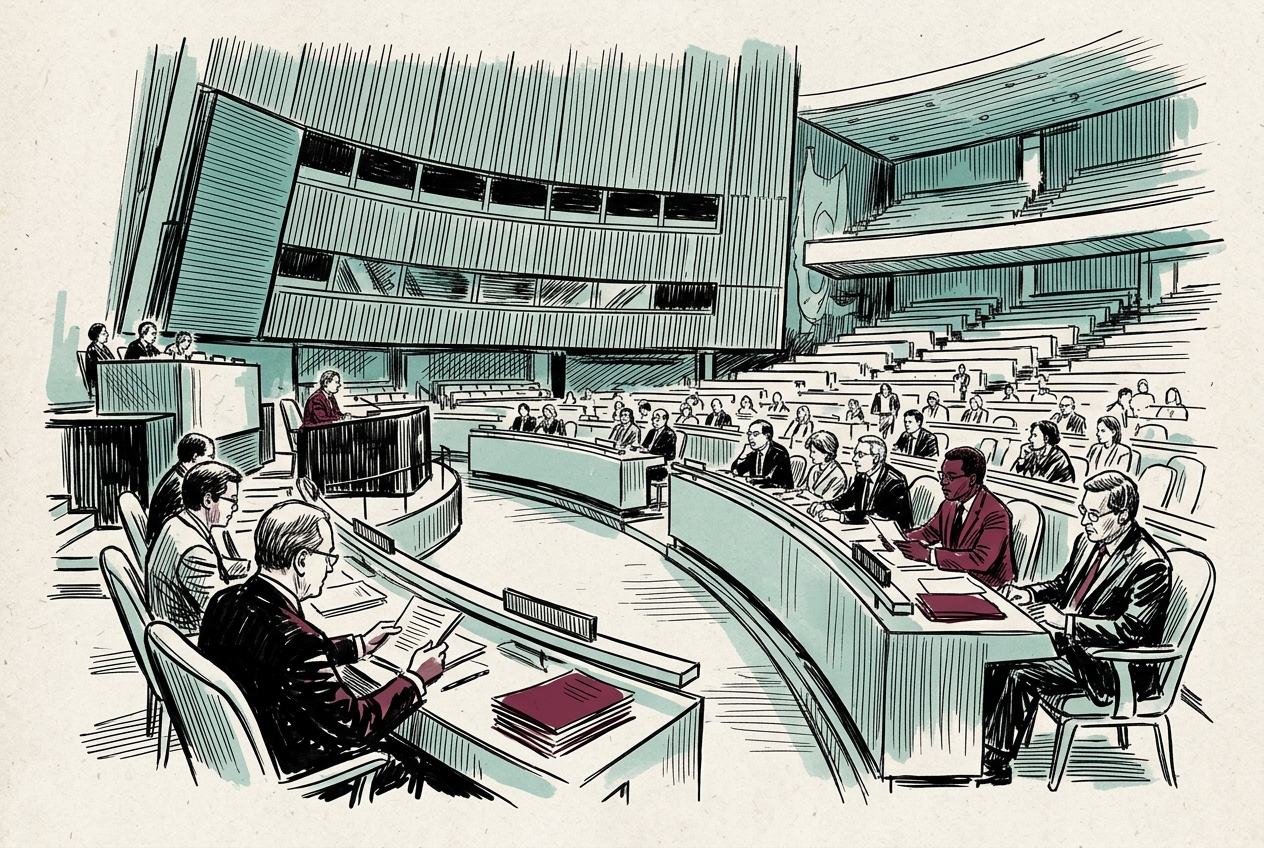
United Nations
193-member intergovernmental body founded 1945; primary forum for global peace, law, and humanitarian coordination.
Iran's nuclear file reached the United Nations Security Council on 9 September, when the IAEA's governing board backed referral by 23 votes to 3; eight days later Russia and China vetoed renewal of the UN panel tracking Iran sanctions breaches.
Last refreshed: 3 October 2026 · Appears in 2 active topics
Can the UN enforce a Hormuz ceasefire when P5 members back opposing sides?
Timeline for United Nations
Mentioned in: Iran hangs two men over Mashhad unrest
Iran Conflict 2026Mentioned in: Treasury names 10 Iran missile suppliers
Iran Conflict 2026Hosted the first structured American contact with Tehran of the war
Iran Conflict 2026: Qatar brings the US answer to AraghchiMentioned in: WHO talks on pathogen sharing fail again
Pandemics and BiosecurityMentioned in: Russia and China kill Iran's UN monitor
Iran Conflict 2026Background
The United Nations is a 193-member intergovernmental organisation founded in 1945, the main global forum for peace, international law and humanitarian coordination. Its work runs from Security Council diplomacy to peacekeeping missions and specialised agencies that monitor nuclear material, shipping and public health.
The Iran war has tested each layer. On 17 April the International Maritime Organization invoked the Law of the Sea against discriminatory Hormuz tolls and reported 20,000 seafarers and 2,000 vessels trapped in the Gulf; by 10 September its count of attacks on merchant ships had reached 75, with 22 seafarers dead. The IAEA lost continuity of knowledge over Iran's enriched uranium, and the Security Council deadlocked over Hormuz.
Outside the war, UN Tourism lowered its expectation for growth in 2026 international arrivals to 1-2%, against 3-4% in its January outlook. The organisation supplies shared procedures, public records and operational capacity; its binding decisions still depend on agreement among the five permanent members of the Security Council.
Iran's nuclear file reaches the Council
The IAEA, the UN's nuclear watchdog, reported on 4 June that it had lost track of Iran's 440.9 kg stockpile of 60%-enriched uranium after 97 days without inspector access, with about 240 kg in no confirmed location. Around 1 September the agency told members that Iranian nuclear material remained unverified and pressed for urgent entry to the Isfahan plant.
On 9 September the agency's governing board backed referral to the Security Council by 23 votes to 3, with eight abstentions, a step last taken against Iran twenty years earlier. The referral moves the file from the UN's technical body to its political one, where China and Russia, which opposed the board vote, hold vetoes over any binding response.
Vetoes block the Council on Iran
On 10 April the Security Council voted 11 to 2 for a resolution calling for the strait of Hormuz to reopen. Russia and China vetoed it, closing the Council's route to a binding demand while Chinese tankers kept transiting under Iranian tolls.
The same two members used the veto again on 17 September, blocking by 11 votes to two the renewal of the UN panel that investigates breaches of Iran sanctions; its mandate expired on 26 September. Britain accused Moscow and Beijing of shielding Tehran. With the panel gone, no body is appointed to keep the Iranian entries on the UN's consolidated sanctions list accurate, and the Council has not elected a chair for the committee that would appoint one.
Peacekeepers come under fire again
Two Ghanaian peacekeepers with UNIFIL, the UN Interim Force in Lebanon, were critically wounded at their base in Qawzah on 6 March, and Ghana lodged a formal protest with Secretary-General António Guterres. On 10 April six peacekeepers were injured and one detained by Israeli forces after a UN convoy was blocked.
On 4 June Serbian peacekeeper Sergeant Milovan Jovanovic died in mortar fire near Marjayoun and two others were wounded; UNIFIL said the attack might be a war crime. The force, deployed under Resolution 1701 with about 10,000 troops, has no enforcement mandate in the zone it patrols. On 22 June its peacekeepers helped reopen roads after Israeli forces pulled back from Debbine.
UNIFIL carries frontline risk
What can UNIFIL do in southern Lebanon?
Can UNIFIL stop Israel's advance north of the Litani?
Reference
How must a country report military self-defence to the United Nations?
Why can Security Council vetoes block United Nations action?
How many countries belong to the United Nations?
What is UNIFIL and why are its peacekeepers in Lebanon?
What is the difference between UNIFIL and the UN Security Council on Lebanon?
What is the United Nations?
Does the UN have to be notified before a country launches military strikes?
Why can't the UN stop the war in Lebanon?
Were UN peacekeepers attacked in Lebanon in 2026?
Who leads the United Nations in 2026?
Why can't the United Nations stop the war between the US and Iran?


