UN General Assembly
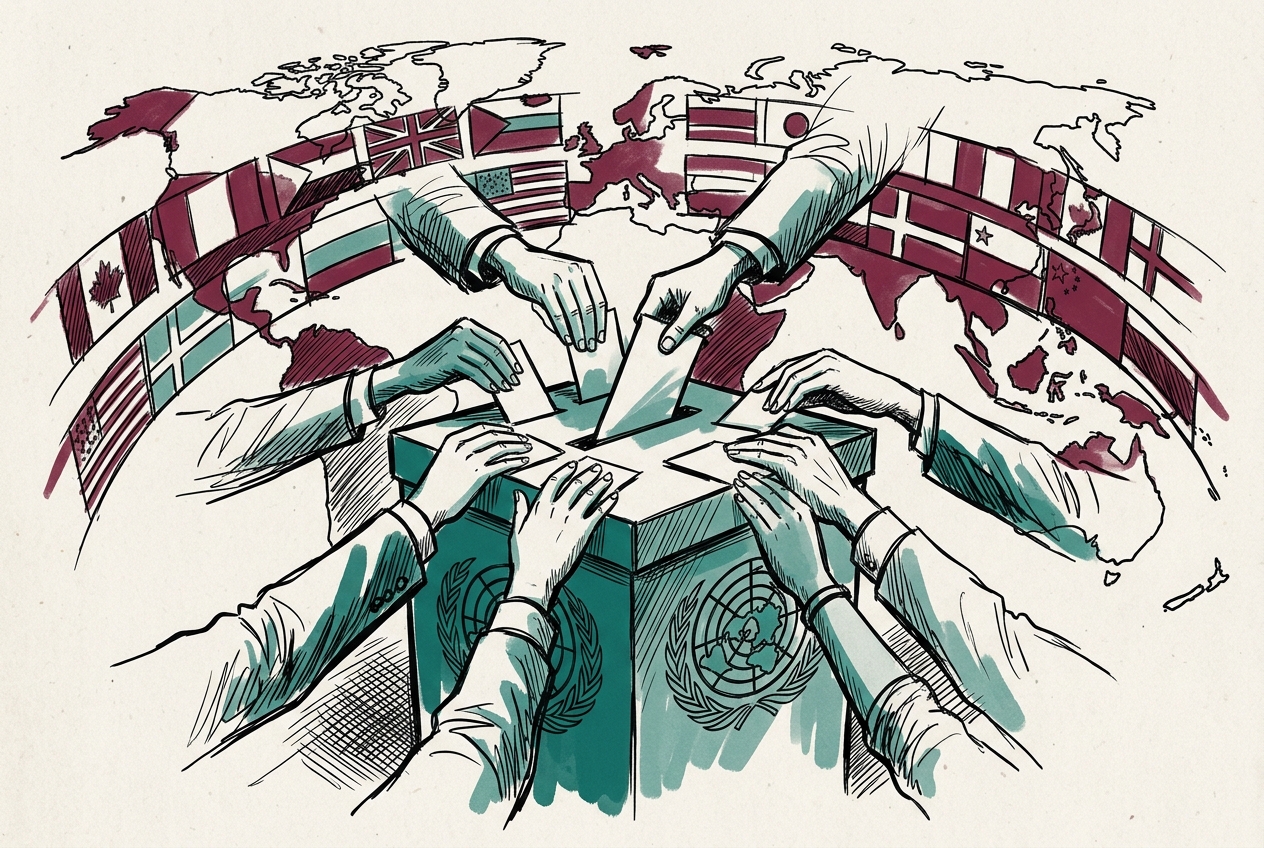
The UN body where all 193 member states vote on global peace and security.
On 25 September 2026 world leaders at the UN General Assembly's high-level meeting on pandemics approved a political declaration, one week after WHO talks on pathogen sharing failed for a second session running.
Last refreshed: 4 October 2026 · Appears in 1 active topic
Can 107 votes for a Ukraine ceasefire mean anything when UNGA resolutions bind no one?
Timeline for UN General Assembly
Approved a declaration restating the May 2027 date
Pandemics and Biosecurity: WHO talks on pathogen sharing fail againMentioned in: IAEA Board sends Iran's file to New York
Iran Conflict 2026Mentioned in: UK presses FIFA as the FA stays silent
2026 FIFA World CupMentioned in: Quirno cites 1982 UN Malvinas resolution
2026 FIFA World CupBackground
The UN General Assembly is the main deliberative organ of the United Nations, set up in 1945 under the UN Charter. All 193 member states hold one vote each, which makes it the only global forum where every sovereign state counts equally. Its resolutions do not bind members, unlike decisions of the UN Security Council.
That gap between near-Universal participation and no enforcement defines the body. When the Security Council deadlocks, states use the assembly to test world opinion without forcing anyone to act. On the fourth anniversary of Russia's invasion of Ukraine, 107 states backed an immediate Ceasefire, 12 opposed and 51 abstained; the United States abstained.
Old resolutions keep a political afterlife. Russia used the forum to condemn strikes near Iran's Bushehr nuclear plant, and in July 2026 Argentina's foreign minister, Pablo Quirno, cited a November 1982 assembly resolution on the Falklands to argue the sovereignty dispute is unresolved.
The assembly endorsed a pandemic declaration
The General Assembly hosted a high-level meeting on pandemics in New York on 25 September 2026, where world leaders approved a political declaration. WHO's account of the meeting restates the Deadline for the Pathogen Access and Benefit-Sharing annex: adoption at the World Health Assembly in May 2027.
The timing exposed the limits of the assembly's role. Seven days earlier, on 18 September, WHO's negotiating group in Geneva closed its eighth session without an agreed annex text. Until member states agree that annex, the treaty WHO adopted in May 2025 stays closed to signatures. A declaration from New York adds political weight but binds no government, so the treaty work stays in Geneva.
The embargo debate moved no positions
The assembly held its annual debate on the US embargo against Cuba on 7 and 8 July 2026, at Cuba's request as in previous years. The EU's Stavros Lambrinidis criticised the embargo's humanitarian harm but also rebuked Cuba's vote against a Ukraine Ceasefire resolution and its ties to Russian forces. The US delegation, led by Mike Waltz, held up photographs of jailed Cuban dissidents.
The session followed Executive Order 14380, signed on 29 January 2026, which declared a US national emergency over Cuba. Neither side shifted. Cuba has brought the embargo resolution to a vote almost every year since 1992, and it usually passes by a wide margin, with no means to make Washington comply.
What did the EU and US say at the 2026 UN Cuba embargo debate?
Why did the US abstain on the Ukraine ceasefire resolution?
How did countries vote on the Ukraine ceasefire at the UN in 2025?
Why are UN General Assembly resolutions not binding?
Does the UN General Assembly vote on the Cuba embargo every year?
What is the difference between the UN General Assembly and the Security Council?
What is the UN General Assembly?
What UN resolution did Argentina cite in the World Cup Falklands row?


