Skip to content
Welcome, thoughtbot's Giant Robots listeners!Start here
Pandemics and Biosecurity
3OCT

WHO talks on pathogen sharing fail again

3 min read
13:42UTC

WHO's working group closed its eighth session in Geneva on 18 September without agreeing the annex on sharing pathogen samples, its second failure in a row.

ScienceDeveloping
Key takeaway

The WHO Pandemic Agreement stays closed for signature until governments agree the pathogen-sharing annex.

The eighth session of the World Health Organization's Intergovernmental Working Group (IGWG) closed in Geneva on 18 September without an agreed text for the Pathogen Access and Benefit-Sharing (PABS) annex⁠1. IGWG7 also ended without a text on 17 July. WHO's release says negotiations "advanced" but names no agreed provision. Co-chair Tovar da Silva Nunes of Brazil said member states had "once again demonstrated their commitment to completing the PABS annex".

The annex sets how countries share virus samples and genetic sequences, and what they receive in return, such as vaccine doses. The WHO Pandemic Agreement, adopted in May 2025, cannot open for signature until the annex is adopted, so it binds no government yet.

World leaders approved a political declaration at the United Nations General Assembly high-level meeting on pandemics in New York on 25 September⁠2. WHO's account repeats the May 2027 deadline for adopting the annex that the World Health Assembly (WHO's annual meeting of all member states) set in May. That leaves little room for the earlier special session in 2026 that the IGWG release still lists as an option. In practice, a pathogen that emerges before then will be shared without the agreement's benefit-sharing rules.

Deep Analysis

In plain English

When a new virus appears, scientists need samples and its genetic code fast to make tests and vaccines. Poorer countries that share samples have often been last in line for the vaccines that result. WHO members agreed a Pandemic Treaty in 2025, but left one key part unfinished: the rules on sharing samples and what countries get in return. Talks on that part failed to agree a text in July and again in September. Until that part is agreed, no government can sign the 2025 treaty. World leaders backed a declaration at the UN in September, but it does not change that.

Deep Analysis
Root Causes

The annex tries to settle a trade that COVID-19 exposed. Countries that sequenced new variants first, such as South Africa in 2021, faced travel bans and waited for vaccines, so they now want guaranteed returns before sharing.

Industry and many high-income governments want samples and sequences to flow freely and fast, with benefit-sharing kept voluntary. A federated model of national labs gives source countries more control; a central database gives faster access.

The treaty's structure locks this in. The WHO Pandemic Agreement was adopted in May 2025 but cannot open for signature until the annex exists, so every other provision waits on this one dispute.

What could happen next?
  • Consequence

    No IGWG9 date was announced, so the May 2027 World Health Assembly is the realistic adoption point.

    Medium term · Assessed
  • Risk

    A pathogen that emerges before 2027 would be shared under ad hoc and bilateral rules.

    Medium term · Assessed
  • Precedent

    The influenza framework took four years; PABS talks risk a similar timescale.

    Long term · Suggested
First Reported In

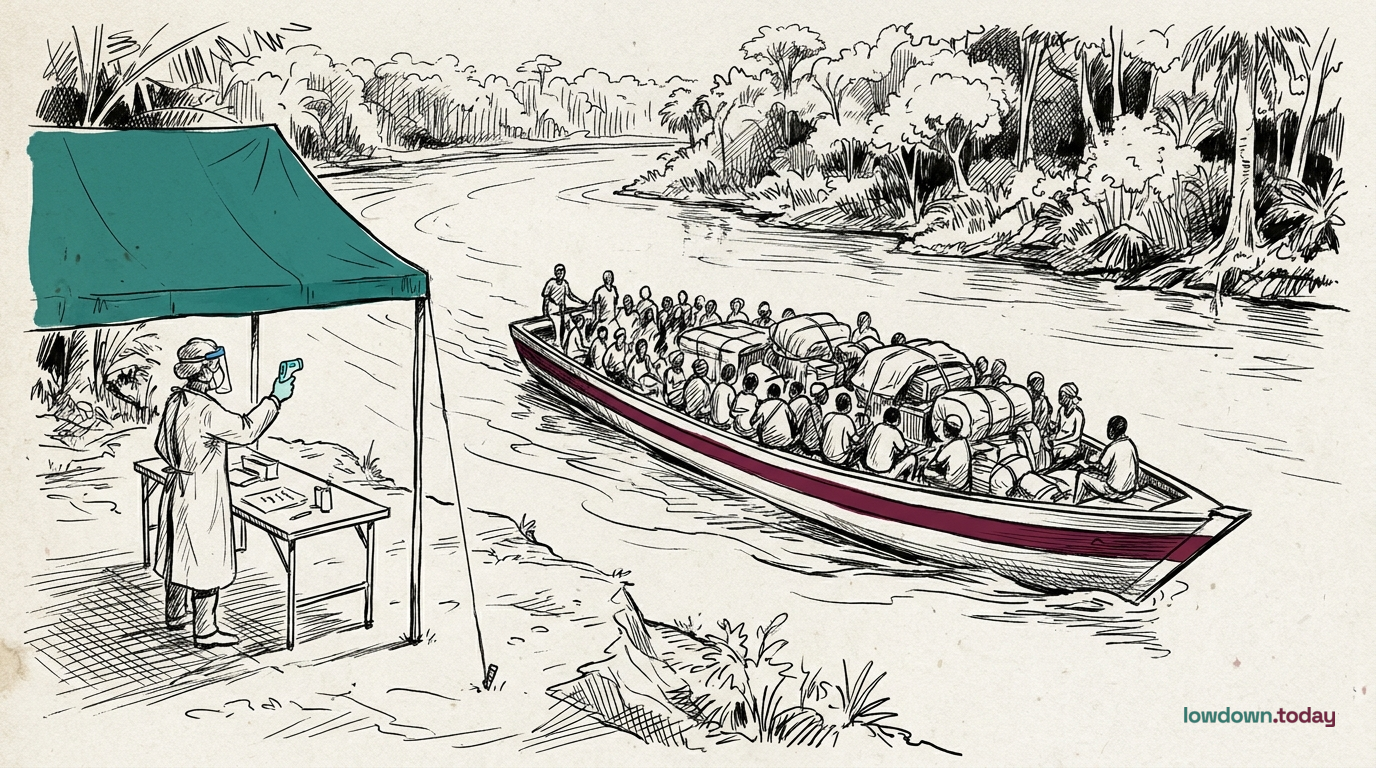
Update #14 · River boat carries Ebola 1,000 km downriver

World Health Organization· 3 Oct 2026
Read original →
Different Perspectives
IGWG co-chair Tovar da Silva Nunes
The Brazilian co-chair closed the eighth pathogen-sharing session on 18 September without an agreed annex text, the second session in a row to end that way. He presented the outcome as continued commitment, with adoption due at the World Health Assembly in May 2027.
Fraport
Fraport
The Frankfurt Airport operator has told staff to watch for fever, hessenschau reported, after six airport workers caught malaria. Germany does not require insecticide spraying of arriving aircraft cabins, and parasite genotyping to trace the source is due at the end of October.
European Centre for Disease Prevention and Control
ECDC reported the eight Frankfurt Airport malaria cases on 18 September and considers repeated arrivals of infected mosquitoes on aircraft likely. It has not ruled out local mosquitoes, and awaits genotyping due at the end of October.
Pan American Health Organization
PAHO counted 53,957 measles cases in the Americas by 19 September and is supporting Peru's response in Puno and Arequipa. It warns that October's Señor de los Milagros festivities and Pope Leo XIV's November visit could increase transmission.
Bangladesh Directorate General of Health Services
The DGHS recorded 1,030 measles-related deaths and 172,720 suspected cases by 14 September, after a campaign that reached 19.75 million children. Its disease-control director, Halimur Rashid, said further vaccination rounds were expected within two weeks.
Minapharm
Minapharm
The Egyptian drugmaker and its Berlin subsidiary ProBioGen were awarded up to US$16.5m by CEPI on 27 August to take a Bundibugyo vaccine into a Phase 1 trial in Africa. Final manufacture is planned for Cairo, making it CEPI's first Bundibugyo candidate with an African producer.
