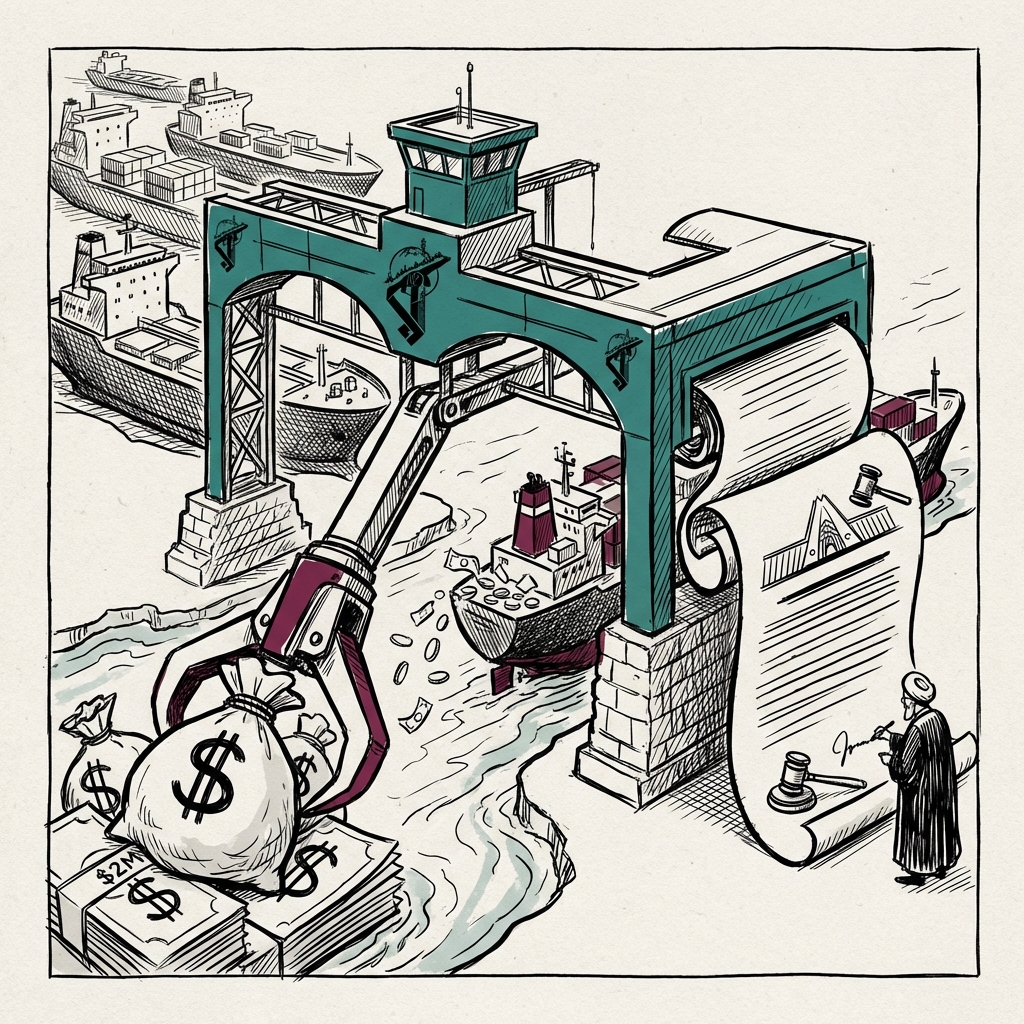
Strait of Hormuz Toll System
Iran's IRGC toll on Hormuz transit; $1/barrel, illegal under UNCLOS, operative since February 2026.
Last refreshed: 5 May 2026 · Appears in 1 active topic
With Project Freedom announced, why did TTF barely move on 4 May?
Timeline for Strait of Hormuz Toll System
Mentioned in: TTF settles EUR 46.44 inside tight weekly range
European Energy MarketsProject Freedom moves TTF only 1.48%
European Energy MarketsMentioned in: Reuters cuts TurkStream YoY drop to 1.7%
European Energy MarketsMentioned in: OIES frames Iran shock as multi-year
European Energy MarketsMentioned in: REMIT 2.0 hits first 14-day reporting deadline
European Energy Markets- What is the Strait of Hormuz toll and how does it work?
- Iran's IRGC charges $1 per barrel (roughly $2 million per large tanker) for passage through a 5-mile corridor in the Strait of Hormuz. Ships must pass background checks, carry VHF passcodes, accept escort, and change flag if required. Non-compliant vessels face drone or missile strikes.Source: Lloyd's List Intelligence
- Is the Hormuz toll legal under international law?
- No. UNCLOS guarantees innocent passage through international straits and permits fees only for specific services rendered. Iran claims wartime sovereignty suspends that right. The EU explicitly rejected the toll as a UNCLOS violation. Iran's Majlis is advancing domestic legislation to codify it regardless.Source: EU statement / UNCLOS
- Is the Strait of Hormuz open or closed right now?
- Partially open but effectively blockaded. Weekly transits stand at roughly 53, down from a pre-war baseline of 966. 325 oil tankers remain stranded in the Gulf. The IRGC declared on 12 April the strait will never return to its previous status.Source: Kpler / IRGC
- Why did Trump propose a joint venture on the Hormuz toll?
- Trump suggested the US and Iran co-operate on toll collection as a revenue-sharing arrangement during Islamabad talks. The EU rejected the idea as legally incompatible with UNCLOS. Iran has not formally accepted or rejected the proposal.Source: EU Foreign Affairs / Reuters
- What does codifying the Hormuz toll into Iranian law mean?
- It converts a wartime coercive measure into a permanent statutory instrument. Any future Iranian government would need a formal legislative act to abolish it, making it FAR harder to trade away in negotiations. Iran's Majlis advanced the bill on 27 March 2026.Source: Reuters / Al Jazeera
- What is the Strait of Hormuz toll system and how does it work?
- Iran's IRGC charges $1 per barrel (paid in yuan or stablecoins) on vessels transiting the Strait of Hormuz, with a VLCC paying roughly $2 million per transit. It has been operative since February 2026 and is illegal under UNCLOS.Source: Lowdown / UNCLOS
- How has the Hormuz toll affected European gas prices?
- Hormuz has been closed to LNG traffic since 28 February 2026, removing roughly 20% of global LNG supply. TTF held EUR 43-47/MWh through late April to early May 2026, pricing the closure as durable risk.Source: ICE / GIE AGSI+
- Is Project Freedom likely to reopen Hormuz to LNG tankers?
- Markets gave a muted response: TTF moved only +1.48% on the 4 May announcement. The Mubaraz precedent showed the first post-conflict Hormuz LNG transit went to Asia, not Europe, suggesting traders price the operation as risk management, not a supply unlock.Source: Al Jazeera / ICE
- Why is the Hormuz toll illegal under international law?
- UNCLOS guarantees innocent passage through international straits as a right; unilateral transit fees have no legal basis. The EU and Shipping Industry have rejected the toll outright on these grounds.Source: UNCLOS / EU Council
Background
The Strait of Hormuz Toll System shapes European gas markets through the LNG supply it has removed since February 2026. With roughly 20% of global LNG normally transiting Hormuz, the IRGC's $1-per-barrel charge and associated interdiction risk have kept the strait effectively closed to LNG traffic since 28 February 2026, accumulating over 12 bcm of supply loss to European terminals. TTF's response to the system reflects this: the benchmark held a tight EUR 43.4 to 47.4/MWh range in the week to 4 May 2026, pricing the risk as persistent background rather than acute crisis.
For European energy desks, the operative signal from the toll system is not the per-barrel fee itself but the transit architecture it imposes. The Mubaraz completed the first loaded LNG Hormuz transit since the war began on 27 April, heading to Asia rather than Europe, consistent with the pattern of post-conflict cargoes routing to higher-priced Asian markets. Project Freedom's 4 May announcement produced only a +1.48% TTF move, confirming that markets price the system as a durable geopolitical risk rather than a bottleneck about to clear.
The toll system's persistence amplifies the EU's storage pace problem. At 0.21 pp/day actual injection against a 0.257 pp/day floor required for 80% fill by 1 November, every week the Hormuz route remains closed is a week Atlantic LNG supply must compensate at spread economics that do not favour European bias over Asian spot demand. Bruegel's EUR 26-44bn refill model assumes cargo supply availability; the toll system is the structural constraint on that assumption.
Iran's Strait of Hormuz Toll System began as an improvised military blockade in late February 2026 and matured by late March into a functioning customs authority. The IRGC charges $1 per barrel in yuan or stablecoins, with a VLCC paying roughly $2 million per transit. The Hormozgan Provincial Command runs background checks, applies a five-tier country classification, and requires flag changes, VHF passcodes, and patrol escort. Iran's Majlis advanced a bill on 27 March to codify the system as permanent domestic law. Trump subsequently proposed a US-Iran "joint venture" on toll collection, which the EU rejected outright, citing UNCLOS customary international law guaranteeing transit passage rights.
The legal case against the toll is categorical. Under UNCLOS, innocent passage through international straits is a guaranteed right and unilateral transit fees have no legal basis. Iran's counter-argument is that the strait falls within its territorial waters and that wartime conditions suspend normal maritime law. As of 12 April, the IRGC declared the strait will "never return to its previous status", framing the toll as a permanent structural change rather than a wartime expedient. By early April, weekly transits had risen to 53 but remain over 90% below the pre-war baseline of 966 per week. 325 oil tankers and 600-plus vessels remain stranded in the Gulf.
The toll system's strategic significance extends beyond revenue. Codification into domestic law converts a wartime coercive measure into a statutory instrument requiring formal legislative repeal. China-linked tankers are the principal operators still transiting, giving Beijing an asymmetric interest in the system's continuation. The UN Security Council voted 11 to 2 for a Hormuz reopening resolution; Russia and China vetoed, with China's veto directly protecting the toll architecture its own tankers already exploit. The IEA declared the disruption the largest oil supply shock in global market history.
