Skip to content
Briefings are running a touch slower this week while we rebuild the foundations.See roadmap
MonitoringScience· Active since 2 April 2026

Artemis II Moon Mission

11 updates · 132 entities · 45 days active

Current Assessment

Crew public, data private, rockets moving, mission record still sealed.

#11
17Apr10:19

Day 17: Crew speaks; radiation record stays sealed

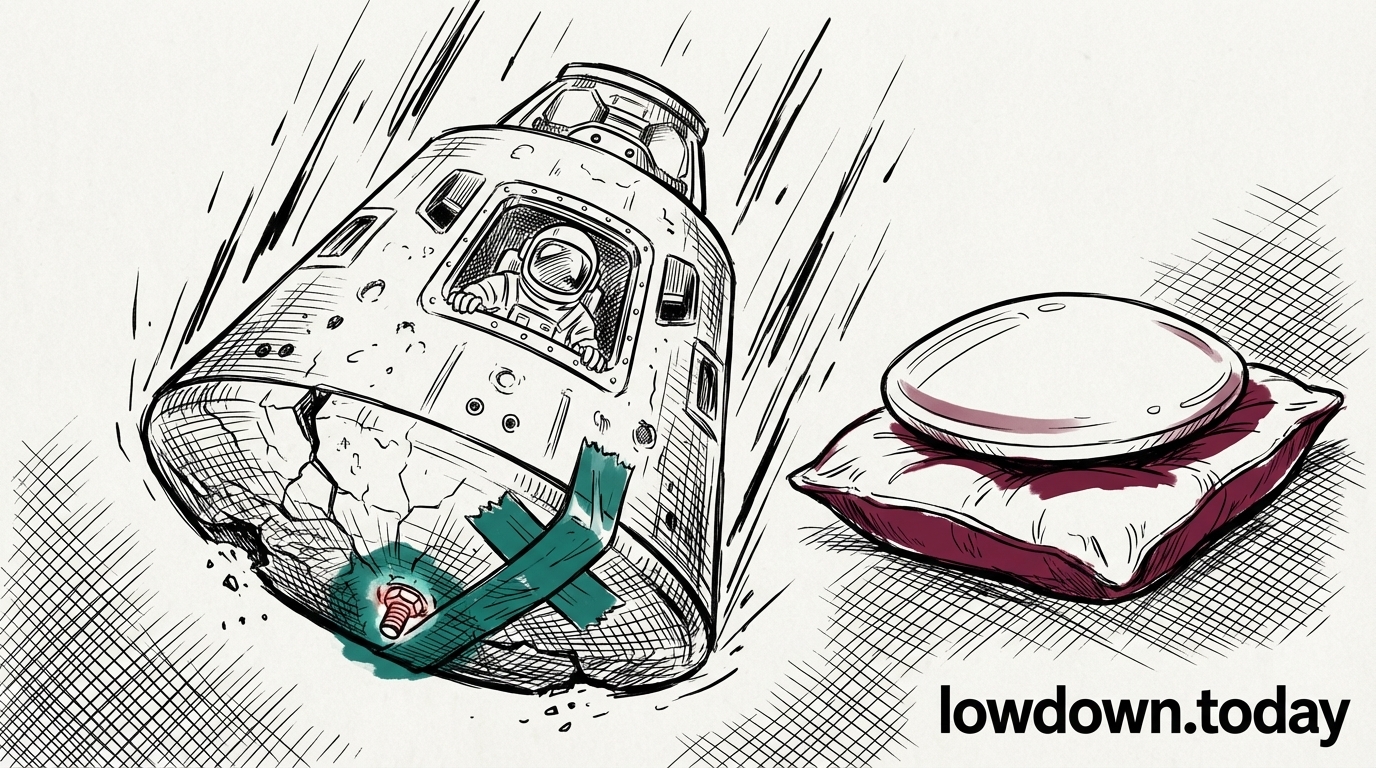
Six days after splashdown, the Artemis II crew fronted a press conference at Johnson Space Center while NASA's third scheduled window for crew radiation data passed without release. The Space Launch System core stage for Artemis III rolls from Michoud on Monday, and the European Service Module valve anomaly now runs at 10 times the rate ground tests predicted.

Day 17: Crew speaks; radiation record stays sealed
Read full update
#9
11Apr13:15

Day 11: First crewed Moon return since Apollo 17

Four astronauts splashed down safely in the Pacific at 20:07 EDT on 10 April, ending the first crewed return from the Moon since 1972. The post-mission press conference two hours later disclosed no heat shield findings, no radiation dose, and no bolt inspection; the one official responsible for crew radiation science was absent from the podium.

Day 11: First crewed Moon return since Apollo 17
Read full update
#8
10Apr11:48

Day 10: Thirteen minutes on a shield NASA already replaced

Orion splashes down tonight carrying four astronauts through a 13-minute re-entry on a heat shield NASA has already committed to redesigning for Artemis III, while nine days of withheld radiation dose data and the European Service Module's physical destruction on separation close two evidence windows simultaneously.

Day 10: Thirteen minutes on a shield NASA already replaced
Read full update
#7
9Apr15:28

Day 9: Orion Faces the Heat Shield It Fixed

Orion re-enters Earth's atmosphere tomorrow at 34,965 feet per second on a lofted return trajectory that has never carried a crew, testing a heat shield fix designed after Artemis I's uneven char loss. NASA cancelled both the radiation shelter demonstration and a manual piloting exercise on Day 8 without headline disclosure, extending a pattern of quiet operational adjustments as a seventh anomaly, elevated pressure in an oxygen manifold, surfaced for the first time.

Day 9: Orion Faces the Heat Shield It Fixed
Read full update
#6
7Apr15:00

Day 7: Rest Day Between Records and Reckoning

Day 7 is Artemis II's first scheduled rest day, the quiet interval between yesterday's flyby records and tomorrow's primary radiation shelter demonstration. At 1:25 PM EDT Orion exits the Moon's gravitational sphere of influence and becomes an Earth-bound spacecraft; the crew is off-duty as first-party records of the flyby resurface, including a crater proposed in honour of Commander Wiseman's late wife Carroll and six human-observed meteoroid impact flashes during the eclipse.

Day 7: Rest Day Between Records and Reckoning
Read full update
#5
6Apr14:21

Day 6: Records fall while Orion goes silent

Four astronauts reach the farthest point from Earth in human history at 7:05 PM EDT on 6 April, three minutes after closest lunar approach, while a 40-minute communications blackout cuts all contact with mission control. The Apollo 13 distance record breaks hours earlier at 1:56 PM EDT, a third correction burn ends the streak of perfect navigation, and the crew prepares to observe a solar eclipse from beyond the Moon that no human mission has ever witnessed.

Day 6: Records fall while Orion goes silent
Read full update
#4
5Apr16:13

Day 5: Lunar Gravity Reclaims Humans for the First Time Since 1972

Orion crossed into the Moon's gravitational dominance on Day 5, the first human spacecraft to do so since Apollo 17 in December 1972, on a trajectory so precise that NASA cancelled a second consecutive correction burn.

Day 5: Lunar Gravity Reclaims Humans for the First Time Since 1972
Read full update
#3
4Apr15:01

Day 4: G3 storm hits crew; NASA stays silent

A G3 geomagnetic storm, the strongest during crewed deep-space transit since Apollo, peaked overnight as Orion coasted beyond Earth's magnetosphere with zero crew radiation dose data published. The White House proposed cutting NASA science by 47% while the crew validates the sole budget-protected programme, and a cabin pressure false alarm during the irreversible TLI burn surfaced not through NASA but through Canadian astronaut Jeremy Hansen at a CSA media call.

Day 4: G3 storm hits crew; NASA stays silent
Read full update
#2
3Apr12:59

Day 3: Solar storm threatens Orion beyond Earth

Artemis II's translunar injection burn fired flawlessly on 2 April, committing four astronauts to a lunar flyby, but space weather has escalated from a G1 watch to an active G2 geomagnetic storm with a coronal mass ejection forecast to arrive on 4 April while the crew coasts in unshielded translunar space.

Day 3: Solar storm threatens Orion beyond Earth
Read full update
#1
2Apr11:46

Day 2: Artemis II Commits to the Moon With Three Open Questions

Four astronauts aboard Orion 'Integrity' face a go/no-go decision tonight for the translunar injection burn that will send humans beyond low Earth orbit for the first time in 54 years. The mission launches under active space weather, with an unpublished heat shield safety review, and into a programme whose architecture was restructured around the crew mid-flight.

Day 2: Artemis II Commits to the Moon With Three Open Questions
Read full update