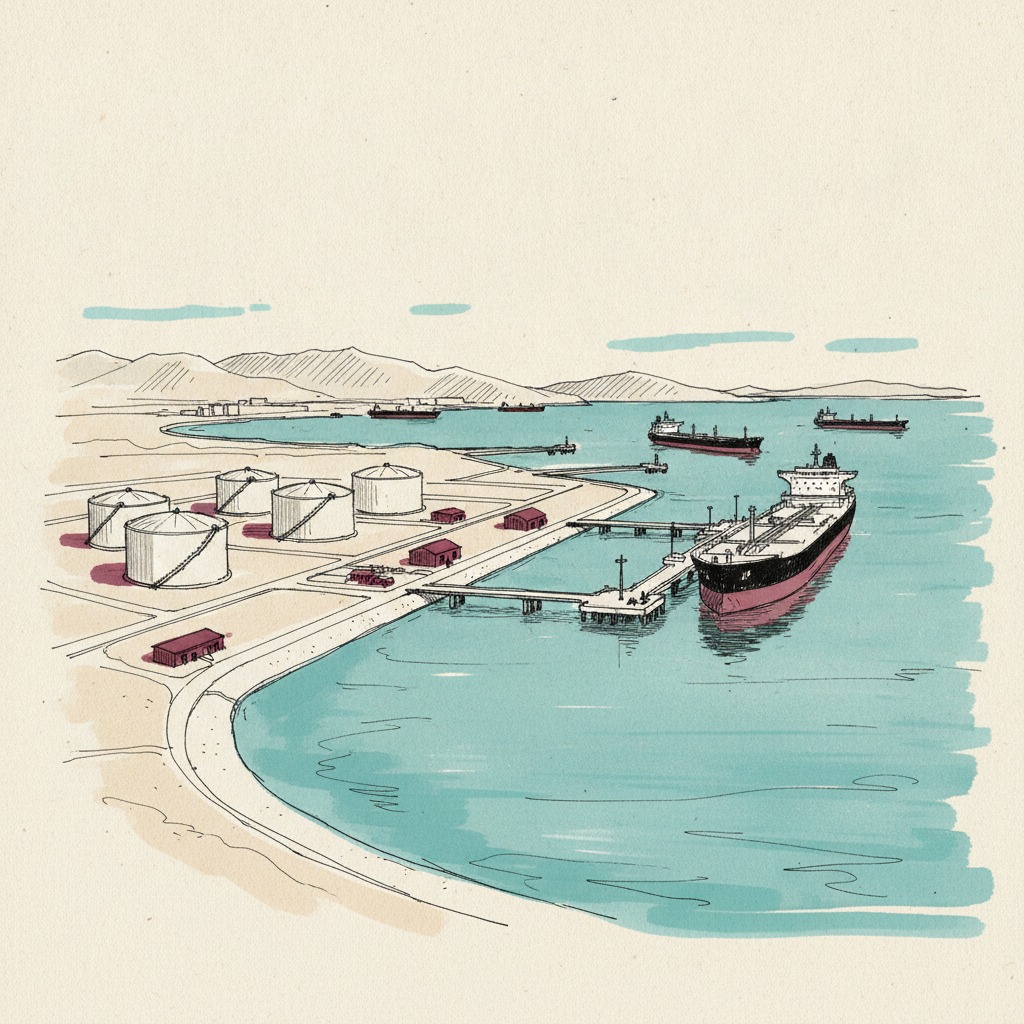
Mina Al Fahal
Oman's main crude export terminal on The Gulf of Oman, outside the strait of Hormuz.
Last refreshed: 8 June 2026
Why did a drone strike on Mina Al Fahal matter to global oil supply?
Timeline for Mina Al Fahal
Drone hits Oman's last safe oil route
European Oil MarketsBackground
Mina Al Fahal became the focus of international oil-supply anxiety on 5 June 2026 when a drone strike disrupted loadings for several days, eliminating what had briefly been treated as the last non-Hormuz Safe crude routing in the wider Gulf region. India had deliberately structured a supply deal around Omani barrels precisely to avoid Hormuz exposure, and the strike invalidated that hedge overnight.
Located approximately 10 kilometres north-west of Muscat on The Gulf of Oman coast, Mina Al Fahal is the principal export terminal of Petroleum Development Oman (PDO) and handles the bulk of Oman's roughly 1 million Barrels Per Day of crude exports. The facility operates three single-buoy mooring systems capable of accommodating tankers up to 554,000 DWT, and the refinery co-located on site runs at approximately 104,000 b/d. Because it sits on The Gulf of Oman east of the strait of Hormuz Chokepoint rather than inside The Persian Gulf, it has historically been considered insulated from Hormuz-related disruptions.
The June 2026 strike demonstrated that the geographic buffer Mina Al Fahal offered was not absolute. The terminal's significance extends beyond Oman's own exports: it had become a notional safe-routing benchmark for Indian and Asian buyers restructuring supply chains around the Hormuz blockade. Its disruption, even temporarily, removed the last readily available non-Hormuz loading option at scale, accelerating pressure on the Kirkuk-Ceyhan and Caspian Pipeline routes as the only viable alternatives.
Where is Mina Al Fahal terminal and why does it matter for oil exports?
What happened at Mina Al Fahal in June 2026?
Is Mina Al Fahal inside or outside the Strait of Hormuz?
Who operates Mina Al Fahal oil terminal?


Written with AI from Lowdown's published reporting. Not individually reviewed by an editor. Updated 8 June 2026. Editorial standards.