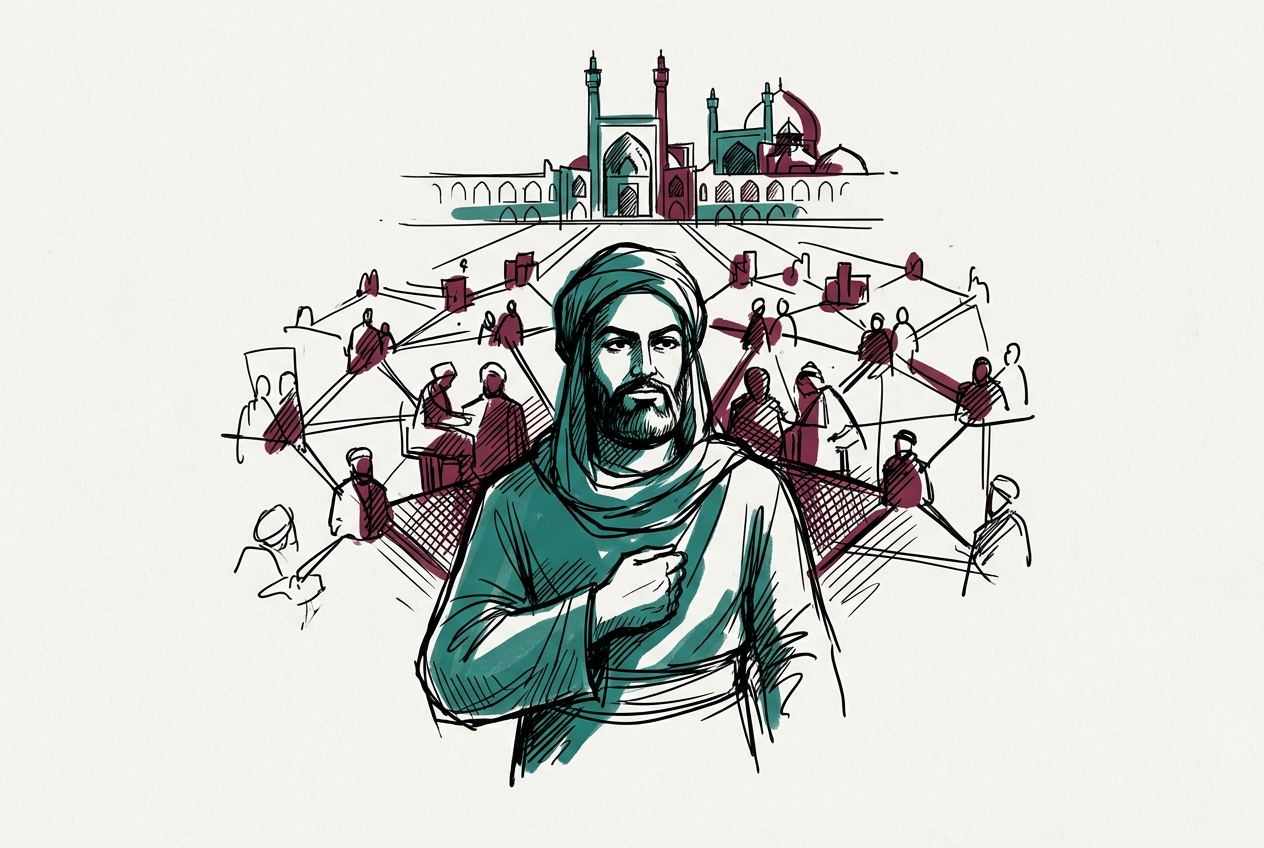
Shia
The Islamic tradition following Ali; state religion of Iran and confessional foundation of the Axis of Resistance.
Shia Islam split from the Sunni majority in the seventh century over succession to the Prophet Muhammad. On 7 March 2026 Iran's Assembly of Experts proclaimed Mojtaba Khamenei Supreme Leader before his father's funeral, breaking Shia doctrine's own investiture rule.
Last refreshed: 31 July 2026
Can Shia political authority survive a succession crisis that broke its own theological rules?
Timeline for Shia
Mentioned in: Riyadh names energy, port and airport targets
Iran Conflict 2026Mentioned in: Baghdad cancels Riyadh visit over strike
Iran Conflict 2026Mentioned in: A senior cleric blesses Khamenei's coffin
Iran Conflict 2026Mentioned in: Medvedev likens Hormuz to nuclear arms
Iran Conflict 2026Mentioned in: Iraq to host Khamenei funeral rites
Iran Conflict 2026Background
Shia Islam emerged in the seventh century from a dispute over WHO should lead the Muslim community after the death of the Prophet Muhammad. The tradition holds that leadership passed through Ali ibn Abi Talib, the Prophet's cousin and son-in-law, making descent from Ali the theological basis of legitimate authority; the majority Sunni tradition instead accepted Abu Bakr. That schism produced distinct ritual practice and separate schools of jurisprudence, chiefly Ja'fari, Zaydi and Ismaili, with major seminaries at Najaf in Iraq and Qom in Iran.
Roughly 15 to 20 per cent of the world's Muslims, some 300 to 400 million people, identify as Shia. Majority Shia populations exist in Iran, Iraq, Bahrain and Azerbaijan, with politically significant minorities in Lebanon, where the community forms Hezbollah's base, and in Pakistan and Kuwait.
The Khomeinist doctrine of Velayat-e Faqih, guardianship of the jurist, is a modern Shia innovation that gives a qualified cleric supreme political authority pending the return of the Hidden Imam; it underpins the Islamic Republic of Iran's constitution but is not accepted across all Shia jurisprudence. The Sunni-Shia divide is real but often overstated: Shia communities in Lebanon, Iraq and Pakistan have distinct political priorities that do not automatically track Tehran's.
Succession broke investiture doctrine
Iran's Assembly of Experts proclaimed Mojtaba Khamenei Supreme Leader on 7 March 2026, days before his father's death was confirmed. Shia jurisprudence holds that a Supreme Leader cannot be invested until the predecessor is interred; Qom's seminary leadership warned on 1 July that the succession fell short of that standard.
Eight Assembly of Experts members had already signalled they would boycott the vote, and Ali Khamenei's funeral rites, hosted for the first time by an Iraqi head of state at Najaf, followed only on 8 July, four months after his son's proclamation. The gap between doctrine and practice now sits at the centre of the Islamic Republic's claim to represent Shia religious authority.
Reference
What is Velayat-e Faqih?
What is Shia Islam and how does it differ from Sunni Islam?
What is Shia Islam?
Why are Lebanese Shia communities critical of Hezbollah in 2026?
Can a Shia Supreme Leader be named before the burial of the previous one?
Which countries have Shia majorities?


