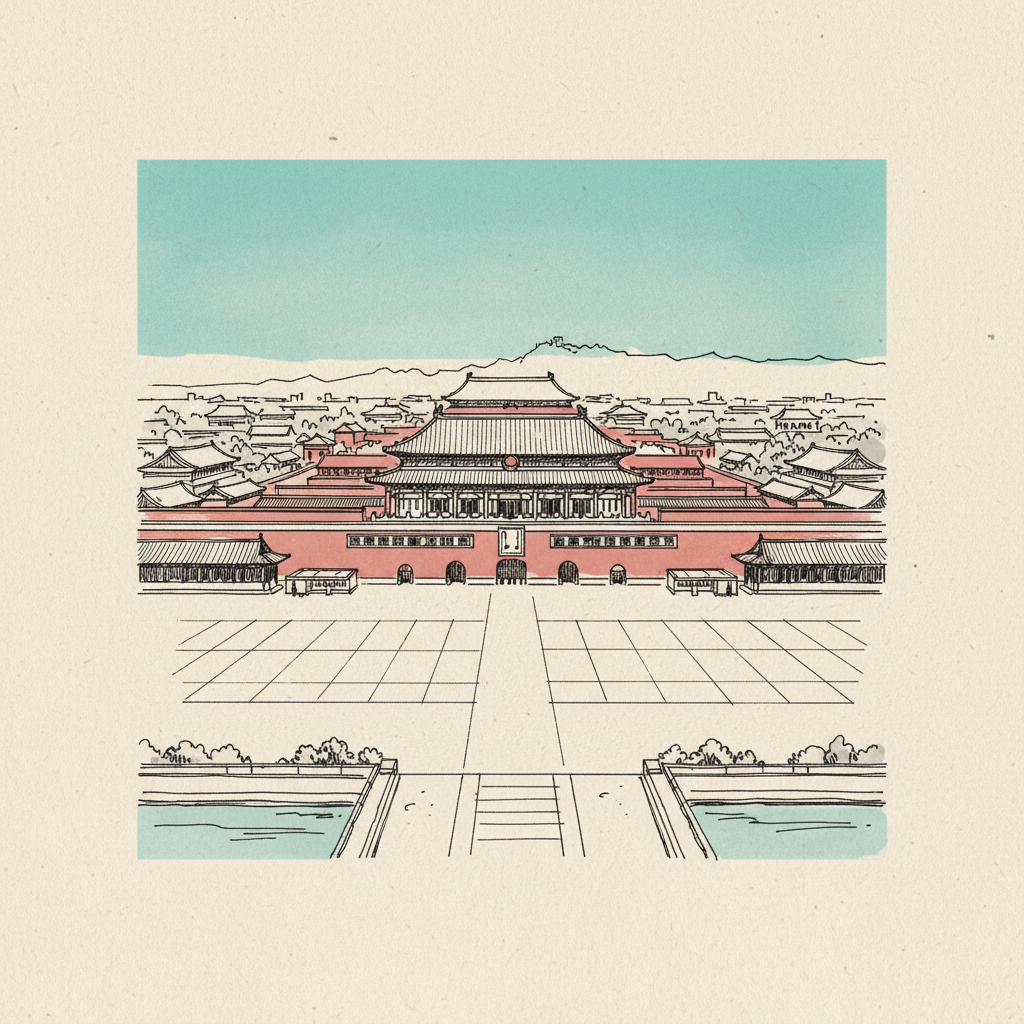
Beijing
Capital of the People's Republic of China; seat of the Communist Party and global diplomatic counterweight.
Beijing's foreign ministry twice said in October it had no information on a Putin-Xi-Trump meeting. On 19 November 2026 the three leaders signed a four-point declaration in Shenzhen that pledges more refined fuel and never mentions Ukraine.
Last refreshed: 28 November 2026 · Appears in 4 active topics
How is Beijing shaping the Iran deal without openly backing Tehran?
Timeline for Beijing
Mentioned in: Nvidia reinstates Huang after US input
AI: Jobs, Power & MoneyMentioned in: Putin, Xi and Trump sign a fuel pledge
Russia-Ukraine War 2026Mentioned in: Baykar delivers three uncrewed Kızılelma jets
Drones: Industry & DefenceMentioned in: China's robot output up 26.0% in October
AI: Jobs, Power & MoneyBackground
Beijing is the capital of the People's Republic of China and the seat of the Communist Party leadership, the State Council and The National ministries. In foreign reporting the name stands for the Chinese state, and the foreign ministry under Wang Yi speaks for it.
Its ministries use trade rules as a lever. A rule published on 19 October 2026 makes exporters of drone jet engines, swarm radios, autopilots and heavy-lift motors seek a licence from 18 November for every destination, so each approved sale names its buyer and end user.
At the UN Security Council, Beijing's veto shapes the Iran file. On 17 September 2026 China and Russia cast the two votes against renewing the UN panel of experts on Iran sanctions, so it lapsed despite 11 votes in favour. Its reach also runs to the Red Sea: Djibouti, across the strait from Yemen, hosts China's only overseas military base.
The Shenzhen text promises more fuel
Kremlin aide Yuri Ushakov said on 21 October 2026 that no capital had rejected a three-way meeting in Shenzhen, host of the Asia-Pacific summit in November. Asked twice, the Chinese Foreign Ministry replied that it had no information, and Beijing confirmed nothing for weeks. The same day Putin told Premier Li Qiang that he and Xi had met three times that year.
The text signed on 19 November commits the three leaders to raise refined-fuel output and supply and to hold talks on nuclear risk. It is silent on a Ceasefire, on sanctions and on Ukraine, which had no seat at the table. As host, Beijing put Xi's signature beside the Russian diesel trade that Washington had licensed on 9 October.
Its envoy pitched a new regional order
Guo Jiakun, the foreign ministry's spokesman, said on 27 October 2026 that Beijing would soon send special envoys to The Gulf region. A reporter had asked him whether Washington and Israel might bomb Iran again. On 28 October the same spokesman condemned strikes on civilian airports, following Houthi claims of attacks on Saudi Arabia. Beijing buys crude from Riyadh as well as Tehran.
Middle East envoy Zhai Jun followed on 8 November, meeting senior Iranian security and foreign ministry officials. He told them force cannot solve problems and proposed a new regional security order. China's readout named no city for the talks, while Iran's Tasnim agency placed them in Tehran.
Its labour plan sets no targets
China's Labour ministry issued an Action Plan for AI and employment on 15 September 2026. It named three programmes and fixed no numerical goal for jobs created or protected. Its recruitment drive for AI jobs, run from 14 to 20 September, brought in upwards of 1,700 employers advertising more than 13,000 posts.
On 16 October the State Council added a brake. Local governments must now pace AI in Labour-intensive industries, and big AI projects in sectors that depend on state market access face an employment risk check before they go ahead. The central government still promotes AI; the October order governs how fast it may displace workers. Shijiazhuang made the order public on 4 November.
Beijing keeps Iran out of its readout
Why did Pakistan's army chief visit Beijing during the Iran conflict?
Who met Wang Yi in Beijing ahead of the Trump-Xi summit?
Beijing freezes new loans to sanctioned refiners
What did China's big four banks do about Iran sanctions in May 2026?
Why did China activate its Blocking Rules against US Iran sanctions in May 2026?
What is Beijing's role in the 2026 Iran sanctions dispute?
What is China's Decree 835 and why was it issued?
Why hasn't China retaliated against US sanctions on Chinese companies?
Did Trump reject China as a custodian for Iran's nuclear stockpile?
What is China's Blocking Statute and how does it affect US Iran sanctions?




Written with AI from Lowdown's published reporting. Not individually reviewed by an editor. Updated 28 November 2026. Editorial standards.