Skip to content
You can now search across every topic, entity and event.What's new
Iran Conflict 2026
3JUL

Syria, Lebanon join US defence table

2 min read
10:02UTC

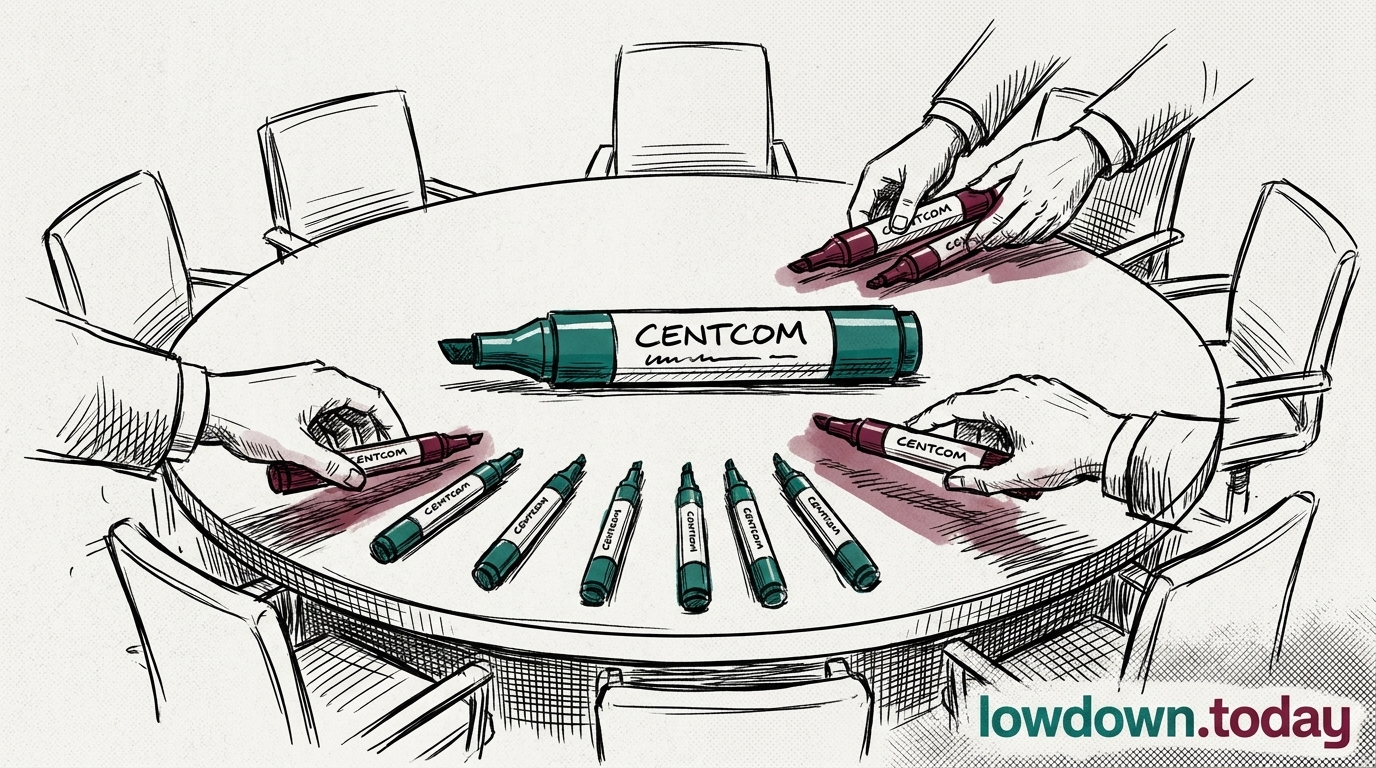
Post-Assad Syria and Lebanon sat at a US-hosted defence table for the first time on 1 July, joining a twelve-nation CENTCOM dialogue in Bahrain that named no adversary.

ConflictDeveloping
Key takeaway

Syria and Lebanon joining a US defence table signals a lasting shift away from Tehran's orbit.

The militaries of post-Assad Syria and of Lebanon joined a US-led defence table for the first time on 1 July. Admiral Brad Cooper, commander of CENTCOM (US Central Command), convened senior officials from eleven regional states at a security dialogue hosted by the Bahrain Defence Force. Participants came from Bahrain, Egypt, Jordan, Kuwait, Lebanon, Oman, Qatar, Saudi Arabia, Syria, the United Arab Emirates and Yemen, a 12-nation gathering. 1

Post-Assad Syria and Lebanon have spent years inside or alongside Tehran's regional axis. Their attendance marks a security realignment that runs independently of the Iran ceasefire track. Kuwait sat at the same table only days after absorbing Iranian missile fire on the US bases it hosts , a reminder that several attendees remain live theatres of this war.

The assembled leaders shared "a commitment to the free flow of commerce through the Strait of Hormuz," according to the CENTCOM release, which named no adversary. 2 Read against the timing, the composition carries more weight than the communique: Damascus and Beirut are positioning towards Washington while the IRGC (Islamic Revolutionary Guard Corps) is absorbed by a funeral and by disputes over who governs Hormuz.

Deep Analysis

In plain English

CENTCOM is the US military command responsible for the Middle East. On 1 July it hosted a meeting in Bahrain's capital, Manama, bringing together senior military officers from twelve countries to discuss keeping shipping lanes open through the Strait of Hormuz, the narrow waterway between Iran and the Arabian Peninsula that a fifth of the world's oil passes through. Syria, run by a new government since long-time ruler Bashar al-Assad was toppled in December 2024, and Lebanon, home to the Iran-backed group Hezbollah, both sent officers for the first time. Both countries used to sit inside Iran's network of allies. Their presence at a US-organised table suggests they are trying to build new relationships with Washington, even though no formal agreement was signed.

Deep Analysis
Root Causes

The US permanently revoked its Syria sanctions on 30 June 2025 and the EU followed on 28 May 2025, unlocking roughly $28 billion in investment pledges; a visible break from the Assad-era Russian and Iranian security architecture costs Damascus little and helps keep that money moving.

The Lebanese state has been functionally insolvent since 2019 and depends on foreign funding to keep the Lebanese Armed Forces paid, so appearing at a US table costs Beirut little even while the 27 June trilateral framework tying Israeli withdrawal to Hezbollah's disarmament remains rejected by Hezbollah's own leadership.

The dialogue also did not remove the attendees' exposure. Kuwait and Bahrain, both present in Manama, had absorbed IRGC ballistic missile and drone fire on the same US-hosted bases days earlier on 28 June , a reminder that sitting at Washington's table has not yet bought any attendee protection from Tehran.

What could happen next?
  • Precedent

    A repeat CENTCOM dialogue with Syrian and Lebanese attendance, held after the funeral period, would confirm this was policy rather than a one-off gesture.

  • Risk

    Kuwait and Bahrain's continued exposure to IRGC strikes even after joining the dialogue shows attendance has not yet converted into any protective guarantee from Washington.

First Reported In

Update #144 · Syria, Lebanon join a US defence table

US Central Command (via DVIDS)· 3 Jul 2026
Read original
Different Perspectives
India
India
New Delhi has a national unaccounted for among GFS Galaxy's eleven-strong Indian crew, turning a standoff over transit rights into a consular emergency for a state with no seat at either table.
Oman
Oman
Muscat's 9 July arrangement to jointly manage Hormuz traffic with Iran, outside the frozen US channel, is overridden within days by Tehran's own unilateral closure and strike on GFS Galaxy.
Qatar
Qatar
Doha keeps mediating from an exposed position: Al Udeid hosts the CENTCOM strikes it is trying to broker a stand-down around, a week after a Qatari carrier was itself hit in the strait.
United States / CENTCOM
CENTCOM flew a third strike wave in a week, roughly 140 targets, killed Lieutenant Dehghani at Jask, and insists the strait remains open. It signed no instrument making that claim enforceable against Iran's closure.
Iran / IRGC
Iran / IRGC
Tehran struck GFS Galaxy and declared Hormuz closed, reasserting IRGC toll authority after its Oman-brokered management track failed to bind Washington to anything. The strike restores unilateral control after days of a negotiated alternative gaining ground.
Russia
Russia
Grossi's non-confirmation came from Kaliningrad, hours after Rosatom, the state agency that built and fuels Bushehr, hosted his talks. A refusal delivered from inside Russia's own nuclear orbit carries weight a Western capital could not manufacture, though Moscow itself made no statement on Iran's strike claim.