Skip to content
You can now search across every topic, entity and event.What's new
European Energy Markets
31JUL

Iran claims sole control of Hormuz

3 min read
09:44UTC

Foreign Minister Abbas Araghchi declared from Baghdad that Iran would hold sole oversight of the Strait of Hormuz for 30 days, then demanded a single coastal corridor.

EconomicDeveloping
Key takeaway

Iran and the US read Article 5 to opposite ends, so every Hormuz crossing breaks the deal for one side.

Foreign Minister Abbas Araghchi declared from Baghdad on 28 June, the same day Iran struck Kuwait and Bahrain, that Iran would hold "sole oversight and management" of the Strait of Hormuz for 30 days 1. A day later Washington said commercial traffic could pass the strait unhindered. On 30 June Iran demanded a single corridor along its own coastline and threatened to obstruct ships using any other route 2.

Both sides cite the same text. Article 5 of the 16 June MoU (Memorandum of Understanding) promises safe passage at no charge for 60 days and mine clearance inside the same window Iran now claims to police; Iran reads that as its right to run the strait during the clearance period, and Washington reads it as a guarantee of open routing 3. Every routing decision now breaks the agreement by one reading or the other, which keeps insurers' war-risk cover suspended and tankers waiting.

The IRGC (Islamic Revolutionary Guard Corps) had already rejected the Oman-coordinated southern lane ; the tankers Ever Lovely and Kiku were struck while using exactly that route, not an Iranian corridor 4. Iran and Oman set up a bilateral fee committee for the strait on 23 June , yet the corridor stays contested, which is why the ceasefire keeps breaking on the water.


Deep Analysis

In plain English

Iran's foreign minister, Abbas Araghchi, announced on 28 June 2026 from Baghdad, the capital of neighbouring Iraq, that Iran would take sole responsibility for managing the Strait of Hormuz for 30 days. The Strait of Hormuz is the narrow gap between Iran and the Arabian Peninsula that oil tankers must pass through to reach the open ocean from the Persian Gulf. Two days later, on 30 June, Iran went further, insisting that all ships use only a single shipping lane close to Iran's own coastline. Ships using any other route, Tehran warned, would be at risk. The June peace agreement between the US and Iran contains a clause, called Article 5, that deals with the strait during the period when sea mines are being cleared. The US reads that clause as guaranteeing ships can sail freely by any safe route. Iran reads it as giving Tehran the right to manage traffic during the mine-clearance period. Because neither side has changed its reading, insurers covering commercial shipping against war damage have not reinstated cover, meaning most shipping companies are keeping their vessels out of the strait regardless of what either government says.

Deep Analysis
Root Causes

Iran never ratified the 1982 UN Convention on the Law of the Sea (UNCLOS), which establishes transit passage rights through international straits as a customary norm that cannot be suspended by the adjacent coastal state.

Tehran instead relies on its own maritime law, updated in 2024, which claims jurisdiction over the Strait of Hormuz based on Iran's internal continental shelf claims and frames the right to regulate 'hostile-linked vessels' broadly enough to cover any flag state that has sanctioned Iran. This legal asymmetry gives Iran a domestic legal basis for sole-corridor control that it need not breach UNCLOS to assert, because it never accepted UNCLOS.

Article 5 of the Islamabad MOU was drafted in the shuttle-mediation format, with separate rooms and Qatari and Pakistani relays, meaning both parties agreed to language without reconciling their baseline legal positions on Hormuz governance. The result is a text whose routing provisions each side reads as confirming its own prior stance, making the dispute non-resolvable by reference to the agreement both signed.

What could happen next?
  • Consequence

    Lloyd's of London war-risk rates stay suspended and tankers remain outside the strait for as long as the Article 5 routing contradiction is unresolved, regardless of the verbal stand-down.

    Immediate · Reported
  • Risk

    Iran's 30 June single-corridor demand gives the IRGC a formal justification to strike any vessel using an alternative route, including the Oman-coordinated southern lane already used by the Ever Lovely and Kiku before their attacks.

    Immediate · Reported
  • Precedent

    Araghchi's declaration from Baghdad, not from Tehran, signals Iran is using regional diplomatic forums to assert Hormuz claims without the domestic political cost of a formal Majlis position, a pattern that could be replicated for future jurisdictional assertions.

    Medium term · Suggested
First Reported In

Update #141 · Iran hits two US bases; Trump pulls back

Al Jazeera· 30 Jun 2026
Read original
Different Perspectives
Spain's LNG terminal operators
Spain's 9,145 GWh terminal inventory is the largest single stock in the EU LNG network, an option value that can reroute cargoes wherever the winter strip pays best rather than a cavern gas obligation tied to a fixed date. That flexibility matters more as Germany's cavern shortfall pushes more of the winter security question onto import infrastructure.
European Commission
European Commission
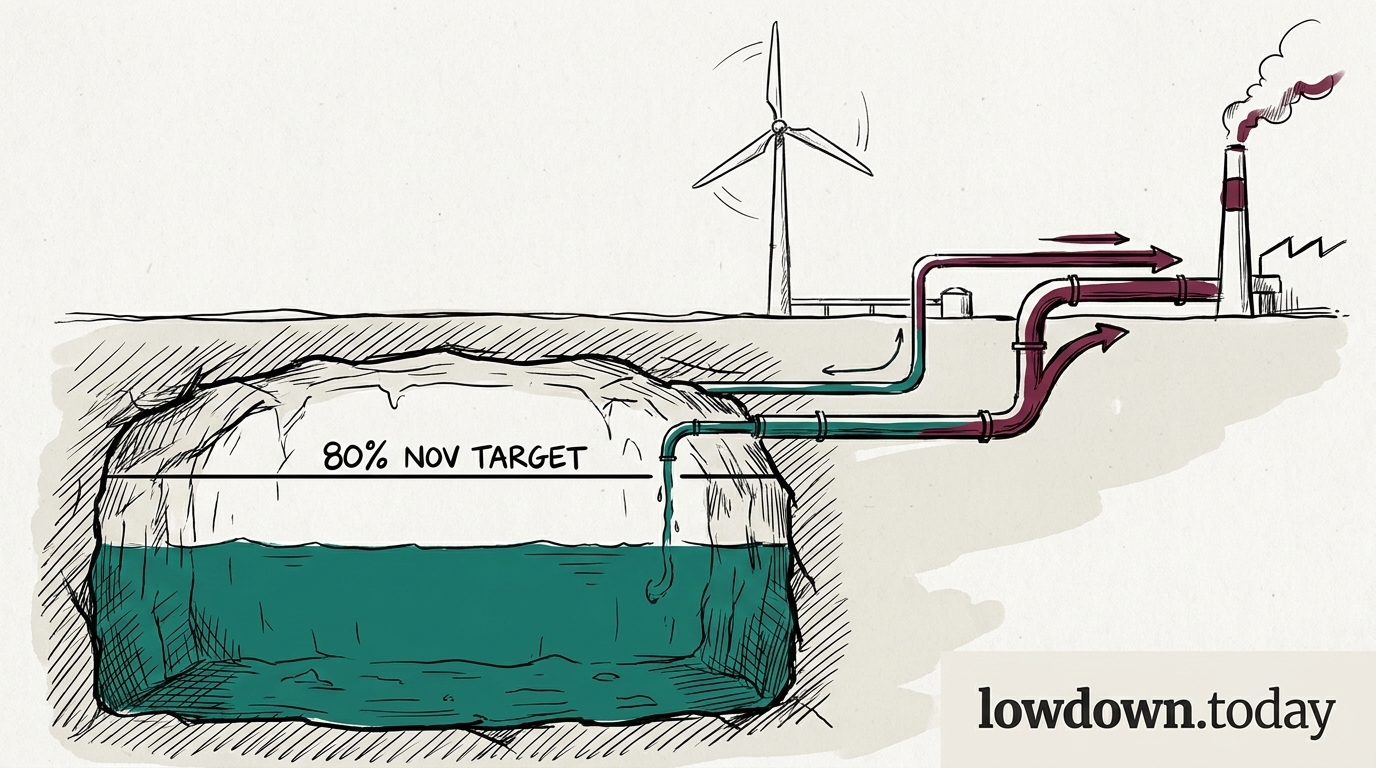
Brussels holds the bloc to 90% on a flexible window while Germany, holding roughly a quarter of EU storage capacity, tracks toward missing its own lower 80% figure by 21 points. A national shortfall this size in the anchor market matters more to bloc security than the flexible timetable alone can absorb.
French power exporters and CRE
French day-ahead rose in step with Germany but by less, reopening a EUR 7-17 premium that makes northward export flows commercially attractive again after the EUR 43.09 discount evaporated in days. CRE separately authorised RTE and Enedis to buy flexibility locally, betting the coming winter's binding constraint is grid congestion rather than a shortage of firm capacity.
TTF trading desk
TTF trading desk
A visible national shortfall like Germany's 21-point gap is a directional signal, not noise, for a desk holding the summer-winter spread. TTF's flat EUR 58-60 range through this week's German price swings says the market has not yet chosen to reprice refill risk into the front of the curve.
German cavern and CCGT operators
German caverns kept buying prompt gas at TTF near EUR 58-60 through the inversion; the wind collapse to 2.4 GW then flipped the spark spread to plus EUR 29 and put turbines back in the same queue. Every day turbines win that bid, injection at a third of the 877 GWh/day pace needed falls further behind.
Slovakia
Slovakia
Slovakia says it dropped its hold-out on the 21st sanctions package only after Ursula von der Leyen personally signed written gas-price and supply guarantees. The Council of the European Union's own 17,238-character release on the package names neither Slovakia nor any guarantee, leaving Bratislava's account unconfirmed by the institutional record.



