Skip to content
You can now search across every topic, entity and event.What's new
European Energy Markets
31JUL

Caverns restart, 21 points short of November

3 min read
09:44UTC

German storage operators restarted injection on 22 July, one gas day after the stall this desk led on. The pace since lands the caverns at 58.5 per cent on 1 November, not 80. A wind collapse then flipped the clean spark spread positive, putting gas turbines back in competition with the caverns for the same prompt molecules.

EconomicCREACER
Key takeaway

Germany's cavern refill runs on spread economics, not a pace mandate, and CCGTs just re-entered the same bid for gas.

This briefing mapped
Economic
Regulatory

German fill reached 46.54% on the 29 July gas day at an eight-day mean injection rate of 313.7 GWh/day. Carry that pace forward and the caverns arrive at 1 November 21 points short of a target Berlin had already cut for itself.

Sources profile:This story draws on neutral-leaning sources

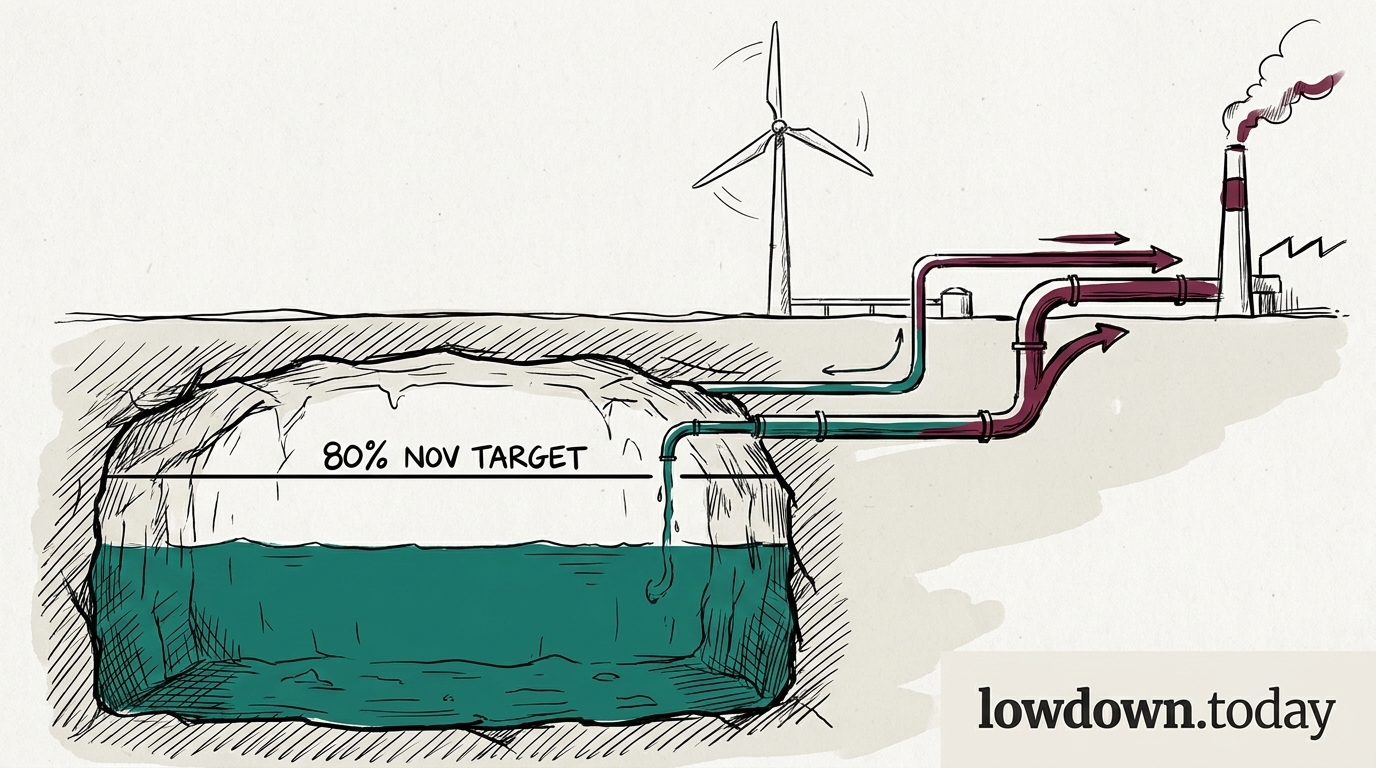
Germany is on pace to miss the storage benchmark it lowered for itself: having cut its own 1 November requirement from 90% to 80% under the Gasspeicherfüllstandsverordnung, the country's caverns are tracking toward just 58.5% fill by that date at the current 313.7 GWh/day eight-day mean injection pace, a rate that would need to nearly triple to 877 GWh/day to reach even the reduced 80% target from 29 July's 46.54% fill.

Germany would need to nearly triple its current injection rate every day until November to reach a benchmark it lowered from 90% to 80%. 

Sources:GIE AGSI+

German storage operators put 246.5 GWh into the caverns on Wednesday 22 July, one gas day after the 0.8 GWh trickle this desk led on. The halt lasted a single day.

Sources profile:This story draws on neutral-leaning sources

German storage operators restarted cavern gas injection at 246.5 GWh on 22 July, one gas day after the 0.8 GWh stall previously reported, and injection ran at a 313.7 GWh/day mean through 29 July, lifting national fill from 45.53% to 46.54%.

The framing that an inverted spark spread had stopped German storage buying is now falsifiable, and false. 

Sources:GIE AGSI+

Jack Sharples and Ricky Hill told a 27 July presentation that EU-27 stocks reach 72 bcm on 1 November if injections match 2024, the lowest first-of-November level since 2012.

Sources profile:This story draws on neutral-leaning sources

Jack Sharples of the Oxford Institute for Energy Studies and Ricky Hill of Centrica presented "European Storage Refill in Summer 2026" on 27 July, projecting EU-27 stocks at 72 bcm, or 67% full, on 1 November if injections from 22 July match the same period in 2024, the lowest 1 November level since 2012.

A bloc-wide projection and a German national calculation reach the same verdict from entirely different data. 

German gas-fired output ran a 3,039 MW mean on 27 July and a 5,730 MW mean on 31 July as day-ahead power reached EUR 147.05/MWh, flipping the clean spark spread from breakeven into clear profit on a fuel leg that never moved.

Sources profile:This story draws on neutral-leaning sources

German gas-fired generation rose from a 3,039 MW mean on 27 July to a 5,730 MW mean on 31 July, putting CCGTs back in competition with storage operators for the same prompt gas the caverns had been buying uncontested during the inversion, as day-ahead power rose from EUR 116.65/MWh on 28 July to EUR 147.05/MWh by 31 July on a wind collapse to 2.4-3.4 GW, with a peak print of EUR 352.36/MWh on 29 July, flipping the clean spark spread from a roughly breakeven minus EUR 0.52 to plus EUR 5.03/MWh on 30 July to plus EUR 23.58 to plus EUR 29.13/MWh on the morning of 31 July on a flat TTF (EUR 58-60) and flat EUA (EUR 79.4-82.0) fuel and carbon leg.

Turbines that had left the prompt gas market to the caverns are now bidding against them, in the week refill needs to nearly triple. 

French day-ahead means rose from EUR 74.53/MWh on 27 July to EUR 129.93 by 31 July, leaving Germany dearer by only EUR 7 to EUR 17 against the EUR 43.09 discount France held on 26 July.

Sources profile:This story draws on neutral-leaning sources

French day-ahead daily mean power rose from EUR 74.53/MWh on 27 July to EUR 129.93/MWh by 31 July, rising in step with Germany but by less, reopening a EUR 7-17/MWh German premium against the EUR 43.09 French discount recorded on 26 July.

French nuclear is a partial hedge against German wind volatility, and the hedge shrinks whenever German gas plants set the price. 

German day-ahead peaked at EUR 187.30/MWh at 05:00 UTC on 31 July with wind at 3.4 GW. At 10:15 UTC on 29 July, wind sat at the same 3.4 GW and the price printed zero.

Sources profile:This story draws on neutral-leaning sources

This desk's wind-only framing of German price spikes needs correcting: identical wind output of 3.4 GW produced a EUR 187.30/MWh peak at 05:00 UTC on 31 July but a EUR 0.00 to minus EUR 0.06/MWh print at 10:15 UTC on 29 July, isolating post-solar residual load, not wind alone, as the variable setting Germany's clearing price, because midday solar covers the residual load caverns and CCGTs otherwise draw on at night.

Post-solar residual load, not wind output on its own, is the variable that sets Germany's clearing price. 

France's energy regulator approved experimental rules on 30 July for local flexibility markets on the RTE and Enedis platforms, the first authorised French framework for buying demand response at distribution level.

Sources profile:This story draws on neutral-leaning sources

CRE, France's energy regulator, approved experimental rules on 30 July for local flexibility markets run on the RTE and Enedis distribution platforms, letting grid operators procure demand response and distributed storage at distribution level for the first time under an authorised French framework.

Paris and Berlin are answering the same dispatchability problem in opposite directions, one locally and one through a national auction. 

ACER released the first EU-wide dataset of capex and opex parameters for generation and flexibility technologies on 30 July, covering member states on a common basis.

Sources profile:This story draws on neutral-leaning sources

ACER published the first EU-wide investment-cost dataset for generation and flexibility technologies on 30 July, covering capex and opex parameters across member states.

Every national and EU energy model has until now run on private or inconsistent cost assumptions for the same technologies. 

Sources:ACER

EU terminals sent out 2,965.7 GWh/day on the gas day ending 30 July against aggregate inventory of 27,213 GWh, with Spain holding the largest single stock at 9,145 GWh.

Sources profile:This story draws on neutral-leaning sources

EU LNG send-out ran 2,965.7 GWh/day on the gas day ending 30 July with aggregate terminal inventory of 27,213 GWh, and Spain held the largest single terminal inventory at 9,145 GWh.

Terminal inventory is the buffer between an LNG cargo schedule and the injection rates European storage needs this summer. 

Sources:GIE ALSI
Closing comments

Direction: sideways to up on storage risk. The mechanism that tips it either way is wind: a sustained return of German wind above 15 GW would flip the clean spark spread back negative, taking CCGTs off-merit and handing the prompt-gas queue back to the caverns, while a continued wind trough into August keeps turbines bidding against storage through the exact weeks the 877 GWh/day pace is needed to reach the 80% target. Watch the first StromVKG auction's clearing price and its still-unresolved state-aid position, since a delayed clearance removes a demand-side signal for firm capacity investment at the same moment the spread is telling the market gas-fired generation pays.

Different Perspectives
German cavern and CCGT operators
German caverns kept buying prompt gas at TTF near EUR 58-60 through the inversion; the wind collapse to 2.4 GW then flipped the spark spread to plus EUR 29 and put turbines back in the same queue. Every day turbines win that bid, injection at a third of the 877 GWh/day pace needed falls further behind.
TTF trading desk
TTF trading desk
A visible national shortfall like Germany's 21-point gap is a directional signal, not noise, for a desk holding the summer-winter spread. TTF's flat EUR 58-60 range through this week's German price swings says the market has not yet chosen to reprice refill risk into the front of the curve.
French power exporters and CRE
French day-ahead rose in step with Germany but by less, reopening a EUR 7-17 premium that makes northward export flows commercially attractive again after the EUR 43.09 discount evaporated in days. CRE separately authorised RTE and Enedis to buy flexibility locally, betting the coming winter's binding constraint is grid congestion rather than a shortage of firm capacity.
European Commission
European Commission
Brussels holds the bloc to 90% on a flexible window while Germany, holding roughly a quarter of EU storage capacity, tracks toward missing its own lower 80% figure by 21 points. A national shortfall this size in the anchor market matters more to bloc security than the flexible timetable alone can absorb.
Spain's LNG terminal operators
Spain's 9,145 GWh terminal inventory is the largest single stock in the EU LNG network, an option value that can reroute cargoes wherever the winter strip pays best rather than a cavern gas obligation tied to a fixed date. That flexibility matters more as Germany's cavern shortfall pushes more of the winter security question onto import infrastructure.



