Skip to content
You can now search across every topic, entity and event.What's new
European Energy Markets
31JUL

Oil barely moves on the stand-down

3 min read
09:44UTC

Brent settled near $72.91 on 29 June, up just 1.3% on the stand-down, with the second quarter closing about 30% lower.

EconomicDeveloping
Key takeaway

Oil rose just 1.3% after Iran hit US bases, with Brent betting on a Hormuz reopening that has not come.

Brent Crude settled near $72.91 on 29 June, up just 1.3% on the verbal stand-down, after touching $75.26 when the Kiku tanker was struck on 27 June 1. WTI (West Texas Intermediate), the US benchmark, sat near $69.70, below its pre-war range 2. The second quarter closed down about 30%, the steepest quarterly fall since 2020.

Iran struck two US bases, yet the benchmark held near $73, a sign traders are betting the strait reopens rather than pricing the escalation. Mines stay uncleared, hundreds of vessels remain stranded, and Iran's single-corridor demand is unmet; ING analysts warned that traders are too optimistic about the timeline for Gulf supply to return 3. Brent had settled at $71.99 on 26 June , so a fortnight of strikes, base attacks and a stand-down moved the benchmark barely a dollar.

Deep Analysis

In plain English

Oil prices moved very little on 29 June despite the US and Iran announcing a ceasefire. Brent crude, the main international oil price measure named after a North Sea oilfield, settled at $72.91 a barrel, up just 1.3% from the day before. Analysts at ING, a large Dutch bank that monitors commodity markets closely, warned that the modest rise was misleading. The physical problem, the Strait of Hormuz being practically closed to most shipping, has not gone away: sea mines still need to be cleared, hundreds of cargo vessels remain stuck outside the strait, and Iran insists ships use only a specific route it controls. Until shipping insurers reinstate war-risk cover, the cover that companies need before sending a vessel into a conflict zone, physical supply will not fully return even if the benchmark price implies otherwise. The broader picture: oil prices fell roughly 30% between April and June 2026, the sharpest quarterly decline since the early months of the COVID-19 pandemic in 2020.

What could happen next?
  • Consequence

    Brent's failure to rally more than 1.3% on the stand-down announcement confirms that restoring physical supply requires reinstating Lloyd's of London war-risk cover, rather than a verbal agreement to halt fire.

    Immediate · Reported
  • Risk

    ING's assessment that traders are too optimistic about the Gulf supply recovery timeline, given uncleared mines and the single-corridor dispute, suggests a downside correction is possible if the Doha shuttle fails to produce a routing resolution within the Article 5 window.

    Short term · Assessed
  • Consequence

    Q2 2026's roughly 30% Brent decline is the steepest quarterly fall since 2020, materially reducing the fiscal revenues of all Gulf oil producers and raising budget-deficit pressures in Saudi Arabia, Kuwait, and the UAE simultaneously with the active conflict.

    Short term · Reported
First Reported In

Update #141 · Iran hits two US bases; Trump pulls back

GlobalSecurity.org· 30 Jun 2026
Read original
Different Perspectives
Spain's LNG terminal operators
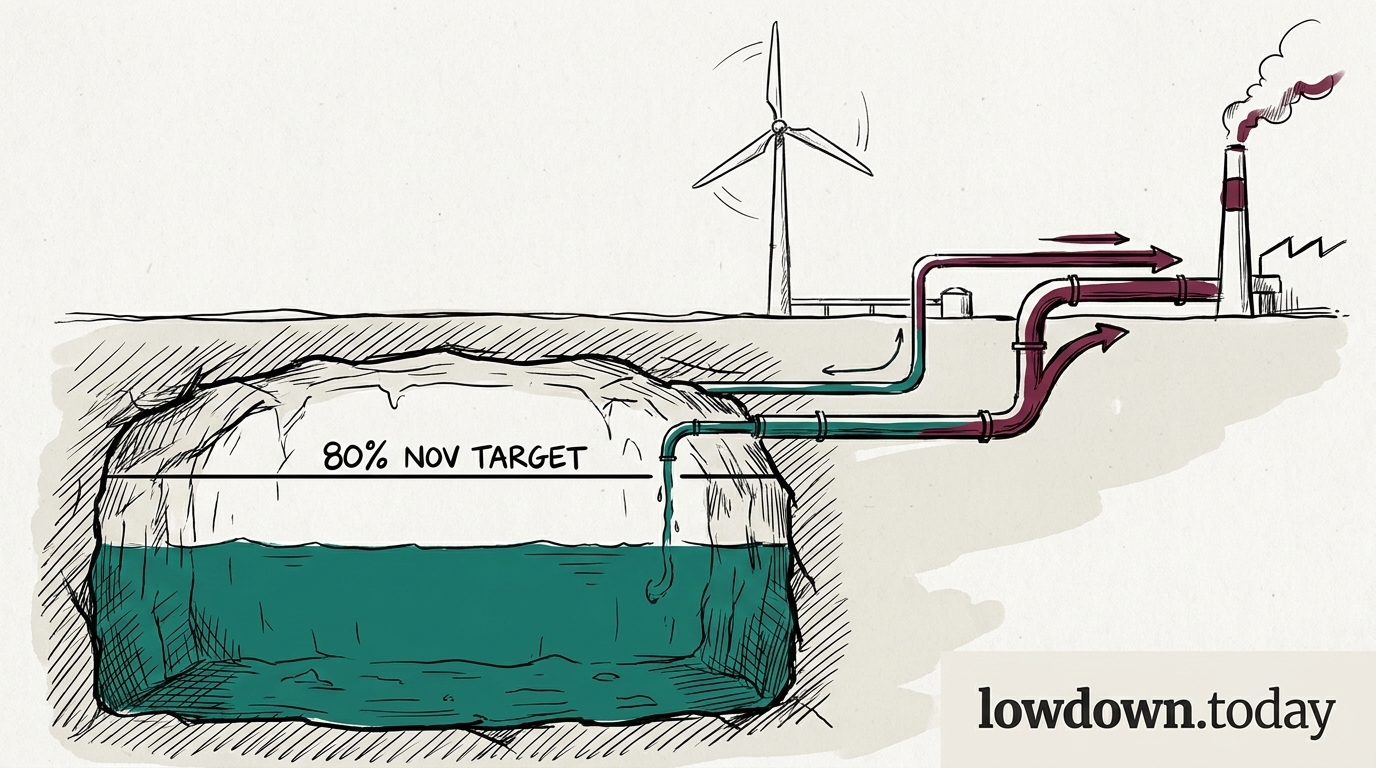
Spain's 9,145 GWh terminal inventory is the largest single stock in the EU LNG network, an option value that can reroute cargoes wherever the winter strip pays best rather than a cavern gas obligation tied to a fixed date. That flexibility matters more as Germany's cavern shortfall pushes more of the winter security question onto import infrastructure.
European Commission
European Commission
Brussels holds the bloc to 90% on a flexible window while Germany, holding roughly a quarter of EU storage capacity, tracks toward missing its own lower 80% figure by 21 points. A national shortfall this size in the anchor market matters more to bloc security than the flexible timetable alone can absorb.
French power exporters and CRE
French day-ahead rose in step with Germany but by less, reopening a EUR 7-17 premium that makes northward export flows commercially attractive again after the EUR 43.09 discount evaporated in days. CRE separately authorised RTE and Enedis to buy flexibility locally, betting the coming winter's binding constraint is grid congestion rather than a shortage of firm capacity.
TTF trading desk
TTF trading desk
A visible national shortfall like Germany's 21-point gap is a directional signal, not noise, for a desk holding the summer-winter spread. TTF's flat EUR 58-60 range through this week's German price swings says the market has not yet chosen to reprice refill risk into the front of the curve.
German cavern and CCGT operators
German caverns kept buying prompt gas at TTF near EUR 58-60 through the inversion; the wind collapse to 2.4 GW then flipped the spark spread to plus EUR 29 and put turbines back in the same queue. Every day turbines win that bid, injection at a third of the 877 GWh/day pace needed falls further behind.
Slovakia
Slovakia
Slovakia says it dropped its hold-out on the 21st sanctions package only after Ursula von der Leyen personally signed written gas-price and supply guarantees. The Council of the European Union's own 17,238-character release on the package names neither Slovakia nor any guarantee, leaving Bratislava's account unconfirmed by the institutional record.