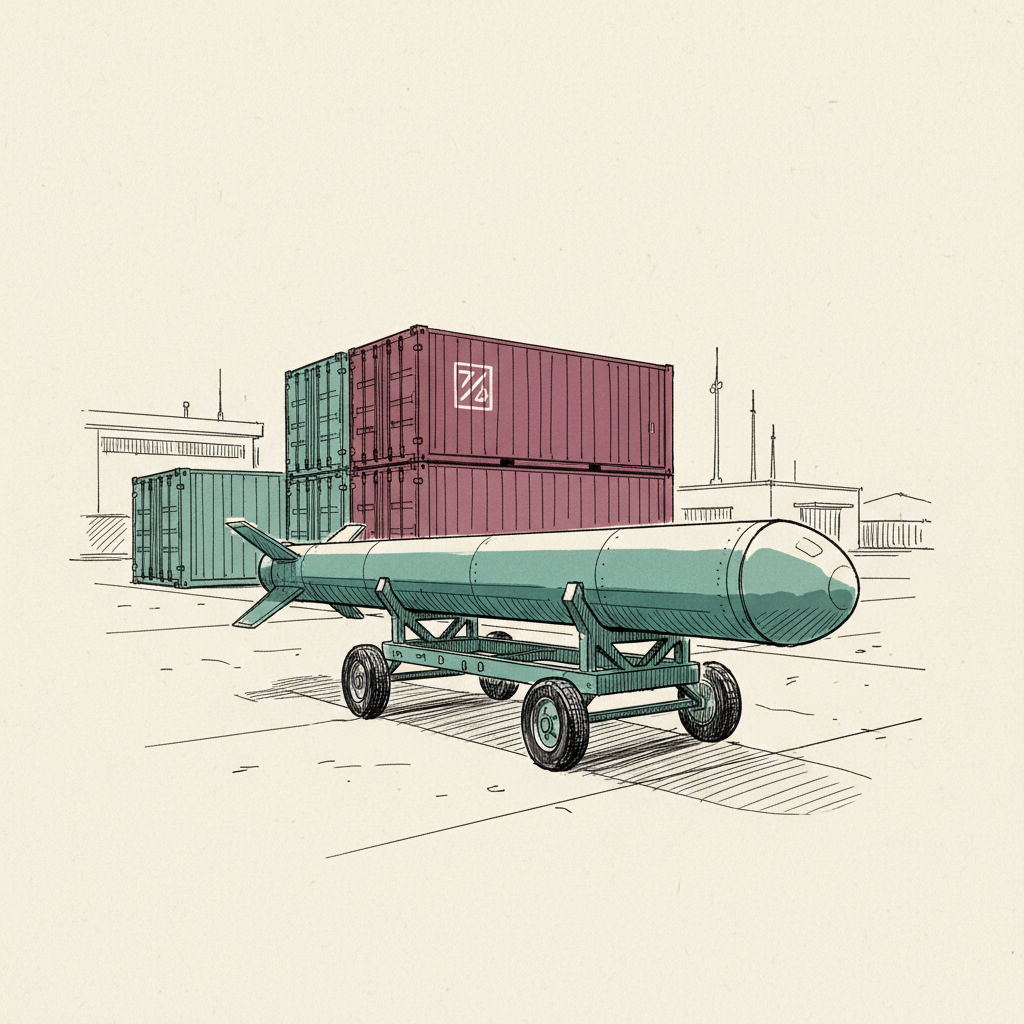
Coyote
Raytheon Technologies' tube-launched counter-drone effector; a new non-kinetic reusable variant demonstrated in 2026 can engage drone swarms, return to base, recharge, and redeploy.
Last refreshed: 5 July 2026 · Appears in 1 active topic
Can a reusable non-kinetic Coyote make counter-drone intercepts economically viable at scale?
Timeline for Coyote
Mentioned in: Hegseth watches five laser weapons fire
Drones: Industry & DefenceMentioned in: Northrop banks two drone awards in one week
Drones: Industry & DefenceDemonstrated in reusable non-kinetic configuration capable of engaging swarms and returning to base
Drones: Industry & Defence: RTX demos reusable Coyote against swarmsBackground
The Coyote is a family of tube-launched, expendable counter-drone effectors developed by Raytheon Technologies (RTX) under the Raytheon Intelligence and Space division. The original Coyote Block 1 is a small, expendable UAS interceptor that can be launched from ground vehicles, ships, or other platforms. On 21 April 2026 RTX reported on its Q1 earnings call that a new non-kinetic, reusable Coyote variant had been demonstrated successfully: the system engaged a drone swarm, returned to base under its own power, recharged, and was redeployed for a second engagement. An FMS case (a US government-brokered defence export) was also approved for Coyote sales to the United Arab Emirates. The high-power microwave (HPM) variant behind that reusable demonstration received its formal Block 3 designation and a public unveiling on 23 June 2026, when it was fired at White Sands Missile Range before Defense Secretary Pete Hegseth, the first sitting defence secretary to attend a directed-energy live-fire, alongside four other systems including AeroVironment's AMP-HEL and Epirus's Leonidas.
The reusable Coyote variant is the first declared response to the cost-per-engagement problem that has defined the C-UAS field in 2025 and 2026. Where a kinetic Coyote is consumed on each Intercept, the reusable variant can be recovered, recharged, and reused, sharply reducing the per-engagement cost against drone swarms that may number in the hundreds. RTX also disclosed that effectors exceeded 40% of Raytheon segment sales with double-digit growth in Q1, underlining the commercial significance of the C-UAS line.
Coyote competes in the same enterprise C-UAS market as Fortem Technologies' DroneHunter and Anduril's Lattice-integrated effectors. The UAE FMS approval opens a Gulf export market at the moment when Gulf states are processing the largest drone Intercept datasets in history following Iran's campaign since February 2026. The reusability demonstration directly answers the economic critique of kinetic C-UAS at scale: a single-use interceptor at $20,000-$30,000 per unit is economically unsustainable against a $300 drone swarm. The White Sands demonstration placed Coyote HPM Block 3 alongside four rival directed-energy systems in a single live-fire, the clearest public signal yet that the Pentagon is evaluating microwave and laser counter-drone effectors side by side ahead of programme-of-record decisions.
What is the Raytheon Coyote drone interceptor?
Is Coyote being sold to the UAE?
Why does the reusable Coyote matter for counter-drone economics?
What share of Raytheon's revenue comes from counter-drone weapons?
Has the Coyote high-power microwave weapon been publicly demonstrated?
