Skip to content
Briefings are running a touch slower this week while we rebuild the foundations.See roadmap
Iran Conflict 2026
12APR

Day 44: Islamabad collapses: 10 days to expiry

4 min read
08:59UTC

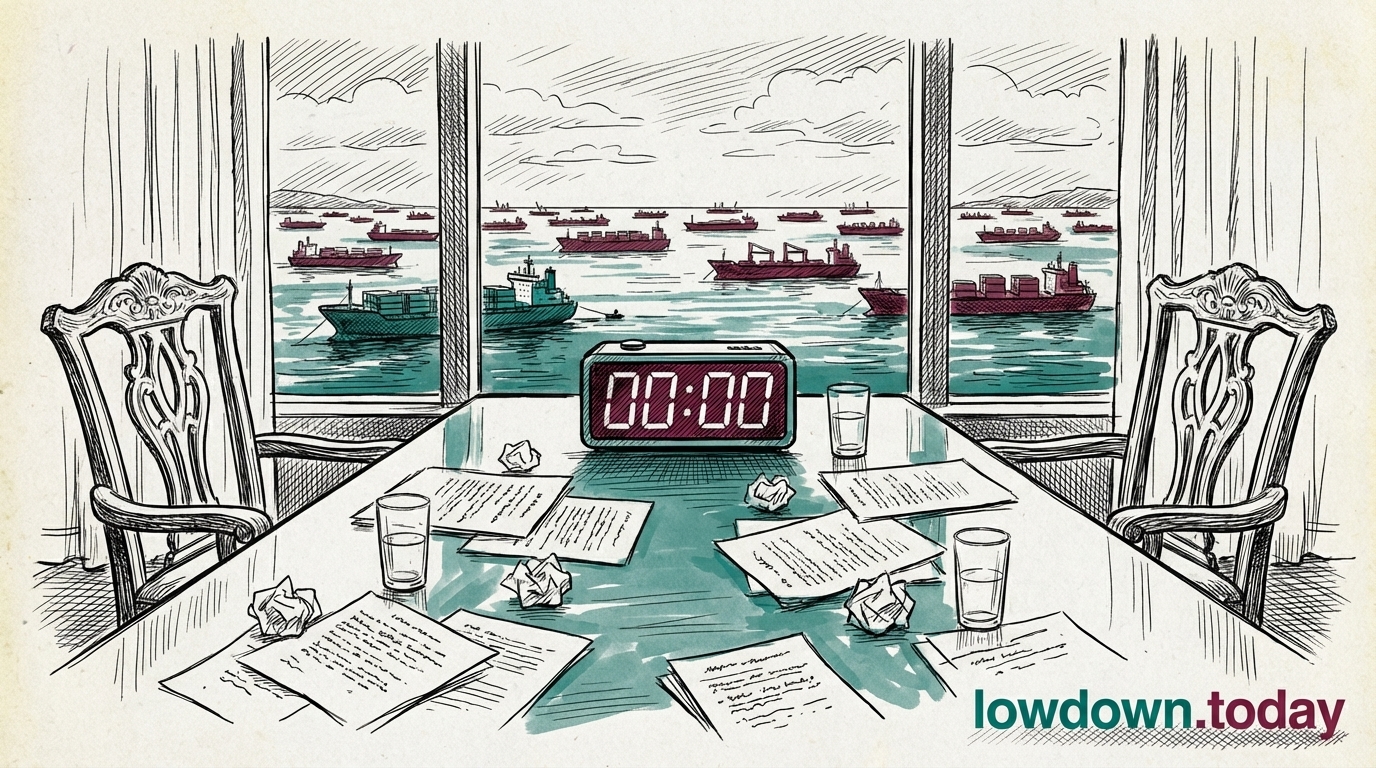
US-Iran talks at Islamabad's Serena Hotel ended after 21 hours with no agreement, no joint text, and no next meeting scheduled. JD Vance presented what he called a 'final and best offer' before departing; Iran refused to commit to forgoing nuclear weapons. The ceasefire expires in roughly 10 days with nothing behind it but three confirmed structural deadlocks: nuclear weapons commitment, HEU removal, and Hormuz reopening.

Key takeaway

The ceasefire has 10 days, three deadlocks, and no scheduled diplomacy to break any of them.

This briefing mapped
Loading map…
Diplomatic
Military
Economic
Domestic

Vance departs after two days of negotiations with no agreement, no joint text, and no next meeting.

Sources profile:This story draws on centre-left-leaning sources from Qatar and Israel
QatarIsrael

The Islamabad talks ended after 21 hours across two days with no agreement, no joint text, and no next meeting scheduled. JD Vance presented a 'final and best offer' before departing on 12 April; Iran refused to commit to forgoing nuclear weapons.

The Ceasefire's negotiation window now has roughly 10 days left with no diplomatic framework behind it. Vance's 'final and best offer' framing closes the US concession space before the deadline arrives. 

Briefing analysis

The JCPOA (Joint Comprehensive Plan of Action), signed in 2015, bridged a comparable enrichment gap between the US and Iran. That process took 20 months of structured negotiation, continuous IAEA monitoring, and a verification architecture that allowed both sides to verify compliance before making concessions.

Islamabad had none of those conditions. The IAEA has had no on-site access to Iran since 28 February 2026. The talks lasted 21 hours, not 20 months. And both sides published their positions publicly before entering the room, removing the ambiguity that allowed the JCPOA negotiators to find bridging language.

The JCPOA ultimately collapsed in 2018 when Trump withdrew the US. Iran subsequently escalated enrichment from the deal's 3.67% limit to 60%. The stockpile at that level, last verified at 440.9 kg, is now a central bargaining chip that neither side can verify or physically account for.

Iran's 10-point plan claims a right to enrichment; the US demands zero. The gap is publicly irreconcilable.

Sources profile:This story draws on mixed-leaning sources from Israel
Israel

Iran tabled a 10-point plan at Islamabad that lists acceptance of enrichment as non-negotiable; the US tabled a 15-point plan demanding zero nuclear weapons commitment, removal of the HEU stockpile, and unconditional Hormuz reopening. The gap on enrichment alone is publicly irreconcilable.

The enrichment deadlock is not a negotiating position that can be split; both sides have staked public credibility on mutually exclusive outcomes, and IAEA monitoring is dark. 

CENTCOM sent two destroyers through the strait on 11 April; the IRGC denied entry and threatened reprisal.

Sources profile:This story draws on mixed-leaning sources from United States and Qatar (includes United States state media)
United StatesQatar

CENTCOM announced USS Frank E. Petersen Jr. and USS Michael Murphy transited the strait of Hormuz on 11 April as part of a mine clearance mission. The IRGC directly denied the ships entered the strait and threatened that any military vessel attempting transit 'will be dealt with severely.'

This is the first confirmed US unilateral military action in Hormuz since the Ceasefire began, launched while the Islamabad talks were still running. 

Iran says mines stay in the water and the strait's pre-war status is gone permanently.

Sources profile:This story draws on mixed-leaning sources from United States, Qatar and 1 more (includes United States state media)
United StatesQatarFrance

The IRGC stated that mines remain in the strait of Hormuz water and that the strait 'will never return to its previous status.' Commercial traffic remains at roughly 8.0% of pre-war daily baseline, with more than 600 vessels including 325 oil tankers stranded in The Gulf.

The IRGC statement removes ambiguity about whether Hormuz reopening is a negotiable condition or a permanent new reality, with 600 vessels still stranded. 

Iran claimed the US agreed to release the funds; Qatar says Treasury approval was never granted.

Sources profile:This story draws predominantly on Iran state media, with sources from Iran
Iran

Qatar confirmed on 11 April that the $6 billion in frozen Iranian assets remain frozen and any release requires US Treasury Department approval, which has not been granted. Iran had entered the Islamabad talks claiming the US had already agreed to release these funds.

The gap between Iran's public claim and Qatar's factual correction reveals the $6 billion was a domestic framing device, not an operational concession. 

Sources:PressTV

Israeli strikes in southern Lebanon continued through the Islamabad talks, with 13 dead in Tefayta alone.

Sources profile:This story draws on centre-left-leaning sources from Qatar
Qatar

As Islamabad talks concluded on 12 April, IDF strikes killed 18 people in southern Lebanon, 13 of them in Tefayta. Iran listed Lebanon as a precondition at Islamabad; it was not resolved.

Lebanon has no seat at the Serena Hotel, no Ceasefire of its own, and no voice in the terms under which the parallel conflict continues. 

Sources:Al Jazeera

Tehran's Foreign Ministry says points were agreed; IRGC-aligned media says Hormuz stays closed until a deal suits Iran.

Sources profile:This story draws on mixed-leaning sources from Iran and Qatar (includes Iran state media)
IranQatar

Iran's Foreign Ministry stated 'the two sides agreed on a number of points' without specifying which. Iranian state television described the Islamabad session as 'the third round,' implying prior rounds that were never publicly acknowledged. Fars News (close to the IRGC) stated Iran 'is in no hurry' and Hormuz will not change until the US agrees to a 'reasonable deal.'

The split between the Foreign Ministry's softer language and Fars News's harder line reveals competing signals from within the Iranian state about what Islamabad means. 

Sources:Fars News Agency·Al Jazeera

Brussels cited UNCLOS transit rights to dismiss a US-Iran joint venture on strait fees.

Sources profile:This story draws on centre-leaning sources from United States
United States
LeftRight

The EU rejected Trump's suggestion of a US-Iran 'joint venture' on Hormuz toll collection. UNCLOS customary international law guarantees transit passage rights and permits fees only for specific services rendered; blanket selective tolls are a clear violation.

The EU rejection exposes a transatlantic split: Trump entertained a toll concept that violates the maritime law framework Europe considers binding. 

OFAC's General License U expires 19 April with no Treasury signal, after 23 days of silence on Iran sanctions.

Sources profile:This story draws on centre-left-leaning sources from Qatar
Qatar

OFAC General License U, authorising Iranian-origin crude oil deliveries loaded before 20 March, expires 19 April. OFAC has not published a single Iran-related action since 20 March, 23 days of silence during an active conflict, while amending Russia and Venezuela general licences in the same window.

Non-renewal recriminalises all Iranian oil deliveries in transit three days before the Ceasefire deadline, tightening pressure at the worst possible moment. 

Sources:Al Jazeera

Oil prices stayed flat at $95-97, pricing a sustained stalemate rather than confidence in resolution.

Sources profile:This story draws on centre-leaning sources from United States
United States
LeftRight

Brent Crude traded between $95.20 and $96.69 on 11-12 April, essentially flat from the prior update's $96.39. Oxford Economics projects world GDP growth at 1.4% in 2026 under prolonged conflict, down from a 2.6% baseline.

Rangebound Brent above $95 means markets have not priced in a clean resolution, and the economic cost of the conflict is accumulating, not receding. 

Deputy PM Ishaq Dar confirmed Pakistan will continue its mediator role despite the Islamabad breakdown.

Sources profile:This story draws on centre-left-leaning sources from United States
United States

Pakistan Deputy PM Ishaq Dar confirmed Pakistan will continue mediating despite no deal from Islamabad. Iran's Foreign Ministry left the door open to further talks but neither side proposed a date for a next round.

Pakistan is now the only active mediator with a stated commitment to continue, but its credibility depends on producing a follow-up session before the Ceasefire expires. 

Sources:NPR

US and Israeli intelligence claim Iran's Supreme Leader cannot participate in decision-making.

Sources profile:This story draws on neutral-leaning sources

The Soufan Center reported on 9 April that Mojtaba Khamenei, Iran's Supreme Leader since March 2026, is reportedly unconscious and unable to participate in decision-making, citing US and Israeli intelligence. This is a single-source claim that cannot be independently verified.

If confirmed, the incapacitation of the authority who approved the Ceasefire raises a direct question about who holds Ceasefire authority in Tehran

Closing comments

Three triggers converge in a 10-day window: GL-U lapse on 19 April recriminalises oil in transit before the political deadline; ceasefire expires around 22 April with no framework to extend or replace it; the IRGC threat to respond 'severely' to further mine clearance operations creates a flashpoint that could collapse the diplomatic frame in hours. The ceasefire holds on mutual fear of worse alternatives, not agreement.

Different Perspectives
United States
United States
Vance called the breakdown 'bad news for Iran much more than for the US' after presenting what he framed as a final offer and departing without agreement. The framing shifts responsibility to Tehran while closing US concession space before the ceasefire expires.
Iran
Iran
Iran's Foreign Ministry claimed 'the two sides agreed on a number of points' without specifying which, while IRGC-aligned Fars News stated Iran 'is in no hurry.' The two-track message (diplomatic door open, military position hardened) reflects competing internal audiences as much as a coherent strategy.
Israel
Israel
Netanyahu declared the ceasefire 'does not bind Israel in Lebanon,' and IDF operations killed 18 in southern Lebanon as the Islamabad talks concluded. Israel continues to treat the Iran ceasefire and the Lebanon front as legally and operationally separate.
Pakistan
Pakistan
Deputy PM Ishaq Dar confirmed Pakistan will continue mediating despite no deal emerging from Islamabad. Pakistan's role as the sole active mediator now depends on producing a follow-up session before the ceasefire expires.
European Union
European Union
The EU rejected Trump's Hormuz toll joint venture proposal, citing UNCLOS transit passage rights that prohibit blanket selective fees. The rejection is a legal position without operational enforcement capacity given Russia and China's UNSC veto.
Qatar
Qatar
Qatar publicly corrected Iran's claim that the US had agreed to release $6 billion in frozen assets, confirming the funds remain frozen pending Treasury approval not yet granted. The correction exposed Iran's domestic political framing as operationally unsupported.

