Skip to content
Briefings are running a touch slower this week while we rebuild the foundations.See roadmap
Iran Conflict 2026
11APR

Day 43: Iran lost its own minefield

5 min read
11:03UTC

Iran cannot locate or remove the naval mines it laid in Hormuz, US officials tell the New York Times and Wall Street Journal, as Saturday's Islamabad talks open in a proximity format with delegations in separate rooms. Trump has issued zero Iran presidential instruments in 42 days.

Key takeaway

The war ends on paper; the strait stays shut; Iran has lost its own mines.

This briefing mapped
Loading map…
Military
Economic
Diplomatic
Regulatory

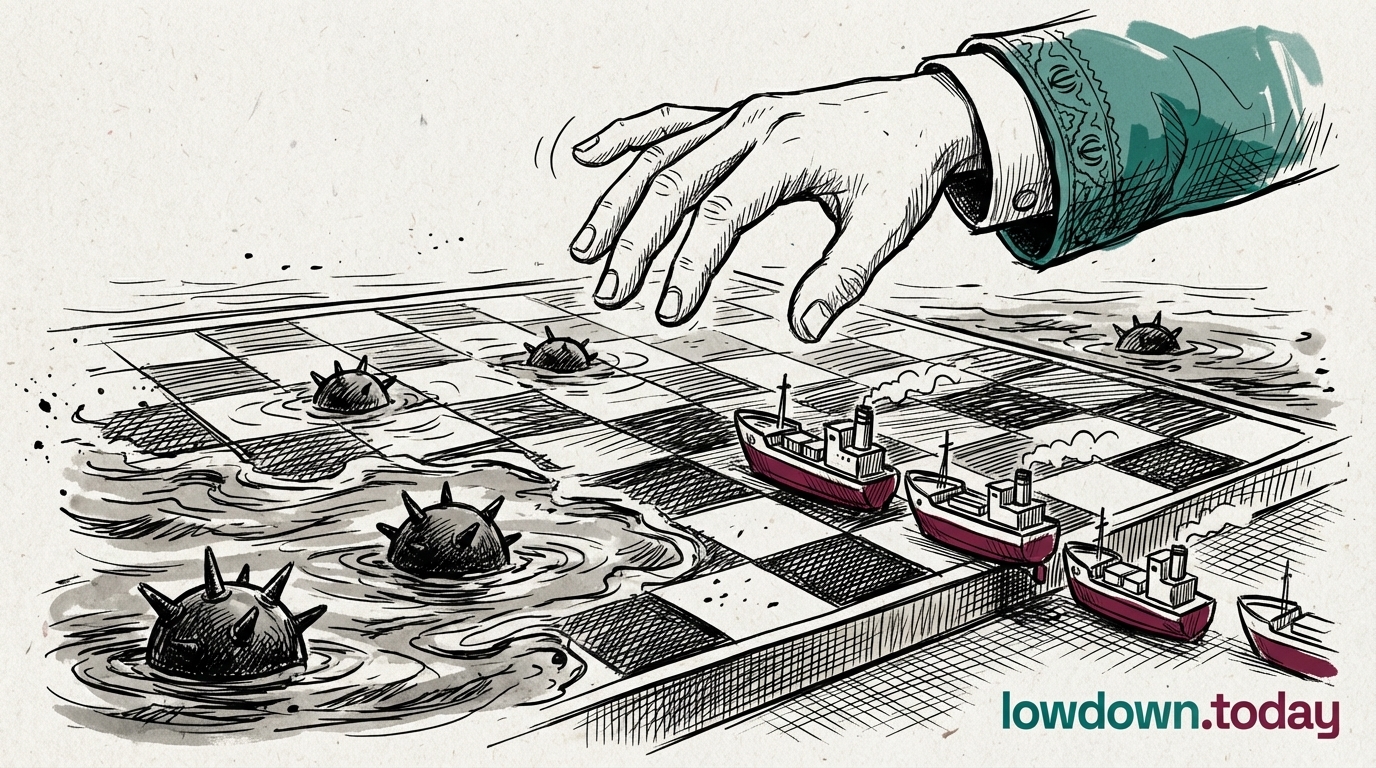
Tehran deployed at least a dozen mines in Hormuz and never mapped most of them. US intelligence officials told the New York Times and Wall Street Journal the minefield now sits beyond Iran's own reach.

Sources profile:This story draws on mixed-leaning sources from Qatar
Qatar

US intelligence officials told The New York Times and Wall Street Journal that Iran deployed at least a dozen naval mines in the strait of Hormuz without systematically tracking every placement, and Tehran now cannot reliably map, locate, or recover all of them. The two models identified are the Maham-3 moored mine and the Maham-7 seabed limpet device. Iran also lacks the capability to remove the mines once found. The IRGC corridor charts published on 9 April directing traffic near Larak Island now read as a confession that Iran does not know which channels are safe.

The ceasefire demand that Iran reopen Hormuz is no longer within Iran's physical power to satisfy, and no external minesweeping mandate has been issued. 

Briefing analysis

Primary parallel: The 1988 Geneva Accords on Afghanistan, cited by Pakistani officials as the format precedent for Islamabad, were themselves the product of six years of proximity talks between Afghan and Pakistani delegations who never met face to face. UN diplomat Diego Cordovez shuttled messages between hotel rooms in Geneva from 1982 to 1988. The final accords produced a Soviet withdrawal timetable but did not end the civil war; the Afghan conflict continued for another decade, producing the Taliban and the conditions for 9/11. Proximity formats are designed to preserve deniability for all sides and survive repeated breakdowns, not to produce comprehensive settlements.

Counter-parallel: The 1953 Korean Armistice talks at Panmunjom also ran for two years in a quasi-proximity format, but produced a durable (if incomplete) cessation of hostilities that has held for more than 70 years. The difference between Geneva 1988 and Panmunjom 1953 was not format but leverage: at Panmunjom, neither side could force a conclusion, and both sides wanted out. Whether Islamabad 2026 looks more like Geneva or Panmunjom depends on whether Washington and Tehran are genuinely exhausted.
Kpler logged five vessel transits through the Strait of Hormuz on 9 April and seven on 10 April, against a pre-war baseline of 120 to 140 a day. ADNOC's chief executive told reporters the strait is not open.

Sources profile:This story draws on centre-left-leaning sources from Qatar
Qatar

Kpler recorded 5 vessel transits through the strait of Hormuz on 9 April and 7 on 10 April, against a pre-war baseline of 120 to 140 daily. This is below the 20 transits per day that Iran's own toll regime was producing on 5 April . More than 600 vessels including 325 oil tankers remain stranded inside the Gulf. ADNOC chief executive Sultan Al Jaber stated the strait is not open and access remains restricted, conditioned, and controlled. Kpler analyst Ana Subasic projects a maximum of 10 to 15 transits per day even if the ceasefire fully holds.

The ceasefire has so far produced fewer transits than the blockade it was supposed to end, implying insurance and oil markets will hold war-risk pricing indefinitely. 

Sources:Al Jazeera

The first formal US-Iran negotiating session since 1979 opened at the Serena Hotel in Islamabad on Saturday with both delegations staying in separate rooms. Pakistani officials physically walked messages between them.

Sources profile:This story draws on centre-left-leaning sources from Qatar and United States
QatarUnited States

The first formal US-Iran negotiating session since 1979 opened at the Serena Hotel in Islamabad in a proximity format: delegations in separate rooms with Pakistani officials physically walking messages between them. JD Vance arrived at Nur Khan air base on 10 April leading the 30-member US delegation , which includes Steve Witkoff and Jared Kushner. Iran sent Parliament Speaker Mohammad Bagher Ghalibaf and Foreign Minister Abbas Araghchi. Ghalibaf met Prime Minister Shehbaz Sharif before any contact with Americans. Iranian state television said timing of US talks would be determined after preconditions are clarified through Pakistani mediators. Former Pakistani UN Ambassador Zamir Akram described Pakistan's success bar as 'breathing space, not expecting anything big'. Pakistani officials logged more than 25 high-level diplomatic contacts in the two days setting up the summit.

The proximity format is designed to preserve deniability and survive failure, not to produce breakthroughs, and Pakistan's own success bar is simply keeping the process alive. 

Across 42 days of war and four of ceasefire, the Trump administration has issued zero formal Iran presidential instruments. A Lowdown audit of the Federal Register and the White House actions index found exactly one Iran-mentioning document, a statutory annual renewal.

Sources profile:This story draws on neutral-leaning sources

A Lowdown audit of the Federal Register and the White House presidential actions index found zero formal Iran presidential instruments issued across 42 days of war, extending the finding at 40 days . The only Iran-mentioning presidential document since 1 March 2026 is the statutory annual National Emergency renewal dated 5 March. Seven non-Iran presidential documents were issued between 1 and 10 April. OFAC has issued zero Iran-specific actions since 20 March when it issued General License U . OFAC amended Russia General Licenses on 30 March and 8 April and issued new Venezuela General Licenses on 27 March during the same 22-day window. General License U expires 19 April, eight days from Saturday.

A war without executive instruments leaves no legal scaffolding to negotiate over, no text for Congress to review, and a General License U cliff on 19 April that no one has moved to prevent. 

The Wall Street Journal, citing US intelligence officials, reported on 10 April that Iran has preserved roughly half its ballistic missile and attack-drone stockpile. Defence Secretary Pete Hegseth called the programme 'functionally destroyed' a fortnight earlier.

Sources profile:This story draws on centre-left-leaning sources from Israel
Israel

The Wall Street Journal, citing US intelligence officials, reported that Iran has preserved roughly half its ballistic missile and attack-drone stockpile and retains thousands of ballistic missiles. More than half of Iran's missile launchers have been destroyed, damaged, or buried, but US intelligence believes Tehran can repair or excavate buried launchers and reconstitute significant strike capability on a timeline of months. The assessment contradicts Defence Secretary Pete Hegseth's claim that Iran's missile and drone programmes were 'functionally destroyed' and Benjamin Netanyahu's claim that Iran had 'no ability' to rebuild. CENTCOM confirmed the F-15E shot down over western Iran on 3 April in the same reporting window.

The rhetoric-versus-reality gap is becoming the war's most consistent pattern, and every future strike calculus must assume Iranian retaliation capability rather than a degraded one. 

Sources:Haaretz

Iranian Parliament Speaker Mohammad Bagher Ghalibaf publicly named three ceasefire violations: Israel's continued strikes on Lebanon, a drone incursion into Iranian airspace, and the US refusal to accept Iran's enrichment rights. He set two preconditions for Saturday's talks to begin.

Sources profile:This story draws on centre-left-leaning sources from Qatar and United States
QatarUnited States

Iran's parliament Speaker Mohammad Bagher Ghalibaf publicly listed three ceasefire violations: Israel's continued strikes on Lebanon, a drone incursion into Iranian airspace, and the US refusal to accept Iran's enrichment rights, advancing his earlier rejection of the ceasefire framework . Ghalibaf and President Masoud Pezeshkian set two preconditions for Saturday's talks: a Lebanon ceasefire and the release of Iran's blocked foreign-exchange assets. The preconditions provide domestic cover for Mojtaba Khamenei, who authorised the ceasefire . Netanyahu signalled readiness to open Lebanon negotiations through the US State Department, but Trump privately asked him to reduce visibility on Lebanon ahead of Islamabad.

The codified violations and preconditions give the new Supreme Leader's inner circle a pre-built justification for walking out of Islamabad and reveal the limits of what proximity talks can actually produce. 

The IAEA newscenter carries no active Iran story as of 11 April, the monitoring framework structurally dark since Iran's Majlis voted 221-0 to suspend all cooperation on 3 April. OFAC has published no Iran action in 22 days.

Sources profile:This story draws on neutral-leaning sources

The IAEA newscenter carries no active Iran news story or press release as of 11 April 2026. The nuclear monitoring framework has gone structurally dark since Iran's Majlis voted 221-0 to suspend all IAEA cooperation on 3 April. OFAC has also not published a single Iran-related action since 20 March, 22 days of silence during an active war, while actively maintaining Russia and Venezuela sanctions programmes in the same window .

Both multilateral nuclear monitoring and unilateral US sanctions enforcement are running on silence during the war's most consequential diplomatic week. 

Brent crude recovers from post-ceasefire low

Brent crude traded at $96.39 on Friday morning, recovered from its post-ceasefire low of $94.41 reached after the 15 to 16 per cent single-day drop on 8 April. Markets are pricing the structural stalemate, not resolution.

Sources profile:This story draws on centre-left-leaning sources from Qatar
Qatar

Brent Crude traded at $96.39 on Friday morning 11 April, recovering from its post-ceasefire low of $94.41 after the 15-16% single-day drop on 8 April . The recovery reflects market pricing of a structural stalemate rather than confidence in resolution. The Kpler-projected 10 to 15 Hormuz transit ceiling implies fuel prices remain 40 to 60 per cent above pre-war levels regardless of the diplomatic scenario.

The recovery implies fuel prices stay 40 to 60 per cent above pre-war levels regardless of which diplomatic scenario plays out, locking in an inflation floor across fuel-import-dependent economies. 

Sources:Al Jazeera
Closing comments

Near-term de-escalating: the physical mine problem reduces US appetite for military action to force Hormuz open, because the clearance task is now acknowledged as multi-month regardless of political will. Medium-term escalating: each week without clearance normalises Iran's toll and inspection regime as the de facto operating baseline for the strait, raising the political cost of any eventual collapse or resumption of hostilities. The 19 April GL-U expiry is the first inflection point: lapse without renewal converts the maritime blockage into a simultaneous maritime-legal crisis, likely triggering insurance-market withdrawal and removing the emergency cargo-transfer option.

Different Perspectives
Iran
Iran
Ghalibaf arrived in Islamabad having already codified three ceasefire violations and two preconditions on the record: a Lebanon ceasefire and release of blocked assets before talks formally begin. Tehran's delegation is structured to walk out with justification intact rather than to reach agreement.
United States
United States
Trump has issued zero Iran executive instruments across 42 days of war; Vance's 30-member Islamabad delegation includes envoys Iran previously asked to exclude. OFAC's GL-U expires 19 April with no renewal signal, creating a sanctions cliff the administration has not publicly addressed.
Pakistan
Pakistan
Islamabad's mediators logged more than 25 high-level contacts in 48 hours to host the proximity format, while former UN Ambassador Zamir Akram described the success bar as breathing space rather than a settlement.
Israel
Israel
Netanyahu signalled readiness to open Lebanon negotiations through the US State Department but was privately asked by Trump to reduce Lebanon's public visibility ahead of Islamabad; continued IDF strikes on Lebanon are Iran's stated primary ceasefire violation.
United Arab Emirates
ADNOC chief executive Sultan Al Jaber stated on the record that the Strait of Hormuz is not open and access remains restricted, conditioned, and controlled; Kpler data of 5 and 7 transits on 9-10 April supports that assessment from the largest Gulf exporter.
Lebanon
Lebanon
Lebanese civilians bear the costs of Israeli strikes that Iran cites as a ceasefire violation requiring resolution before Islamabad talks begin; Beirut has no seat at the Serena Hotel and no voice in the terms under which the parallel conflict continues.
