ⓘWelcome, thoughtbot's Giant Robots listeners!Start here
22MAR
Day 23: Trump: 48 hours to destroy Iran power grid
9 min read
05:50UTC
Trump threatened to destroy Iran's power plants within 48 hours if the strait of Hormuz remains closed, as Iranian missiles struck near Israel's Dimona nuclear reactor — wounding over 100 after air defences failed — and a missile fired at Diego Garcia revealed Iran possesses weapons with double its declared 2,000 km range.
Every buffer between military operations and civilian populations has been removed: air defences are failing, diplomatic channels are closed, international coalitions produce statements without forces, and both combatants now condition strikes on civilian infrastructure serving tens of millions.
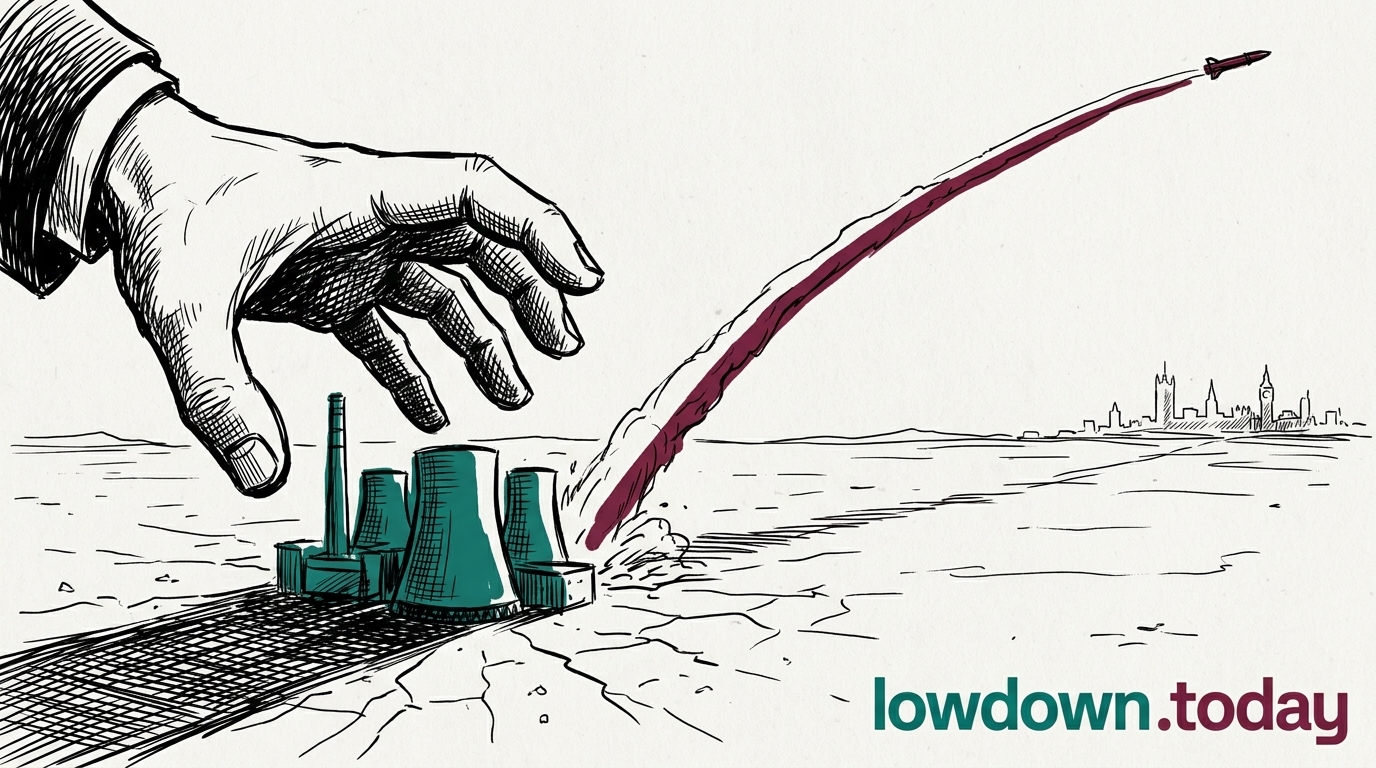
Trump posted on Truth Social at 7:44 PM ET Saturday: open the strait of Hormuz within 48 hours or the US will strike Iranian power plants 'STARTING WITH THE BIGGEST ONE FIRST.' The deadline expires Monday evening.
The 2-day window is shorter than Iran's constitutional decision cycle. Iran holds roughly 440 kg of enriched uranium it cannot move through a strait under active US naval attrition — compliance in 48 hours is structurally impossible.
The IEA's recorded 8 mbpd supply loss exceeds the 1990 Gulf War disruption of approximately 4.3 mbpd, when Iraqi and Kuwaiti production went offline simultaneously. In 1990, Saudi Arabia's spare capacity — ramped up over six months — filled most of the gap. That spare capacity is now itself under daily drone attack, with 47 drones intercepted over Saudi territory in a single day.
The 1973 Arab oil embargo removed roughly 4.4 mbpd and quadrupled prices over six months. The current disruption is nearly double that volume and has produced a 66% price increase in three weeks rather than six months. The IEA's 400-million-barrel strategic reserve release — the largest coordinated draw in the agency's history — covers approximately 50 days of the shortfall at current rates.
Iran fired two missiles at a joint US-UK base 4,000 km from its coastline — double the range Tehran always publicly claimed. Both failed to hit; the capability they demonstrated cannot be undone.
Sources profile:This story draws on centre-left-leaning sources from United States, Israel and 1 more
Iran launched two intermediate-range ballistic missiles at the joint US-UK base on Diego Garcia in the Indian Ocean on Friday. One malfunctioned in flight. The other was intercepted. No damage to the base. Diego Garcia lies approximately 4,000 km from Iran's coastline — double the 2,000 km ceiling Tehran had always publicly stated. Iran's FM Araghchi had previously claimed: 'We intentionally kept the range of our missiles below 2,000 km.' The UK Ministry of Defence condemned Iran's 'reckless attacks' as 'a threat to British interests and British allies.'
Iran's demonstrated 4,000 km strike range demolishes a decade of diplomatic assurances and extends its threat envelope to Southern Europe, all US bases from the Mediterranean to the Indian Ocean, and the entirety of The Gulf.
Iran's supreme military command put every Gulf state's water and electricity supply on the target list — infrastructure tens of millions depend on for drinking water.
Sources profile:This story draws on centre-left-leaning sources from Qatar
Iran's Khatam al-Anbiya command threatened to strike energy, IT, and desalination infrastructure across US-allied Gulf states if Iranian energy sites are hit. Kuwait draws roughly 90% of its drinking water from desalination; Qatar and the UAE depend on it for most of their supply.
The threat targets Gulf Arab governments directly. Iran is telling Riyadh and Abu Dhabi that staying in the US coalition carries a cost measured in civilian water supply.
Interceptors launched and missed at two southern Israeli cities, including the site of the country's nuclear research centre — the second time Iranian warheads have penetrated defences built to prevent exactly this.
Sources profile:This story draws on centre-left-leaning sources from Israel and United States
Israeli interceptors launched at both Dimona and Arad on Friday but failed to engage incoming warheads. IDF Spokesman Brig. Gen. Effie Defrin confirmed the system 'operated but did not intercept the missile.' 84 people were wounded in Arad; 40 in Dimona.
2 simultaneous failures in the same raid points to Iran operationally defeating Arrow-3 via manoeuvring warheads or salvo saturation — a structural gap in Israeli air defence, not a one-off malfunction.
Saudi Arabia declared Iran's military attaché and four embassy staff personae non gratae, formally ending the China-brokered rapprochement that took Beijing years to build and the war three weeks to destroy.
Sources profile:This story draws on centre-left-leaning sources from Qatar
Saudi Arabia declared Iran's military attaché and four embassy staff personae non gratae, giving them 24 hours to leave The Kingdom. The stated reason: 'repeated Iranian attacks' on Saudi territory. This formally ends the 2023 China-brokered Saudi-Iran rapprochement at the diplomatic level — Beijing's most visible Middle Eastern achievement, now dismantled in three weeks of war.
Eliminates China's most prominent Middle Eastern diplomatic achievement and consolidates US-led security architecture as the sole operational framework in The Gulf. Closes one of Tehran's two remaining diplomatic channels among Gulf Arab states.
Ballistic missiles struck Dimona — home to Israel's nuclear reactor — wounding 40 people including a 12-year-old boy. The IAEA confirmed no radiation release, but Israeli air defences failed to intercept for the second time this war.
Sources profile:This story draws on centre-left-leaning sources from Israel
Hostile warheads struck the city housing Israel's nuclear weapons facility, with air defences again failing to intercept, while both sides now operate within striking distance of each other's nuclear infrastructure — a dynamic the IAEA has warned could produce radiological consequences.
Global oil supply has fallen by 8 million barrels per day — the largest disruption ever recorded. Strategic reserves cover roughly 50 days. The war is on day 22.
Sources profile:This story draws on neutral-leaning sources
The IEA's March 2026 Oil Market Report confirmed global supply fell 8 million barrels per day, the largest disruption on record. Gulf production is down at least 10 mb/d including condensates. IEA member states released 400 million barrels from strategic reserves.
At 8 mb/d shortfall, those reserves cover roughly 50 days. Goldman Sachs warned Brent could exceed its 2008 intraday record of $147.50 per barrel if Hormuz remains closed beyond 60 days.
Israel's top general assessed the war at its midpoint with three more weeks of operations planned. Three days earlier, Trump declared it 'militarily won.'
Sources profile:This story draws on mixed-leaning sources from United States and Israel
IDF Chief of Staff Lt. Gen. Eyal Zamir stated Saturday: 'We are halfway through.' Defence Minister Katz promised strikes 'will significantly escalate' this week. The Times of Israel reported at least 3 more weeks of operations, extending through Passover in mid-April.
Three days earlier Trump declared the war 'Militarily WON.' Zamir's halfway assessment puts the end in mid-April, aligning with the Pentagon's $200 billion supplemental far better than Trump's wind-down framing.
The US hit Iran's main enrichment facility for the second time in this war. The IAEA says 440 kg of near-weapons-grade uranium — enough for roughly ten bombs — remains where it was.
Sources profile:This story draws on right-leaning sources from United States
The US struck Natanz again on Friday — Iran confirmed the hit, the IAEA reported no radiation leak, and the IDF denied involvement, indicating a US unilateral operation. This is the second strike on Natanz since the war began. The IAEA estimates Iran holds roughly 440 kg of 60%-enriched uranium — enough for approximately 10 weapons if further enriched. Airstrikes have not altered that stockpile.
The second strike on Natanz exposes the gap between political claims that Iran's enrichment is destroyed and the IAEA's assessment that the material and capacity will survive. Airstrikes can damage centrifuges but cannot safely destroy 440 kg of 60%-enriched uranium — the actual proliferation risk.
Iranian ballistic missiles wounded 84 people in the southern Israeli city of Arad — including a five-year-old girl in serious condition — after interceptors launched and failed to engage incoming warheads.
Sources profile:This story draws on centre-left-leaning sources from Israel and United States
Iranian ballistic missiles struck Arad in southern Israel on Friday, wounding 84 people, 10 seriously, including a 5-year-old girl. Iran's Khatam al-Anbiya command framed the barrage as direct retaliation for the American strike on Natanz hours earlier.
Arad sits roughly 30 km from Dimona. Striking civilian areas adjacent to a nuclear site creates political pressure without requiring Iran to attack the hardened facility itself — a coercive pattern drawn from 1980s Gulf doctrine.
Twenty-two countries issued a joint statement demanding Iran 'immediately cease its threats, the placement of mines, drone and missile attacks, and any attempt to obstruct commercial navigation' in the strait of Hormuz. Signatories span NATO members and Indo-Pacific partners including Australia, Japan, and South Korea. The group tripled from the seven-nation statement earlier in the week. The language is stronger. No country pledged warships. The statement expresses 'readiness to contribute to appropriate efforts' — words that have now appeared in three separate joint declarations without producing a single vessel.
Three consecutive joint declarations demanding Iran reopen the strait have failed to generate any military commitment, exposing a structural gap between diplomatic consensus and operational willingness as the world's largest recorded oil supply disruption enters its fourth week.
Hours after London authorised US operations from Diego Garcia, Iranian missiles arrived — and the UK's own attorney general had advised the war is unlawful.
Sources profile:This story draws on mixed-leaning sources from Israel, United Kingdom and 1 more
The UK granted the US defensive operations from RAF Fairford and Diego Garcia, refusing Akrotiri for offensive strikes. Starmer refused all access on 28 February and reversed on 1 March. Iran fired 2 ballistic missiles at Diego Garcia hours after the authorisation was confirmed.
UK Attorney General Lord Hermer KC had advised the operation does not accord with international law. The government overrode that within 72 hours. Diego Garcia is roughly 4,000 km from Iran.
CENTCOM added a thousand targets in three days while the president talks of winding down. Admiral Cooper calls 130 destroyed vessels the largest naval attrition since World War II.
Sources profile:This story draws on mixed-leaning sources from United States
CENTCOM commander Adm. Brad Cooper reported the US has struck more than 8,000 targets — up from 7,000 disclosed days earlier — and flown 8,000-plus combat sorties in 22 days. More than 130 Iranian naval vessels have been destroyed, which Cooper called 'the largest naval attrition campaign in three weeks since World War II.'
The jump from 7,000 to 8,000 targets in approximately 72 hours demonstrates an accelerating campaign that contradicts The White House wind-down narrative. Cooper's claim of the largest naval attrition since World War II, if sustained, reshapes the military balance around the strait — but has not yet reopened it to commercial shipping.
Thirteen days after being named supreme leader, Mojtaba Khamenei has not appeared in public. Western intelligence agencies cannot confirm he is alive and capable of command.
Sources profile:This story draws on centre-left-leaning sources from United States
Axios reports the CIA, Mossad, and allied agencies are actively searching for evidence Mojtaba Khamenei is alive and functioning. He has not been seen in public since being named Supreme Leader on 9 March — 13 days. His sole substantive communication has been a written Nowruz message read on state television. No video. No voice recording. A US official stated: 'We don't think the Iranians would have gone through all this trouble to choose a dead guy as The Supreme Leader, but at the same time, we have no proof that he is taking the helm.'
Iran's Supreme Leader is the constitutional commander-in-chief and sole authority on war-and-peace decisions. His unverified status during active hostilities raises direct questions about who is authorising Iranian military operations — including the Diego Garcia missile strike and the counter-threat to Trump's power-grid ultimatum — and who possesses the authority to negotiate an end to the war.
UK Attorney General Lord Hermer KC advised the US-Israeli operation does not accord with international law. That advice shaped PM Starmer's initial refusal on 28 February. Starmer reversed within 48 hours, authorising defensive operations from RAF Fairford and Diego Garcia.
Chatham House argues the defensive-offensive base distinction blurs the line between lawful self-defence and unlawful war on Iran. Unlike Iraq 2003, Hermer's advice was not revised. The government acted contrary to it.
The A-10 Warthog has dodged retirement for a decade. Its low-altitude deployment over the Strait of Hormuz is an assessment CENTCOM has not made verbally — that Iran's southern coastal defences can no longer threaten slow-moving aircraft.
Sources profile:This story draws on mixed-leaning sources from United Kingdom, United States and 2 more (includes China state media)
A-10 Warthog aircraft and AH-64 Apache helicopters are flying low-altitude patrols over the strait of Hormuz, hunting fast-attack craft and drones. Both platforms were designed for close air support, not contested airspace. Commanders would not risk them if Iranian air defences in the area remained functional.
CENTCOM has used GBU-72 penetrator bombs against coastal anti-ship sites and destroyed more than 130 Iranian naval vessels. The A-10 deployment implies air superiority Washington has not formally declared.
Lt. Gen. Zamir stated that Berlin, Paris, and Rome fall within direct threat range of the weapon Iran fired at Diego Garcia. NATO's response to the war remains declarations without warships.
Sources profile:This story draws on centre-left-leaning sources from Israel
Zamir is forcing European NATO members to choose: treat Iran as a direct territorial threat or explain why the capitals they declined to defend in the HormuzCoalition now fall inside an Iranian missile's range.
The IDF struck Malek Ashtar University of Technology — a defence ministry institution under UN, US, and EU nuclear sanctions since 2006 — extending the air campaign to weapons research nodes inside the capital.
Sources profile:This story draws on mixed-leaning sources from Israel
The IDF struck Malek Ashtar University of Technology in Tehran on Saturday, calling it a nuclear weapons development site. The university, under Iran's defence ministry, has been sanctioned since 2006 for its role in explosive-detonation research central to warhead design.
The strike extends Israel's campaign from enrichment infrastructure into weaponisation knowledge. By hitting Natanz (US) and Malek Ashtar (IDF) the same day, both sides targeted the full weapon-production chain simultaneously.
Iran publicly executed three young men arrested in the January protests, including one who turned 19 in his cell eight days before his death. Amnesty International and Iran Human Rights warn dozens more face imminent execution while the war absorbs the world's attention.
Sources profile:This story draws on centre-left-leaning sources from United States and France
3 young men were hanged in Qom on 19 March, charged with waging war against God. Saleh Mohammadi was 19; sentenced less than 3 weeks after arrest. His family alleges torture was used to extract a confession. Saeed Davoudi was 21.
Amnesty International called the executions arbitrary, designed to intimidate a traumatised population under bombardment. Iran Human Rights warned of imminent mass executions in the shadow of war, with dozens more at risk including minors.
Eleven submunition craters across a Rishon LeZion kindergarten. No children were inside — a fact determined by the time of day, not by any defence system.
Sources profile:This story draws on centre-left-leaning sources from Israel
An Iranian cluster munition struck an empty kindergarten in Rishon LeZion, leaving 11 submunition impact craters. No children were present.
Iranian cluster munitions have reached a children's facility in metropolitan Tel Aviv. The absence of child casualties was a function of timing alone — the weapon dispersed as designed over open ground built for outdoor play.
Education Minister Yoav Kisch ordered all Israeli schools to remote learning — the first nationwide education shutdown since the war began on 28 February.
Sources profile:This story draws on centre-left-leaning sources from Israel
Education Minister Yoav Kisch ordered all Israeli schools to switch to remote learning — the first nationwide education shutdown of the conflict.
The closure affects approximately 2.5 million students and is an operational concession that Israel's air defences cannot guarantee children's safety across the entire country. Previous conflicts produced regional closures; this one covers every school from Eilat to the Golan.
Tehran threatened 'heavy and crushing strikes' on Ras al-Khaimah — the UAE's most exposed emirate — if any military action targets three islands Iran has occupied since the day before Emirati independence.
Sources profile:This story draws on sources from Iran
Iran threatened crushing strikes on Ras al-Khaimah if military action against Abu Musa and Greater Tunb originates from UAE territory. Iran seized all 3 islands on 30 November 1971; the UAE has contested sovereignty since.
Ras al-Khaimah sits roughly 100 km from Iran's coast with lighter defences than Abu Dhabi. The Al Dhafra Air Base hosts US F-35s and tanker aircraft. Iran is warning the UAE that hosting US operations makes it a combatant.
Saudi forces shot down 47 Iranian drones in 24 hours — 38 within a single three-hour window — as the attritional mathematics of cheap offensive drones against expensive interceptors compounds daily across the Gulf.
Sources profile:This story draws on centre-left-leaning sources from Qatar
Saudi forces shot down 47 drones in 24 hours, including 38 within a 3-hour window. Each Patriot PAC-3 MSE interceptor costs roughly $4 million; Iran's Shahed-series drones cost tens of thousands of dollars each, a cost-exchange ratio of about 80 to 1 in Iran's favour.
Iran does not need to overwhelm Gulf defences on every salvo. Occasional leakage against oil infrastructure compounds a supply disruption the IEA has measured at 8 million barrels per day.
The IMO confirms the largest maritime gridlock since the Second World War, with more than 3,000 vessels stranded on both sides of a closed Strait of Hormuz and no escort corridor in prospect.
Sources profile:This story draws on neutral-leaning sources
More than 3,000 vessels remain stranded across the Middle East, per the International Maritime Organisation. The Ever Given blocked Suez for 6 days in 2021 and held up roughly 400 ships. The Hormuz closure has lasted 22 days with nearly 8 times as many vessels.
Port backlogs will outlast the fighting. If the strait reopened tomorrow, 3,000 ships rushing to unload would overwhelm receiving ports for weeks. Supply shortages will continue long after hostilities end.
Kouroush Keyvani, a dual Iranian-Swedish national, was executed on espionage charges with no public trial details — one of a series of accelerating political executions while international attention is fixed on the battlefield.
Sources profile:This story draws on centre-left-leaning sources from United States
Kouroush Keyvani, a dual Iranian-Swedish national, was hanged on espionage charges on 18 March. Iranian authorities published no trial records and no details of legal representation.
Iran has historically held dual nationals as diplomatic bargaining chips. The Keyvani execution breaks that pattern. Sweden has been seeking Ahmadreza Djalali's release for years; another Iranian-Swedish national on death row for espionage. Stockholm now has no remaining instrument of pressure.
The 48-hour deadline creates a binary forcing function expiring Monday evening. If Trump enforces it, strikes on Iranian civilian power infrastructure would trigger Iran's counter-threat against Gulf desalination and energy — infrastructure serving populations in countries not party to the conflict. If he does not enforce it, US deterrence credibility erodes after a sequence of unexecuted public ultimatums. The IDF's parallel timeline — 'halfway through' with planned escalation this week — operates independently of Trump's rhetoric. Iran's demonstrated 4,000 km range, combined with the Diego Garcia strike hours after UK base authorisation became public, establishes that hosting US forces now carries direct physical risk within that radius. The 22-nation statement's third iteration without warship commitments confirms no external actor will interpose between the combatants. Escalatory momentum is structural: both sides are locked into positions where backing down carries higher domestic political costs than continuing.
AI-assisted, human-edited under the editorial responsibility of Bannermedia Ltd. Reviewed by Ed Woodcock on 22 March 2026. Editorial standards.
Different Perspectives
Saudi Arabia
Expelled Iranian military attaché and four embassy staff within 24 hours, formally ending the 2023 China-brokered diplomatic normalisation — the first full Saudi diplomatic rupture with Iran since the agreement was signed.
United Kingdom (PM Starmer)
Reversed his 28 February refusal and granted US base access at RAF Fairford and Diego Garcia for 'specific and limited defensive operations,' despite the attorney general's advice that the campaign does not accord with international law.
IDF (Brig. Gen. Effie Defrin)
Publicly acknowledged Israeli air defence systems 'operated but did not intercept' Iranian ballistic missiles at Dimona and Arad — confirming interception failure near Israel's nuclear facility.
Western intelligence agencies
CIA, Mossad, and allied agencies are actively searching for evidence Mojtaba Khamenei is alive and functioning — 13 days without a verified appearance has made The Supreme Leader's status the dominant intelligence question.