Skip to content
Briefings are running a touch slower this week while we rebuild the foundations.See roadmap
Iran Conflict 2026
22MAR

Dimona struck: 40 wounded, reactor safe

3 min read
05:50UTC

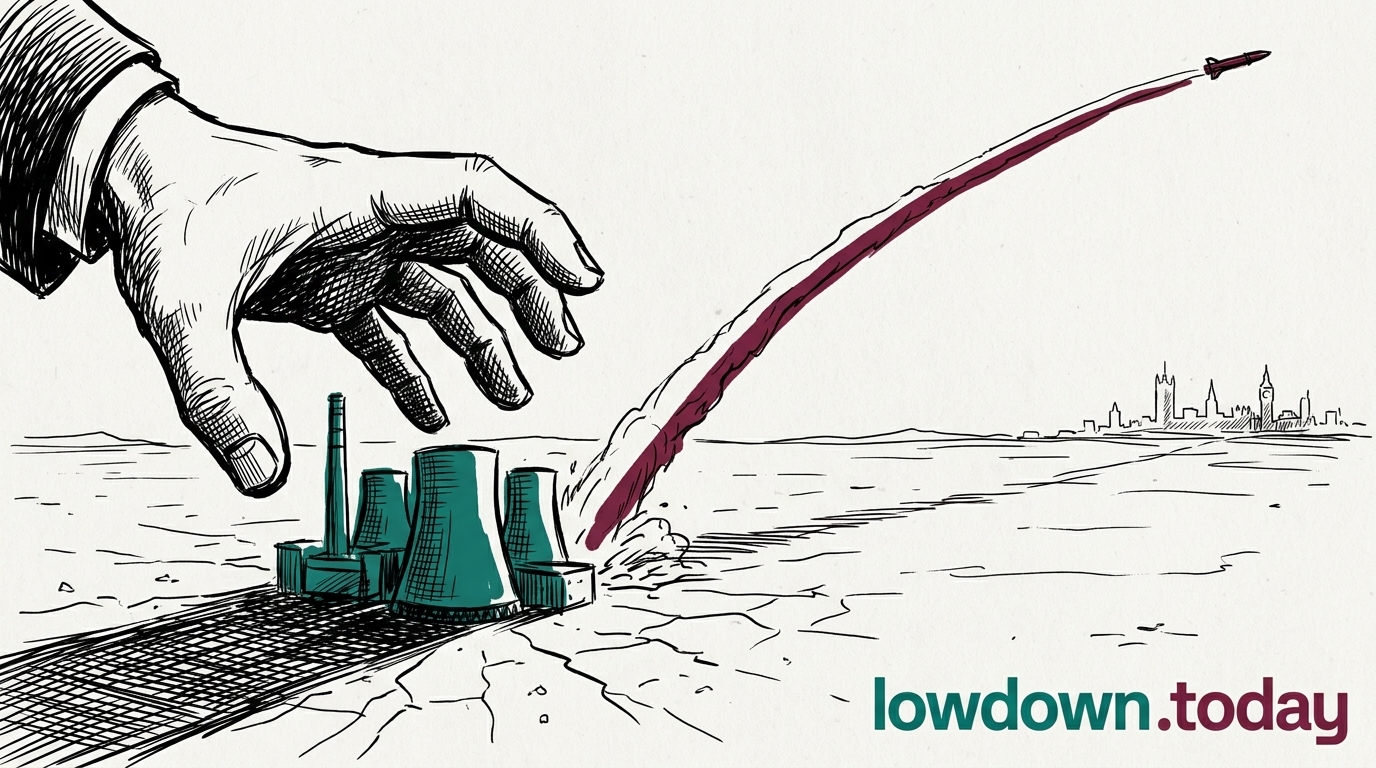
Ballistic missiles struck Dimona — home to Israel's nuclear reactor — wounding 40 people including a 12-year-old boy. The IAEA confirmed no radiation release, but Israeli air defences failed to intercept for the second time this war.

ConflictDeveloping
Key takeaway

Dimona has been struck for the first time, ending 45 years of the Begin Doctrine's assumed asymmetry.

Iranian ballistic missiles struck Dimona on Friday, wounding 40 people, including a 12-year-old boy 1. Dimona houses the Shimon Peres Negev Nuclear Research CentreIsrael's undeclared but widely acknowledged nuclear weapons production facility, operational since the early 1960s. The IAEA confirmed no damage to the reactor and no abnormal radiation levels.

The interceptors failed here as well. Israeli firefighters stated that defensive missiles were launched in both Dimona and Arad but did not hit their targets, producing direct impacts by warheads weighing hundreds of kilograms 2. The facility has faced threats before — Iraq fired Scud missiles toward The Negev during the 1991 Gulf War, and Iran's April 2024 barrage sent interceptor debris into the region — but neither produced confirmed warhead impacts inside the city.

Both sides are now striking in the immediate vicinity of the other's nuclear infrastructure. The United States has hit Natanz twice since 28 February. The IDF struck Malek Ashtar University of Technology — a sanctioned nuclear research institution — in Tehran. The IAEA disclosed an additional underground enrichment facility at Isfahan that inspectors cannot access . Iran, in turn, landed warheads in the city that houses Israel's reactor. IAEA Director General Rafael Grossi warned days earlier that military action cannot eliminate Iran's nuclear programme and that the agency "cannot rule out a possible radiological release with serious consequences" . Netanyahu's claim that Iran's enrichment capacity has been destroyed sits alongside the IAEA's estimate that Iran holds roughly 440 kg of 60%-enriched uranium — enough for approximately 10 weapons if further enriched. Airstrikes have not altered that stockpile. Friday's missiles did not damage Dimona's reactor. The margin between those two facts — stockpile intact, reactor intact — is where the escalation now rests.

Deep Analysis

In plain English

The Shimon Peres Negev Nuclear Research Centre at Dimona is Israel's most sensitive military installation — widely understood to be where Israel maintains its undeclared nuclear arsenal, which it has never officially confirmed possessing. The facility has existed for over 60 years without ever being successfully struck by an adversary. Friday's strike changes that permanently. Even though the reactor was undamaged and the IAEA confirmed no radiation release, the strategic fact is now established: Iran can reach Dimona with ballistic missiles that Israeli defences failed to intercept. Israel's nuclear deterrence has historically depended on the physical inaccessibility of Dimona as much as on deliberate ambiguity about what it contains. Both dimensions have now been challenged in a single strike.

Deep Analysis
Synthesis

The IAEA's no-radiation confirmation is analytically important for immediate safety but strategically secondary. The primary effect is the permanent public falsification of Dimona's untouchable status. Israel cannot publicly characterise the strike in nuclear terms without acknowledging capabilities it has never confirmed, creating a strategic communications bind precisely when domestic public reassurance is most needed. The amimut policy, designed to provide strategic ambiguity, now prevents Israel from explaining to its own population why the most sensitive site in the country was just struck without interception.

Root Causes

Israel's amimut (nuclear opacity) policy has rested on the dual assumption that Dimona's location is known but its contents are officially unconfirmed, and that its air defence envelope makes it effectively unreachable. Iran has spent decades developing ballistic missile capability specifically calibrated to defeat layered Israeli air defences. Friday's penetration is not a sudden capability acquisition — it is the operational dividend of a long-term Iranian investment programme.

Escalation

Striking Dimona signals Iran's willingness to threaten Israel's nuclear deterrent architecture directly, even without intent or current capability to destroy it. This is likely to accelerate Israeli pressure on Washington for authorisation to strike Iranian ballistic missile production and launch infrastructure — a qualitative escalation from targeting what Iran has built to targeting its capacity to build further.

What could happen next?
  • Precedent

    Dimona has been successfully struck for the first time in its 60-year history, ending the physical assumption underpinning the Begin Doctrine's strategic asymmetry.

    Immediate · Reported
  • Risk

    A future strike achieving reactor damage could cause radiological contamination across the eastern Mediterranean — the IAEA clearance applies only to this specific event, not to escalated follow-on strikes.

    Medium term · Suggested
  • Consequence

    Israel will face intense pressure to request US THAAD batteries for the Negev, formally anchoring American military assets to the defence of Israeli nuclear infrastructure.

    Short term · Assessed
  • Meaning

    The Begin Doctrine's core asymmetry — Israel strikes adversary nuclear sites, adversaries cannot credibly retaliate in kind — has been publicly falsified for the first time since 1981.

    Long term · Assessed
First Reported In

Update #44 · Trump: 48 hours to destroy Iran power grid

Haaretz· 22 Mar 2026
Read original
Different Perspectives
Gulf shipping and insurance markets
With Hormuz and Bab el-Mandeb both hostile at once, war-risk underwriters face their first dual-chokepoint pricing problem; the rerouting hedge that absorbed one closure is gone for Israeli-linked hulls. Any deal that reopens Hormuz without a Houthi stand-down clause delivers only partial shipping relief.
Russia and China
Russia and China
Russia and China met IAEA chief Grossi jointly in Geneva on 5 June to coordinate an advance blocking position against Washington's censure resolution, the first documented instance of proactive pre-session obstruction rather than reactive post-vote dissent. Beijing's move came four days after OFAC designated Shanghai Qianye Energy under Iran energy sanctions.
Saudi Arabia
Saudi Arabia
Saudi Arabia was left out of the emergency $4.01 billion Patriot waiver Qatar received on 2 May as its own PAC-3 stocks ran near-empty from intercepting Iranian salvoes over Aramco facilities. Riyadh is on a standard 18-month FMS queue behind a production line booked through 2030, with no equivalent priority to Qatar's Al Udeid basing role.
Houthis (Ansar Allah)
The Houthis declared a complete ban on Israeli Red Sea navigation on 8 June and struck Jaffa, their first attack on Israeli territory since April, seven days after the Tasnim authorisation to activate other fronts including Bab el-Mandeb. The declaration put both chokepoints under hostile authority simultaneously.
Iran
Iran
Iran agreed the 9 June mutual halt after the Mahshahr exchange and coordinated with Russia and China to block Washington's IAEA censure resolution, using the Board as a second front while the bilateral pause held on the military one. Tehran's acceptance of the Lebanon carve-out contradicts the linkage position it stated on 1 June.
Benjamin Netanyahu and the IDF
Israel struck the Karun Petrochemical plant at Mahshahr on 8 June over Trump's explicit objection, then agreed a halt with Iran the following day scoped on Israeli terms with Lebanon carved out. Netanyahu's posture is that the IDF will not accept Iranian missile factories as off-limits regardless of US diplomatic timelines.