
Skip to content
Briefings are running a touch slower this week while we rebuild the foundations.See roadmap
Iran Conflict 2026
23MAR

Day 24: Ultimatum expires; Iran tolls Hormuz at $2m

6 min read
05:40UTC

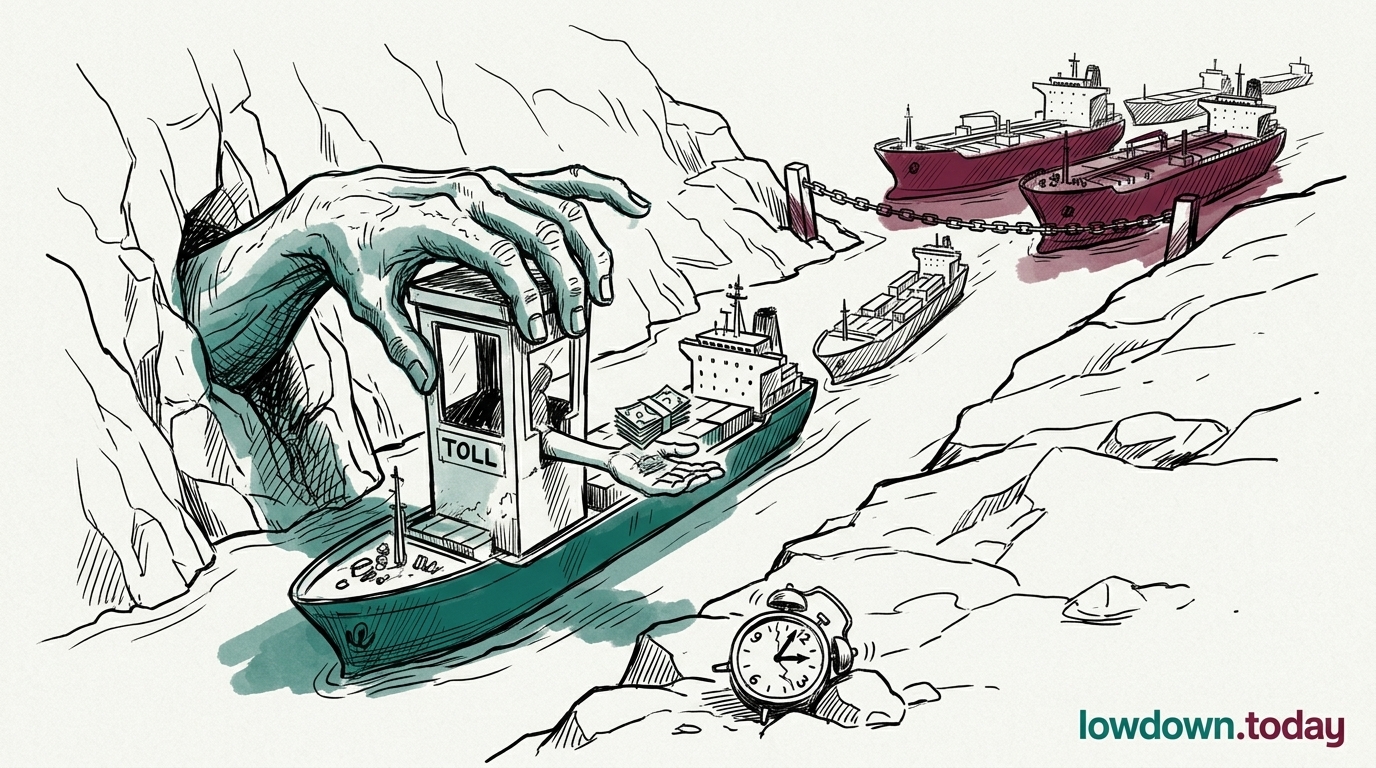
Trump's 48-hour threat to destroy Iran's power grid expires tonight with no sign of compliance. The IRGC has converted its Hormuz blockade into a toll system charging up to $2 million per vessel, selectively granting passage to non-aligned nations, while Iranian missiles struck Dimona and Arad after Israeli air defences failed to intercept — wounding 163 people near Israel's nuclear facility.

Key takeaway

Military escalation toward infrastructure warfare between civilian populations is accelerating while the political, fiscal and legal coalitions required to sustain it are fragmenting in Washington, London and across the US-led alliance.

This briefing mapped
Loading map…
Military
Diplomatic
Legal
Domestic
Economic

India, China, Pakistan, Iraq and Malaysia are negotiating bilateral transit deals with Tehran, splitting global shipping into those who pay Iran and those who cannot pass.

Sources profile:This story draws on centre-left-leaning sources from United States
United States

India, Pakistan, Iraq, Malaysia and China are in direct negotiations with Tehran for bilateral transit arrangements through the strait of Hormuz, following Japan's grant of passage on 21 March. The talks create a two-tier shipping system splitting nations into US-aligned (de facto embargoed) and non-aligned (paying Iran for access).

Iran's bilateral negotiating structure prevents collective bargaining among transit-seeking nations, giving Tehran maximum leverage over each counterpart individually — a feature absent from every previous Hormuz crisis since the 1980s Tanker War

Sources:Time
1 TIME2 Lloyd's List3 Anadolu Agency4 Lloyd's List
Briefing analysis

OAPEC's 1973 oil embargo divided nations into 'friendly,' 'neutral,' and 'hostile' categories — the same tripartite structure Iran is building through its Hormuz toll system. That embargo lasted five months, quadrupled oil prices and permanently restructured global energy politics: the International Energy Agency was created in response, strategic petroleum reserves were established, and OPEC's pricing power was entrenched for a decade.

Iran's approach is more sophisticated. The IRGC generates revenue from transit fees rather than simply denying supply, and bilateral negotiations with individual nations create dependencies that persist beyond any ceasefire. The 1973 embargo ended when political objectives were partially met; Iran's toll system could become a permanent feature of Gulf maritime commerce if no military force clears the strait.

Iran's parliament speaker promised permanent destruction of regional energy infrastructure if Iranian power plants are struck — a threat that reaches the desalination plants on which Gulf populations depend for drinking water.

Sources profile:This story draws on mixed-leaning sources from United States and Qatar
United StatesQatar
LeftRight

Iranian Parliament Speaker Mohammad Bagher Ghalibaf stated that regional energy and oil infrastructure 'will be irreversibly destroyed' if Iranian power plants are struck, escalating beyond the Khatam al-Anbiya command's earlier counter-threat which targeted energy, IT and desalination infrastructure of the US and allies.

Escalates Iran's deterrent posture from proportional retaliation to permanent destruction of Gulf energy and water infrastructure, raising the human stakes of Trump's power-grid ultimatum beyond Iran's borders to include Gulf civilian populations. 

1 Oxford Economics (via Axios)

Israel's prime minister publicly endorsed Trump's 48-hour ultimatum to destroy Iran's power grid, eliminating any remaining diplomatic distance between Washington and Jerusalem on the war's most escalatory threat.

Sources profile:This story draws on mixed-leaning sources from United States and Israel
United StatesIsrael
LeftRight

Prime Minister Benjamin Netanyahu publicly endorsed Trump's 48-hour power-grid ultimatum: 'I think President Trump knows exactly what he's doing. And whatever we do, we do together.' This confirms US-Israeli coordination on the most escalatory threat of the war.

Eliminates diplomatic separation between the US and Israel on the threat to destroy civilian power infrastructure serving approximately 88 million Iranians, and constrains both governments' ability to walk back the ultimatum independently. 

Sources:Fox News·Times of Israel
1 Lloyd's List2 TIME3 Lloyd's List4 The Washington Post5 The Jewish Chronicle6 YouGov (via Middle East Eye)7 Jerusalem Post8 CNN9 Hengaw10 Times of Israel

Iran's foreign minister told Japanese media the strait is blocked only for hostile nations — the first official articulation of a selective blockade doctrine designed to fracture the coalition arrayed against Tehran.

Sources profile:This story draws on centre-left-leaning sources from Qatar
Qatar

Iranian Foreign Minister Abbas Araghchi told Japan's Kyodo News that the strait of Hormuz is 'closed only to ships belonging to our enemies, countries that attack us. For other countries, ships can pass through the strait.' This is the first explicit articulation of a selective blockade policy distinguishing between hostile and non-hostile nations.

By drawing an explicit distinction between hostile and non-hostile nations, Iran converts a military closure into a diplomatic instrument that penalises Coalition membership and rewards strategic ambiguity. 

Sources:Al Jazeera
1 Lloyd's List2 TIME3 Lloyd's List4 The Washington Post5 The Jewish Chronicle6 YouGov (via Middle East Eye)7 Jerusalem Post8 CNN9 Hengaw10 Times of Israel

The destruction of the Qasmiyeh Bridge cuts the main road linking southern Lebanon to Beirut and the north, completing the isolation of a zone where two Israeli armoured divisions are operating.

Sources profile:This story draws on centre-left-leaning sources from Israel
Israel

Israeli forces struck the Qasmiyeh Bridge, severing southern Lebanon's main highway link north. This follows the destruction of Litani River bridges and further isolates the southern zone where two IDF armoured divisions are operating.

The strike completes a systematic campaign to sever southern Lebanon's transport links, trapping roughly a million residents and Hezbollah fighters south of the Litani River in a zone controlled by two IDF armoured divisions. Lebanese President Aoun called it a prelude to ground invasion. 

Sources:Times of Israel
1 Times of Israel (live blog)

Tehran has linked any future reopening of the Strait of Hormuz to the physical reconstruction of power plants Trump has threatened to destroy — a conditional closure that could last years if the ultimatum is carried out.

Sources profile:This story draws on mixed-leaning sources from United States and Qatar
United StatesQatar
LeftRight

Iran threatened to close the strait of Hormuz indefinitely and refuse to reopen it until any destroyed power plants are rebuilt, linking Hormuz reopening directly to the outcome of Trump's power-grid ultimatum.

Iran has converted the strait of Hormuz from a military bargaining chip into a structural hostage tied to the outcome of Trump's power-grid ultimatum. If the US strikes and Iran follows through, the world's most important oil chokepoint stays closed not until a ceasefire is reached, but until physical infrastructure is rebuilt — a timeline measured in years, not weeks. 

1 Lloyd's List2 Lloyd's List3 International Energy Agency

Goldman Sachs's top oil analyst places US recession probability at 25% as the Hormuz supply disruption holds crude 70% above pre-war levels and American households absorb $300 million a day in additional fuel costs.

Sources profile:This story draws on centre-left-leaning sources from United States
United States

Goldman Sachs head of oil research Daan Struyven raised US recession probability to 25%, driven by sustained oil price elevation from the Hormuz supply disruption.

Goldman Sachs's recession probability upgrade quantifies the domestic economic risk of the Hormuz disruption in institutional terms that drive investment decisions, fiscal policy, and consumer confidence across the US economy. 

Sources:Axios
1 Lloyd's List2 TIME3 Lloyd's List4 The Washington Post5 The Jewish Chronicle6 YouGov (via Middle East Eye)7 Jerusalem Post8 CNN9 Hengaw10 Times of Israel

Oil prices have nearly doubled since the war began, driven by the largest supply disruption the IEA has ever recorded. Strategic reserve releases bought days, not weeks.

Sources profile:This story draws on mixed-leaning sources from United States
United States

Brent Crude peaked at $126 per barrel this week — a new spot price high — before settling around $114. The price is approximately 70% above the pre-war level of $67.41.

Brent's new spot high of $126 — 70% above the pre-war $67.41 — reflects the physical reality that 8 million barrels per day have been removed from global supply with no restoration in sight. The price is NOW within striking distance of thresholds that multiple forecasters identify as recessionary. 

Sources:IEA·Bloomberg
1 International Energy Agency2 International Energy Agency3 Lloyd's List4 Lloyd's List5 Oxford Economics (via Axios)

Jeremy Corbyn's bill would require parliamentary approval before foreign nations launch strikes from British soil — a power the prime minister exercised without legal cover, against his own attorney general's advice.

Sources profile:This story draws on centre-left-leaning sources from United Kingdom
United Kingdom

Jeremy Corbyn tabled a bill in the UK Parliament requiring parliamentary approval before foreign nations can use British military bases for operations. The bill responds to the government's authorisation of RAF Fairford and Diego Garcia for US operations against Iran.

The bill targets a constitutional gap between executive authority over base access and parliamentary oversight of military action. With the attorney general's legal advice and 58% public opposition both undermining the government's position, a recorded vote would force Labour backbenchers to choose between party loyalty and their constituents. 

1 The Jewish Chronicle2 Chatham House3 YouGov (via Middle East Eye)

President Aoun called the Qasmiyeh Bridge strike 'a prelude to ground invasion' — a warning grounded in military logic as two Israeli armoured divisions operate in a southern Lebanon now cut off from the rest of the country.

Sources profile:This story draws on centre-left-leaning sources from Israel
Israel

Lebanese President Joseph Aoun called the Israeli strike on the Qasmiyeh Bridge 'a prelude to ground invasion,' after the strike severed southern Lebanon's main highway link north.

The destruction of southern Lebanon's last major highway link north completes the battlefield isolation begun with the Litani River crossings, and follows the pre-assault doctrine of severing logistics before advancing — with two IDF armoured divisions already in theatre and an operational timeline extending through late May. 

Sources:Times of Israel
1 Lloyd's List2 TIME3 Lloyd's List4 The Washington Post5 The Jewish Chronicle6 YouGov (via Middle East Eye)7 Jerusalem Post8 CNN9 Hengaw10 Times of Israel

The IDF struck Hezbollah's elite special operations leadership in Majdal Selm as two armoured divisions press deeper into southern Lebanon.

Sources profile:This story draws on mixed-leaning sources from Israel
Israel
LeftRight

The IDF killed Radwan Force commander Abu Khalil Barji in an airstrike on Majdal Selm in southern Lebanon. Radwan Force is Hezbollah's elite special operations unit.

The killing of a Radwan Force commander during an active ground operation signals Israel is combining territorial advance with decapitation strikes against Hezbollah's most capable tactical unit — the force responsible for cross-border tunnel operations, anti-armour ambushes, and the group's most complex military planning. 

Sources:Jerusalem Post·Times of Israel
1 Lloyd's List2 TIME3 Lloyd's List4 The Washington Post5 The Jewish Chronicle6 YouGov (via Middle East Eye)7 Jerusalem Post8 CNN9 Hengaw10 Times of Israel

Four senior figures killed in a single week have not slowed the IRGC's attack tempo or its commercial management of the Hormuz toll system — the organisation runs on institutional machinery, not individual leaders.

Sources profile:This story draws on centre-left-leaning sources from Qatar
Qatar

The IRGC announced the 70th wave of Operation True Promise 4 on Saturday, up from the 66th wave four days earlier . The organisation continues daily attack waves and manages the Hormuz toll system despite the loss of four senior figures in a single week.

The IRGC's ability to sustain daily multi-front operations while simultaneously running a complex maritime toll system — despite the rapid-fire elimination of four senior figures — demonstrates an institutional command structure that does not depend on centralised leadership. This has direct implications for the US-Israeli decapitation strategy and for how long Iran can maintain offensive operations. 

Sources:Al Jazeera
1 Lloyd's List2 Jerusalem Post

YouGov finds a three-to-one margin against US use of British bases — a problem for a prime minister who overrode his own attorney general's legal advice to grant it.

Sources profile:This story draws on centre-left-leaning sources from United Kingdom
United Kingdom

YouGov polling found 58% of Britons oppose US use of UK bases for strikes on Iran; 21% support it.

Public opinion at this margin constrains Starmer's ability to deepen UK involvement and strengthens the parliamentary Coalition seeking legislative checks on base access — at a moment when the US is actively using British facilities and Iran has demonstrated it can strike them. 

Sources:Middle East Eye
1 YouGov (via Middle East Eye)2 The Jewish Chronicle3 Chatham House

American petrol prices have climbed 30% since 28 February, costing households a collective $300 million per day more than before the war. California has passed $5 a gallon.

Sources profile:This story draws on centre-leaning sources from United States
United States
LeftRight

US petrol prices reached $3.88 per gallon nationally, up from $2.98 before the war. California exceeded $5 per gallon. American households collectively pay an additional $300 million per day at the pump compared to pre-war levels.

The domestic fuel price is the most direct transmission mechanism between the Hormuz crisis and American household finances. At $3.88 per gallon nationally and $300 million per day in additional costs, the war's economic weight is NOW distributed across every driver in the country — a political fact as consequential as the military one. 

Sources:Fortune
1 Oxford Economics (via Axios)2 International Energy Agency

Charter rates for crude tankers have quadrupled and war-risk premiums now exceed $6 million per voyage — costs that did not exist four weeks ago and cascade through every barrel reaching global markets.

Sources profile:This story draws on neutral-leaning sources from United Kingdom
United Kingdom

Charter rates for tankers quadrupled to $800,000 per day. War-risk premiums on very large crude carriers run between $3.6 million and $6 million per voyage.

Charter rate and insurance increases of this magnitude function as an economic blockade layered on top of the physical one: even where transit is possible, the cost of moving oil has become a separate constraint on global supply, accelerating the path toward the $140-per-barrel recession threshold Oxford Economics identified. 

Sources:Lloyd's List
1 Lloyd's List2 Lloyd's List3 Oxford Economics (via Axios)

Oxford Economics has placed the global recession trigger at $140 a barrel. Brent peaked at $126 this week. The gap is narrowing and no diplomatic resolution is in sight.

Oxford Economics assessed that Brent Crude at $140 per barrel triggers a mild global recession at negative 0.7% GDP growth.

Oxford Economics defined the oil price at which the Hormuz disruption produces a global recession. With Brent's weekly peak $14 below that threshold and multiple named analysts forecasting $140-plus, the margin between current conditions and worldwide contraction depends on a diplomatic resolution neither side is pursuing. 

Sources:Oxford Economics (via Axios)
1 Oxford Economics (via Axios)

Greens, independents, a new left-wing party, and Labour's own backbenchers are coalescing against Starmer's Iran policy — backed by 58% of the British public and the attorney general's own legal doubts.

Sources profile:This story draws on centre-left-leaning sources from United Kingdom
United Kingdom

A cross-party UK parliamentary Coalition is forming to oppose British involvement in Iran operations, comprising the Green Party, the new left-wing 'Your Party,' independent MPs, and Labour backbenchers.

The Coalition draws from parties with no shared domestic platform, which indicates the war opposition has broader political roots than any single party's ideology. Labour backbench rebellions on Middle Eastern military action — Iraq in 2003, Syria in 2013 — have historically forced policy reversals or inflicted lasting damage on governing authority. 

1 Chatham House2 YouGov (via Middle East Eye)3 The Jewish Chronicle

IRGC controls Khamenei, sources say

Sources inside and outside Iran describe an inverted power structure: the IRGC installed Mojtaba Khamenei and controls his decisions, leaving wartime command in the hands of an institution that profits from the conflict's continuation.

Sources profile:This story draws on mixed-leaning sources from United States and Israel
United StatesIsrael
LeftRight

Jerusalem Post sources described the Iranian power arrangement: 'The Revolutionary Guards are controlling him, not the other way around.' A Middle East Institute senior fellow assessed that Mojtaba Khamenei 'owes his position to the Revolutionary Guards and is not going to be as supreme as his father.'

The assessment that the IRGC controls Iran's Supreme Leader — rather than the reverse — inverts the foundational power structure of the Islamic Republic and raises immediate questions about who holds authority to negotiate, escalate, or accept a ceasefire. 

Closing comments

Both sides have now explicitly conditioned strikes on civilian infrastructure — power plants, desalination, energy grids — creating a mutual hostage dynamic involving the basic survival systems of entire populations. The deadline structure of Trump's ultimatum forces a binary choice overnight: follow through and trigger Iran's counter-escalation against Gulf water and energy infrastructure, or let the threat lapse and lose coercive credibility. Iran's escalation pattern has been consistent throughout the war — each US-Israeli escalation produces a broader Iranian target set, from military bases to energy facilities to threats against European capitals. The 4,000 km Diego Garcia strike demonstrated range reaching Western Europe. No de-escalation mechanism, back-channel or mediating party is visible in the current diplomatic landscape.

Emerging patterns

  • Formation of parallel trade system bypassing US-aligned nations
  • Escalating mutual threats against civilian infrastructure
  • US-Israeli joint escalation posture against Iranian civilian infrastructure
  • Iranian selective engagement with non-aligned nations
  • Systematic destruction of Lebanese transport infrastructure
  • Escalating conditional threats tying energy infrastructure to maritime access
  • Economic damage approaching recession thresholds
  • Accelerating oil price spiral from supply disruption
  • Democratic resistance to executive war-making decisions on base access
  • Lebanese government framing Israeli operations as precursor to full invasion
Different Perspectives
India, Pakistan, Iraq, Malaysia and China
Five nations entered direct negotiations with Tehran for bilateral Hormuz transit rather than relying on the 22-nation coalition's demand that Iran reopen the strait unconditionally — choosing bilateral accommodation over multilateral confrontation.
Parliament Speaker Mohammad Bagher Ghalibaf
Escalated Iran's counter-threat beyond the Khatam al-Anbiya command's earlier statement, declaring regional energy infrastructure 'will be irreversibly destroyed' — the word 'irreversibly' goes beyond prior language of proportional retaliation.
Jeremy Corbyn
Jeremy Corbyn
Tabled a bill requiring parliamentary approval before foreign nations can use British military bases — a structural legislative mechanism rather than a protest vote, aimed at permanently constraining executive prerogative on base access.