Skip to content
You can now search across every topic, entity and event.What's new
Iran Conflict 2026
17JUN

Second US strike wave in 48 hours

2 min read
09:37UTC

CENTCOM struck about 90 Iranian targets on 8 July, cutting power across three southern ports; a day later the IRGC claimed strikes on 85 US-linked sites and, for the first time, Qatari soil.

ConflictDeveloping
Key takeaway

The war's kinetic track has outrun any signed text, leaving no ceasefire document left to enforce.

CENTCOM, US Central Command, struck Iran again on Wednesday 8 July, hitting roughly 90 military targets: missile and drone stores, logistics depots, a railway bridge in the north-east and a base at Bushehr, with partial power loss reported across the southern ports of Bandar Abbas, Konarak and Chabahar 1. That second wave dwarfs the 80-target strike CENTCOM ran days earlier , widening the campaign from military sites into the electricity that keeps three port cities running.

Iran answered on Thursday 9 July with a claimed joint IRGC Navy and Air Force operation against about 85 US-linked sites, naming Camp Arifjan and Ali Al Salem in Kuwait and Sheikh Isa and Juffair in Bahrain 2. For the first time the IRGC extended its target list to Qatari soil, claiming a strike on a satellite antenna. Iran had last hit US bases in Kuwait and Bahrain on 28 June , a salvo Washington answered then with a bounded raid on ten targets . This round outsizes both, and neither government signed an order to accompany it.

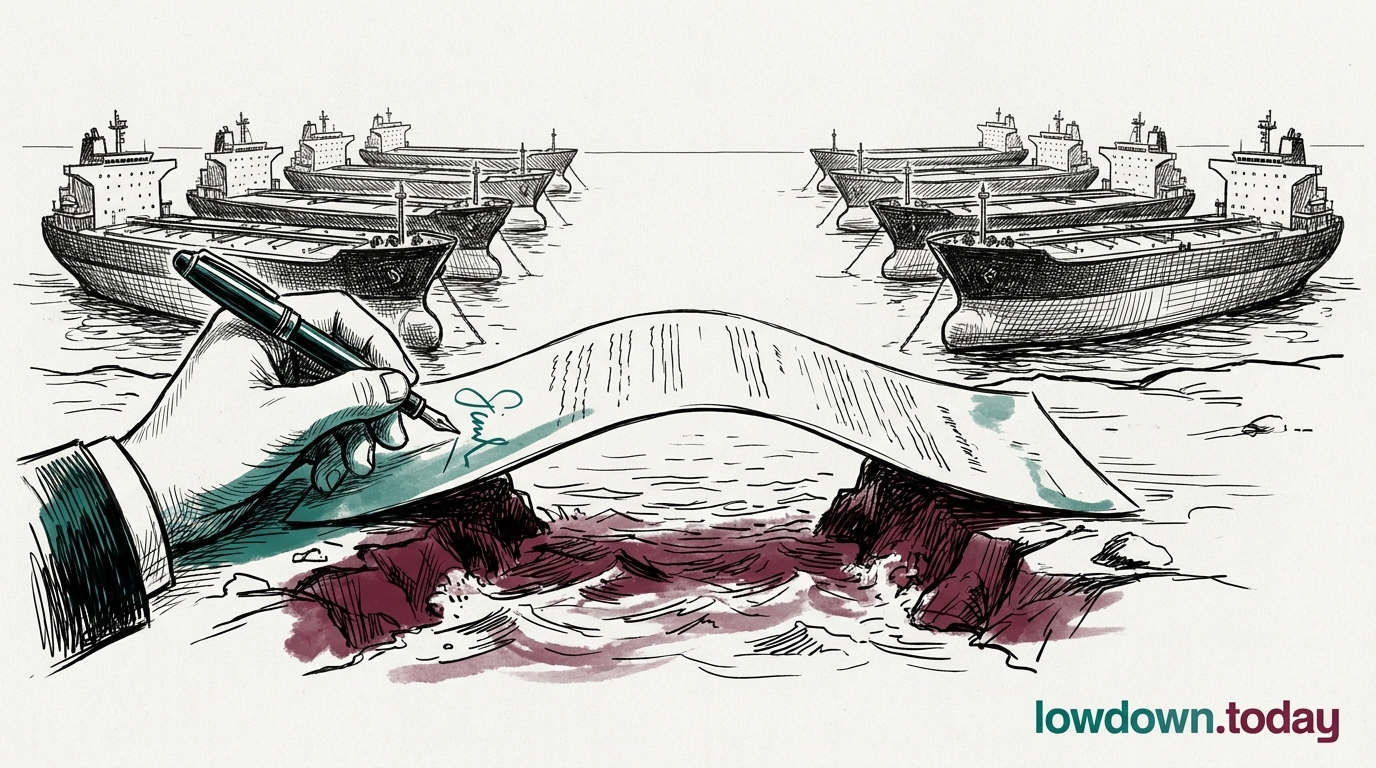
No executive order, sanction or fresh military authorisation accompanied either the strikes or the retaliation. The exchange runs on sorties and claims, not signed instruments, which leaves the Islamabad memorandum with no document to breach and none to restore.


Deep Analysis

In plain English

The United States and Iran have been trading strikes since February, and this is the latest exchange. On 8 July, US Central Command (CENTCOM) hit around 90 sites inside Iran, cutting power in three port cities. Iran's Revolutionary Guard, the country's most powerful military and political force, says it hit back at roughly 85 sites across the Gulf, including for the first time a target in Qatar, a country that has been trying to broker peace talks between the two sides. Nobody outside Iran has independently confirmed most of Iran's claimed hits.

Deep Analysis
Root Causes

The IRGC's Decentralised Mosaic Defence Doctrine, activated on 28 February and built around 31 autonomous provincial launch units, means retaliation claims like the 85-site tally cannot be centrally verified even by Tehran itself; the doctrine trades coordinated accuracy for survivability after the loss of its Navy and Ground Forces chiefs in March.

CENTCOM's own force posture, roughly 24 warships and 50,000 personnel concentrated in theatre since 30 June, sets a target-count asymmetry (90 struck versus 85 claimed) that pressures Iran toward matching numbers rather than matching effect, since it cannot match capability.

First Reported In

Update #150 · Second US strike wave, first heavy toll

CENTCOM· 9 Jul 2026
Read original
Different Perspectives
Lloyd's Market Association
War-risk underwriters price the Houthis' Red Sea attacks because the group announces its targets in advance, but the unclaimed Damietta drone gives insurers a hit with no author to price against. An attack nobody claims costs shipping more than one that is claimed, since premiums are set against a known pattern, not raw damage.
US Central Command
US Central Command
CENTCOM has announced no strike on Iran since resuming bombing on 30 July within hours of an IRGC salvo on Jordan, and centcom.mil did not respond to requests to confirm any pause. The command has gone quiet before while a larger operation was being weighed, so silence alone proves nothing about what it has or has not done.
Hengaw
Hengaw
Hengaw recorded at least 67 executions in Iran during July, of which the state acknowledged only eight, and reported the 1 August execution of protest detainee Arvin Kheirkhahan at Shahrud with no advance notice to his family. A family's first notice of a death sentence is now usually the instruction to collect a body.
Egypt
Egypt
Egypt's government asked media on 2 August to report the Damietta attack accurately, named no author, and said no findings will be published before its own investigation concludes. Cairo holds the debris and jurisdiction over an attack on its own soil, and naming a culprit now would pull it into a dispute it has avoided for five months.
Iran's Foreign Ministry
Araghchi called the Hormuz talks with Oman final-stage on 2 August, four days after his own deputy rejected Oman's lane proposal, and denied the Damietta drone strike as an Israeli false flag while two Iranian officials privately claimed it for Tehran. Iran's public position now contradicts itself on both files at once.
Bahrain and Kuwait
Bahrain and Kuwait
Bahraini and Kuwaiti aircraft flew their own strikes on Iranian depots in July with Emirati air cover behind them, and Ynetnews reports some Gulf capitals wanted the 2 August strike to proceed rather than stop. States that have already taken fire see a closing window on Iranian weakness, not a reason to pause.



