Skip to content
You can now search across every topic, entity and event.What's new
Iran Conflict 2026
17JUN

Day 110: Trump signed the war over; it kept going

3 min read
09:37UTC

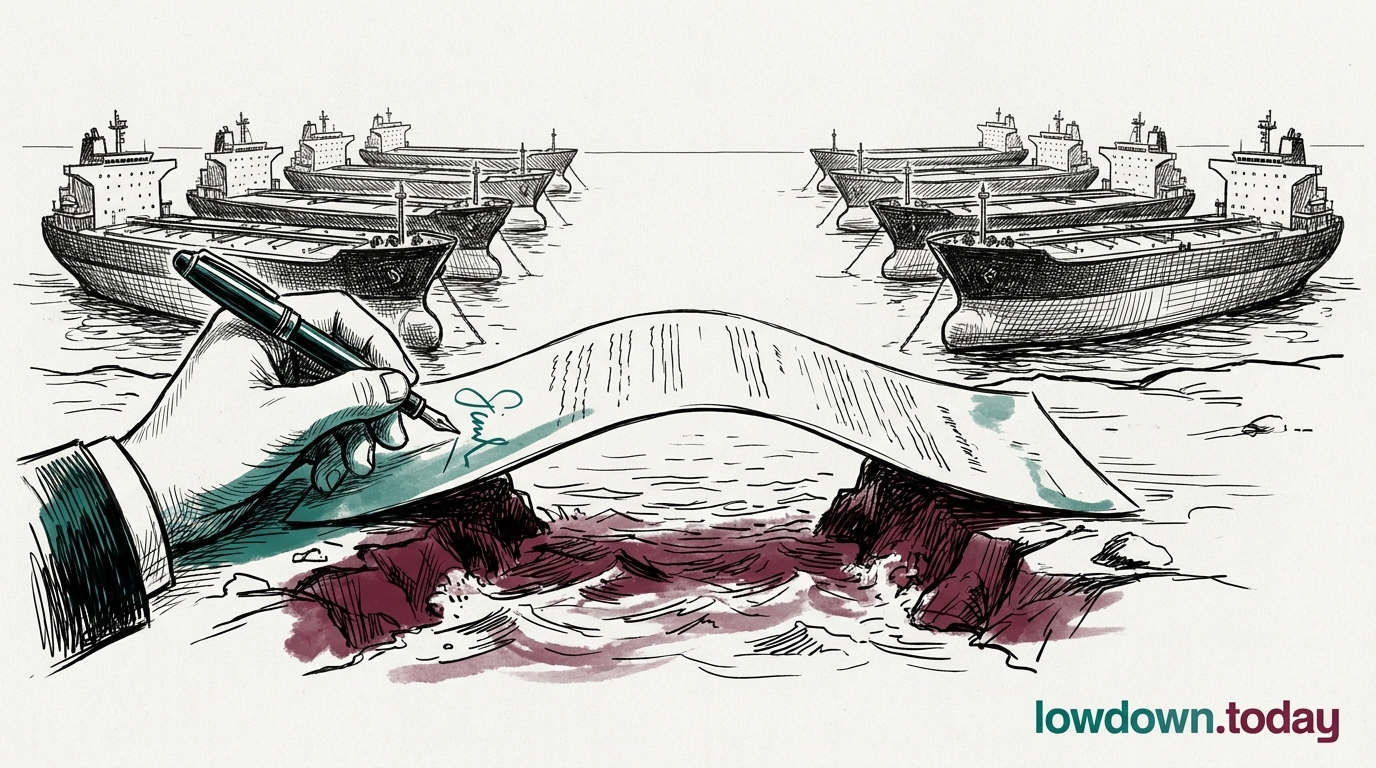
Trump electronically signed the Islamabad Memorandum on Tuesday and ordered the Hormuz blockade lifted, calling the strait completely open. By Wednesday the US military said the blockade stays active until Friday, no tankers had moved, and no executive order backed the signature. The text remains unpublished, and the CIA had warned him before he signed.

Key takeaway

Trump signed a ceasefire; the fleet, the mines, the insurers, and the CIA all say the war continues.

This briefing mapped
Diplomatic
Economic
Legal
Military
Domestic

Trump electronically signed the Islamabad Memorandum on Tuesday 16 June and ordered the Hormuz blockade lifted; by Wednesday CENTCOM said the blockade holds until Friday's ceremony.

Sources profile:This story draws on neutral-leaning sources

Trump electronically signed the Islamabad memorandum on 16 June and declared the strait of Hormuz completely open. US Central Command kept the naval blockade running, saying it would hold until the formal 19 June Geneva ceremony.

A presidential signature alone does not trigger a military stand-down: a formal execute order through the chain of command is required. Friday's ceremony is now the real test of whether the war ends on paper or on the water. 

Sources:Wikipedia

Zero new tankers crossed Hormuz in the 24 hours after Trump's signature; more than 500 ships stayed anchored as Bimco called a crossing very risky.

Sources profile:This story draws on mixed-leaning sources from United Kingdom and United States
United KingdomUnited States
LeftRight

More than 500 ships sat idle in the Gulf on 16 June, with zero new tankers entering Hormuz after Trump's signature. BIMCO, the world's largest shipowner association, said mines were still live and no Iranian military clearance had been issued.

Brent Crude fell to around $79-$81 on the deal news, but no ship was behind that price fall. London-based P&I insurance clubs have not lifted their war-risk exclusions, so ships cannot sail commercially regardless of any political declaration. 

Vance promised the memorandum text by Wednesday and never released it; US officials told CNN Iran's binding commitments are verbal side-deals, not in the signed document.

Sources profile:This story draws on centre-left-leaning sources from United States and Israel
United StatesIsrael

The Islamabad memorandum text was still unpublished on 17 June, a day after Vance promised it. Senate Majority Leader Thune formally demanded it; Republicans said they would not back the deal without reading it. US officials briefing American media said Iran's core commitments exist as verbal back-channel assurances, not in the written document.

Verbal commitments cannot be enforced by Congress, courts, or the nuclear watchdog. If either side disputes what was promised, there is no signed text to appeal to. 

CIA Director Ratcliffe briefed Trump with a pessimistic read on Iran's nuclear concessions before the signing; Trump signed anyway and the memorandum defers every nuclear question 60 days.

Sources profile:This story draws on centre-left-leaning sources from United States
United States

CIA Director John Ratcliffe briefed Trump before the signing with a pessimistic reading of Iran's willingness to concede on its nuclear programme. Trump signed the Islamabad memorandum anyway, deferring enrichment, stockpiles, and ballistic missiles to a 60-day talks window.

The International Atomic Energy Agency (IAEA) has had no inspector access for 97 days. The 60-day talks therefore open without any verified baseline. Ratcliffe's on-record warning means the US entered them expecting the nuclear question to remain unresolved. 

Sources:ABC News

The IRGC says Israel breached the Lebanon ceasefire 84 times in two days; Iran's military threatened retaliation while the US and Iran dispute whether the deal even covers Hezbollah.

Sources profile:This story draws on centre-left-leaning sources from United States and India
United StatesIndia

Iran's military claimed Israel violated the Lebanon ceasefire 84 times in two days. The Israel Defense Forces confirmed they were still firing at Hezbollah in southern Lebanon. Iran threatened retaliation if the offensive continued.

US Ambassador Mike Huckabee said Hezbollah is excluded from the Islamabad deal; Iran and Pakistan say all fronts are included. JD Vance made both claims within 24 hours. That contradiction hands Tehran a documented excuse to declare the deal broken before Friday's Geneva ceremony. 

At the G7 in France, Modi pressed Trump on three Indian seafarers killed by US Navy fire and on Hormuz trade damage; Trump offered no apology, investigation or relief.

Sources profile:This story draws on centre-left-leaning sources from United States
United States

At the G7 in France on 17 June, Indian Prime Minister Modi raised the killing of three Indian sailors by US Navy fire with Trump. He pressed the trade damage: 90 per cent of India's liquefied petroleum gas (LPG) and 55 per cent of its crude passed through Hormuz before the war.

Trump offered no apology, investigation, or compensation. The G7 ended without a joint communique. Modi came with a bill and left empty-handed. 

Lawmaker Nabavian called the memorandum a path to making Iran a US colony; around 60 MPs demanded Ghalibaf justify his signature, but analysts say the revolt has no blocking power.

Sources profile:This story draws on centre-right-leaning sources from United Kingdom
United Kingdom

Around 60 Iranian hardline MPs condemned the Islamabad memorandum on 16-17 June. Lawmaker Mahmoud Nabavian called it colonial capitulation. Analysts Alex Vatanka and Jason Brodsky both assessed the revolt had no blocking power.

In Iran's political system, the Supreme Leader's tacit approval, expressed through silence, means parliament cannot veto the deal. No Revolutionary Guards commander backed the hardliners publicly, leaving the protest without any military institution behind it. 

The Washington Post called the memorandum an informal referendum on Netanyahu's tenure; he was excluded from the diplomacy that ended the war and his cabinet now repudiates its terms.

Sources profile:This story draws on centre-left-leaning sources from Israel and Qatar
IsraelQatar

Israeli media framed the Islamabad memorandum as a referendum on Benjamin Netanyahu ahead of autumn elections. Haaretz called it his second worst fiasco after 7 October. Netanyahu was excluded from the entire mediation, which ran through Qatar, Pakistan, Saudi Arabia and Turkey.

His coalition partners Ben-Gvir and Smotrich said the deal does not bind Israel. Netanyahu promised Iran would never get nuclear weapons on his watch; the 60-day talks, not him, now control that question. 

Closing comments

Direction: pause. The 84-violation count the IRGC filed over 16-17 June 2026 in south Lebanon is the nearest tripwire: if Israel fires on Hezbollah before the 19 June Geneva ceremony and Araghchi formally invokes the MOU's violation clause, the ceremony collapses and CENTCOM's stand-down order, which had not been issued as of 17 June, has nothing to cancel. The nuclear risk is longer-dated: CIA Director Ratcliffe's pre-signing assessment warned Iran would not concede on enrichment, and a 97-day IAEA blackout means the 60-day talks open without a verified enrichment baseline.

AI-assisted, human-edited under the editorial responsibility of Bannermedia Ltd. Reviewed by Ed Woodcock on 17 June 2026. Editorial standards.

Different Perspectives
Trump White House and US Congress
Trump signed the Islamabad Memorandum on 16 June and declared Hormuz open; by 17 June CENTCOM's blockade was still running and the MOU text remained unpublished. Thune formally pressed Trump for the document; Schumer demanded a Gang of Eight briefing on the verbal commitments US officials said were outside the signed text.
Iranian civilian government and Majlis Speaker Ghalibaf
Ghalibaf signed for Iran and the civilian government publicly defended the negotiators; President Pezeshkian backed the deal against hardliner attacks. The civilian government is exposed: it owns the signature without the IRGC having committed to dissolving its Hormuz toll operation or the 84-violation Lebanon claim.
IRGC and Iranian hardliners
No named IRGC officer endorsed or opposed the MOU publicly; the corps held silence, the Persian Gulf Strait Authority toll operation continued, and around 60 Paydari Front MPs condemned the deal as colonial capitulation. The IRGC controls Hormuz revenue and has committed to nothing in writing.
Israel and Netanyahu government
Netanyahu was excluded from negotiations that ran through Qatar, Pakistan, Saudi Arabia and Turkey; Ben-Gvir and Smotrich repudiated the MOU on signing day; the IDF stayed in a 25-mile south Lebanon security zone while Hezbollah continued firing. Haaretz called it Netanyahu's second worst fiasco after 7 October.
India
India
Modi raised the killing of three Indian seafarers by US Navy fire at the G7 on 17 June, warning Trump of a trust deficit; Trump offered no apology or investigation. India's pre-war Hormuz dependency ran to 90 per cent of its LPG and 55 per cent of its crude, making it the largest non-belligerent economic casualty of the blockade.
Pakistan
Pakistan
Islamabad was the channel through which the MOU was brokered, with Interior Minister Mohsin Naqvi's dual civilian-military shuttle carrying messages between Tehran and Washington. Pakistan insists the MOU covers all fronts including Lebanon, a position that directly contradicts US Ambassador Huckabee's statement on the same day.