
Skip to content
Welcome, thoughtbot's Giant Robots listeners!Start here
Autonomous Systems: Land & Sea
7OCT

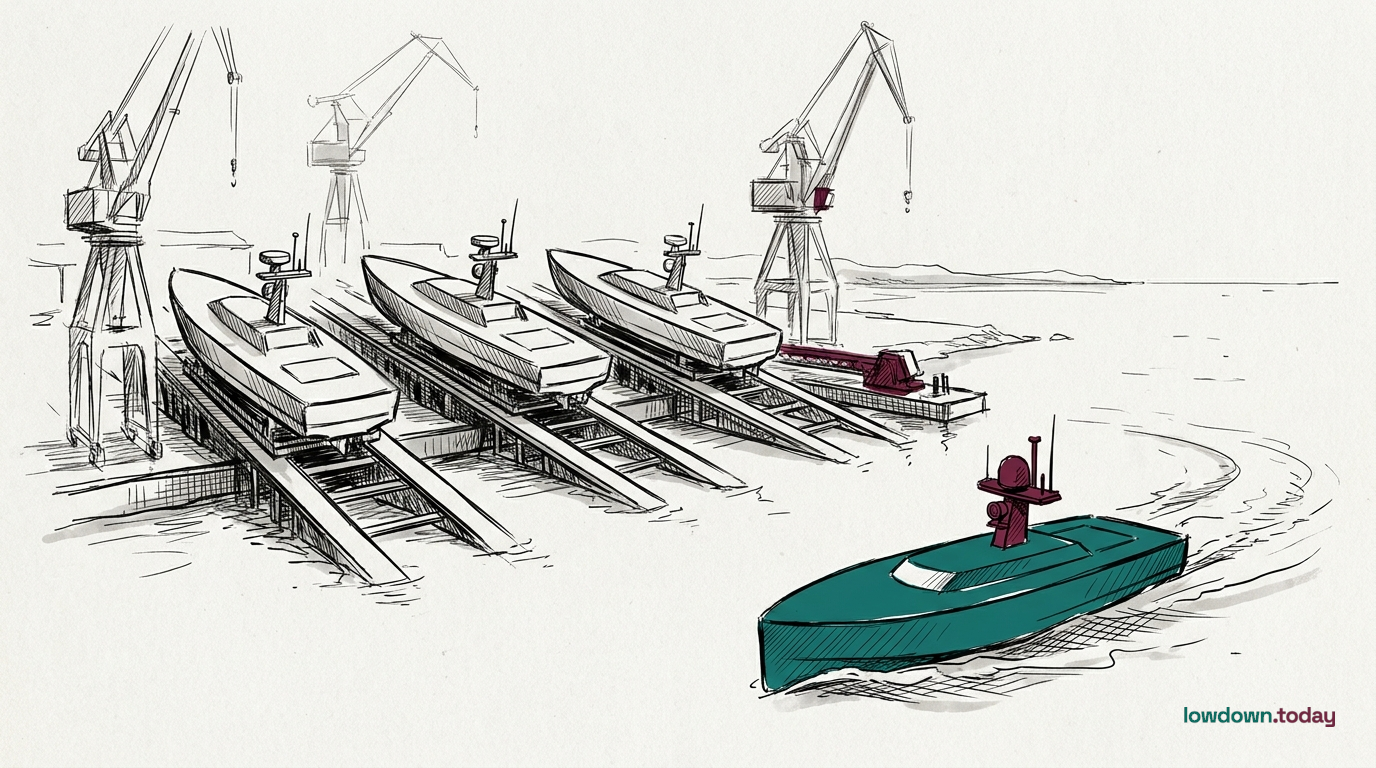
US Navy orders 30 robot boats from 3 yards

5 min read
12:59UTC

The US Navy ordered 30 medium uncrewed surface vessels from Galliano, HII and Saronic on 29 September. In the same weeks Turkey and Spain fired weapons from crewless hulls, and Stark and MBDA announced a planned missile fit. Taiwan signed its unmanned-vehicles law and ARX began delivering ground robots to Ukraine. Europe's public subsea notices told a smaller story: one vehicle at a time.

Key takeaway

Surface autonomy has reached batch orders and live weapons, while Europe's open subsea record still shows one vehicle at a time.

This briefing mapped
Military
Legal
Infrastructure
Competitive
Regulatory

The US Navy split its first production order for medium uncrewed surface vessels evenly between Galliano Marine Services, HII and Saronic Technologies, ten hulls each.

Sources profile:This story draws on mixed-leaning sources from United States
United States
LeftRight

The US Navy ordered 30 medium robot boats on 29 September. Galliano Marine Services, HII and Saronic Technologies will each build ten, with first deliveries due before the end of fiscal 2027.

Seven firms demonstrated at sea in May, and three won hulls to build. Bids were scored on autonomy, design, schedule and cost. The Navy's stated criteria did not mention weapons. 

A gun-armed Ukrainian Sargan-3000 robot boat destroyed a Russian one-way-attack boat in the Black Sea on 12 September, which UK Defence Intelligence says almost certainly marks the first direct clash between the two sides' USVs.

Sources profile:This story draws on neutral-leaning sources

President Lai Ching-te promulgated Taiwan's unmanned-vehicles Act on 11 September, releasing its budget clause at once and the rest of the law six months later.

Sources profile:This story draws on neutral-leaning sources

President Lai Ching-te signed Taiwan's unmanned-vehicles Act into law on 11 September. It sets NT$240bn over six years for drones and other unmanned systems, the same law the Legislative Yuan passed on 27 August.

Only the budget clause applies now. The rest starts around 11 March 2027. The NT$40bn a year baseline sits inside each year's defence budget, so lawmakers can still change it. 

Sources:Focus Taiwan

A one-way-attack boat from Turkish state arms maker MKE destroyed a surface target with a 100kg live warhead during the Turkish Navy's Denizkurdu-I/2026 exercise.

Sources profile:This story draws on neutral-leaning sources

An MKE explosive-carrying robot boat destroyed a surface target with a 100kg live warhead during the Denizkurdu-I exercise, which ran from 20 to 25 September. MKE says no earlier exercise in the series had a live-warhead strike.

A crew ran the boat from a console on a Tuzla-class patrol vessel, switching between remote and autonomous modes. Nobody has published what the boat may do when in autonomous mode. 

Stark Defence and MBDA plan to put four Sea Venom anti-ship missiles and ten Cascade loitering-munition cells on Stark's 12m robot boat, with integration at an early stage.

Sources profile:This story draws on neutral-leaning sources

Stark Defence of Germany and the missile maker MBDA said on 30 September that they plan to arm Stark's 12m robot boat. The design has four Sea Venom anti-ship missiles aft and ten Cascade loitering munitions forward.

The firms call the Sea Venom work early-stage, with autonomy testing at Nordic exercises through 2027. Nobody has fired a missile from this hull yet. 

Spanish firm Arquimea launched its Q-Slam 40 loitering munition from a Spanish Navy robot boat at NATO's REPMUS26 exercise, while Rheinmetall tested a port-defence command post.

Sources profile:This story draws on neutral-leaning sources

Iran's IRGC Navy said it had seized a US Navy Kingfish mine-hunting underwater vehicle in the Strait of Hormuz; US Central Command called the claim "clearly desperate".

Sources profile:This story draws on neutral-leaning sources

Belgium's defence ministry gave Exail Robotics Belgium €9.87m for three TRIDENT mine-disposal systems for Ukraine, the largest sum in a month of European subsea notices that otherwise bought single units.

Sources profile:This story draws on neutral-leaning sources from Netherlands
Netherlands

European public notices between 5 September and 7 October show buyers of underwater robots ordering one at a time. Poland's military university paid 952,383 zloty for one vehicle, and Tallinn University of Technology bought one very small robot submarine.

The biggest sum was Belgium's €9.87m direct award to Exail on 14 September for three mine-disposal systems bound for Ukraine. Nobody has said whether that matches an earlier Exail order. 

ARX Robotics and engine maker DEUTZ handed Ukraine the first GEREON ground robots built in Ulm, 12 weeks after production began, capping four weeks of expansion into Poland and Britain.

Sources profile:This story draws on neutral-leaning sources

ARX Robotics and the engine maker DEUTZ delivered the first GEREON ground robots to Ukraine on 29 September, 12 weeks after production began in Ulm. Four ARX announcements landed in four weeks, covering Poland, Britain and a partnership with Roboneers.

None of them states a quantity or a price. ARX has not published the size of its business. 

Sources:ARX Robotics

Naval News read satellite imagery of a hull at Shanghai's Hudong-Zhonghua yard as China's first mothership for extra-large uncrewed submarines; Beijing has said nothing.

Sources profile:This story draws on neutral-leaning sources from Netherlands
Netherlands

Naval News said on 15 September that a hull being built at the Hudong-Zhonghua yard in Shanghai is China's first mothership for extra-large uncrewed submarines. Satellite images show a stern well-deck and a forward hangar.

The outlet judges the hangar could hold four of the largest vehicles and calls its reading "by far the most plausible". Chinese authorities have said nothing. 

Sources:Naval News

Norwegian classification society DNV and German yard Fassmer agreed at SMM in Hamburg to work towards approval in principle for autonomous and remotely operated naval vessels.

Sources profile:This story draws on neutral-leaning sources

DNV, the Norwegian ship-classification society, and the German yard Fassmer signed a memorandum at the Hamburg shipbuilding fair, announced on 10 September. They aim to agree an approval in principle for autonomous and remotely operated naval and government vessels.

DNV's Rasmus Stute said autonomy is "becoming one of the key pillars in defence". The work uses DNV's rules for Autonomous and Remotely Operated Ships, in force since January 2025. 

Sources:DNV
1 DNV2 DNV

Kraken Technology Group took an 8.4m robot boat carrying a Saab UK Giraffe 1X radar to sea on 5 and 6 October, as an unarmed early-warning picket against aircraft and drones.

Sources profile:This story draws on neutral-leaning sources from Netherlands
Netherlands

Kraken Technology Group sea-trialled an 8.4m robot boat on 5 and 6 October, fitted with a Saab UK Giraffe 1X radar. Kraken built it to sit offshore and warn of aircraft and drones.

Kraken says it took under seven months from concept to prototype. It carries no weapons. The firm announced a joint mission with Shield AI in Portsmouth on 28 September. 

Birdon began building a medium uncrewed surface vessel at C&C Marine in Louisiana on 24 September, five days before the US Navy named three other yards for production.

Sources profile:This story draws on neutral-leaning sources

Birdon started building a medium robot boat at C&C Marine in Belle Chasse, Louisiana, on 24 September. Mythos AI supplies the steering software, and the yard plans one hull every two months.

Birdon was not among the three firms the US Navy picked five days later. It has not said who ordered the boat or how many more it will build. 

Hanwha Aerospace has bought two THeMIS ground robots from Estonia's Milrem Robotics and will bid with it in Australia, New Zealand and Romania, a month after Korea ordered its own robot into production.

Sources profile:This story draws on neutral-leaning sources

Hanwha Aerospace has bought two THeMIS ground robots from Milrem Robotics, the Estonian firm, Milrem said on 7 October. One goes to Korean research, the other to Hanwha's Australian operation.

The two will also bid together for Romania's ground-robot programme. Hanwha already holds a mass-production contract with Korea's procurement agency for its own robot, the Arion-SMET, signed on 4 September. 

The Indian Register of Shipping certified Accurate Industrial Controls' ISACA collision-avoidance software after 2,500 hours of trials; the firm plans to use it in six Indian Navy robot-boat conversions.

Sources profile:This story draws on neutral-leaning sources

Japan's Onomichi Dockyard will manufacture Bulwark Dynamics' Caravel autonomous landing craft for US and allied forces, though the first prototype is still being built.

Sources profile:This story draws on neutral-leaning sources from Netherlands
Netherlands

Onomichi Dockyard, a Japanese yard, will build the Caravel-35 and the smaller Caravel-15 for Bulwark Dynamics, Naval News reported on 21 September. The Caravel-35 is a 35ft landing craft with a bow ramp that steers itself.

Bulwark is still building its first 35ft prototype, so no production craft exists. It talks of several dozen units a year for US and allied forces. 

Sources:Naval News
Closing comments

Direction: up. The mechanism is the Stark and MBDA integration of four Sea Venom missiles, which the firms put at an early stage with Nordic testing through 2027, plus the US Navy's decision on a second tranche after the 30-hull award of 29 September 2026. Both would move armed crewless hulls from demonstration to inventory. A second Black Sea engagement after the 12 September clash would make sea-drone combat routine.

Different Perspectives
US Navy
US Navy
Moved from trials to production on 29 September, buying 30 medium uncrewed vessels from three yards after scoring autonomy, design, schedule and cost. First deliveries are due before the end of fiscal 2027.
Taiwan government (President Lai Ching-te)
Promulgated the unmanned-vehicles Act on 11 September, committing NT$240bn over six years. Only the budget clause applies at once; the rest starts around 11 March 2027.
MKE (Turkey)
MKE (Turkey)
Destroyed a surface target with a 100kg live warhead from a one-way-attack robot boat at Denizkurdu-I/2026, and says it was the first live-warhead strike in that exercise series. Operators switched between remote and autonomous modes.
Stark Defence (Germany)
With MBDA, plans four Sea Venom missiles and ten Cascade loitering munitions on its 12m boat. The firms call the missile integration early-stage, with Nordic autonomy testing through 2027.
Hanwha Aerospace
Hanwha Aerospace
Bought two Milrem THeMIS robots, one for Korean research and one for its Australian operation, and will bid with Milrem for Romania's ground-robot programme. It signed a mass-production contract for Arion-SMET on 4 September, with deliveries from 2027.
