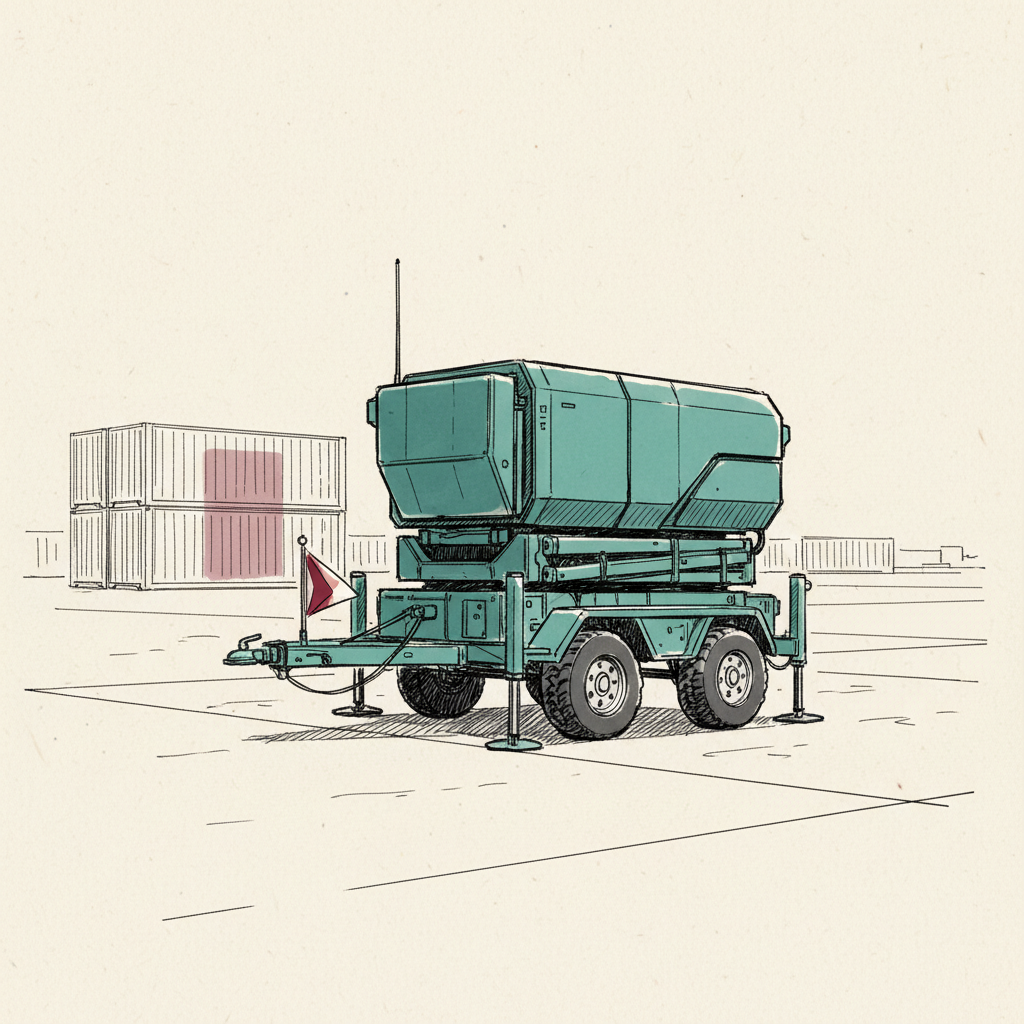
Giraffe 1X
Saab's compact 3D surveillance radar used as the detection component in the GUTE II counter-drone system.
Sweden's 2.6 billion kronor GUTE II award to Saab, made on 2 April 2026, puts the Giraffe 1X at the front of a mobile counter-drone system due from 2027. In October the radar also went to SEA on an 8.4m uncrewed boat.
Last refreshed: 7 October 2026 · Appears in 2 active topics
Timeline for Giraffe 1X
Provided the boat's air and drone early warning
Autonomous Systems: Land & Sea: Kraken trials a Saab radar picket boatMentioned in: Denmark orders €13.3m in drone shotguns
Drones: Industry & DefenceSweden awards Saab 2.6B Swedish kronor C-UAS deal
Drones: Industry & DefenceBackground
The Giraffe 1X is Saab's compact 3D surveillance radar for short-range air defence and counter-drone work. It detects and tracks aerial threats and passes that picture to other parts of a system, which do the shooting or jamming.
Its main home is GUTE II, Sweden's mobile counter-drone system, where it pairs with Trackfire cannon stations and electronic warfare effectors. Its small size lets it go to SEA on light hulls. On 5 and 6 October 2026 Kraken Technology Group, a British builder of fast robot boats, took an 8.4m hull carrying a Giraffe 1X from Saab UK out for SEA trials, as an unarmed picket watching for aircraft and drones. Kraken says it went from concept to prototype in under seven months.
The two uses show the same idea at different scales. On land, the radar finds targets for a counter-drone battery. At SEA, it lets a cheap uncrewed hull give a fleet Early Warning, so a picket that is found and sunk costs a boat rather than a CREW.
Sweden's drone shield starts with this radar
Sweden's Defence Materiel Administration awarded Saab a 2.6 billion Swedish kronor contract (about €230m) on 2 April 2026 for GUTE II, a mobile counter-drone system. The Giraffe 1X finds and tracks the drone, then hands the target to Trackfire remote weapon stations with 30mm cannon and to electronic warfare effectors.
Deliveries begin in 2027, inside a wider programme worth 8.7 billion kronor. Sweden wants the system to guard civilian sites such as power plants and railways as well as military units. That brief followed stray drones reaching Baltic infrastructure in spring 2026, so the radar's job is to SPOT small, slow, low targets near things that matter.
What is the Giraffe 1X radar used for?
Which NATO countries use the Giraffe 1X radar?
How far away can the Giraffe 1X radar detect a drone?






