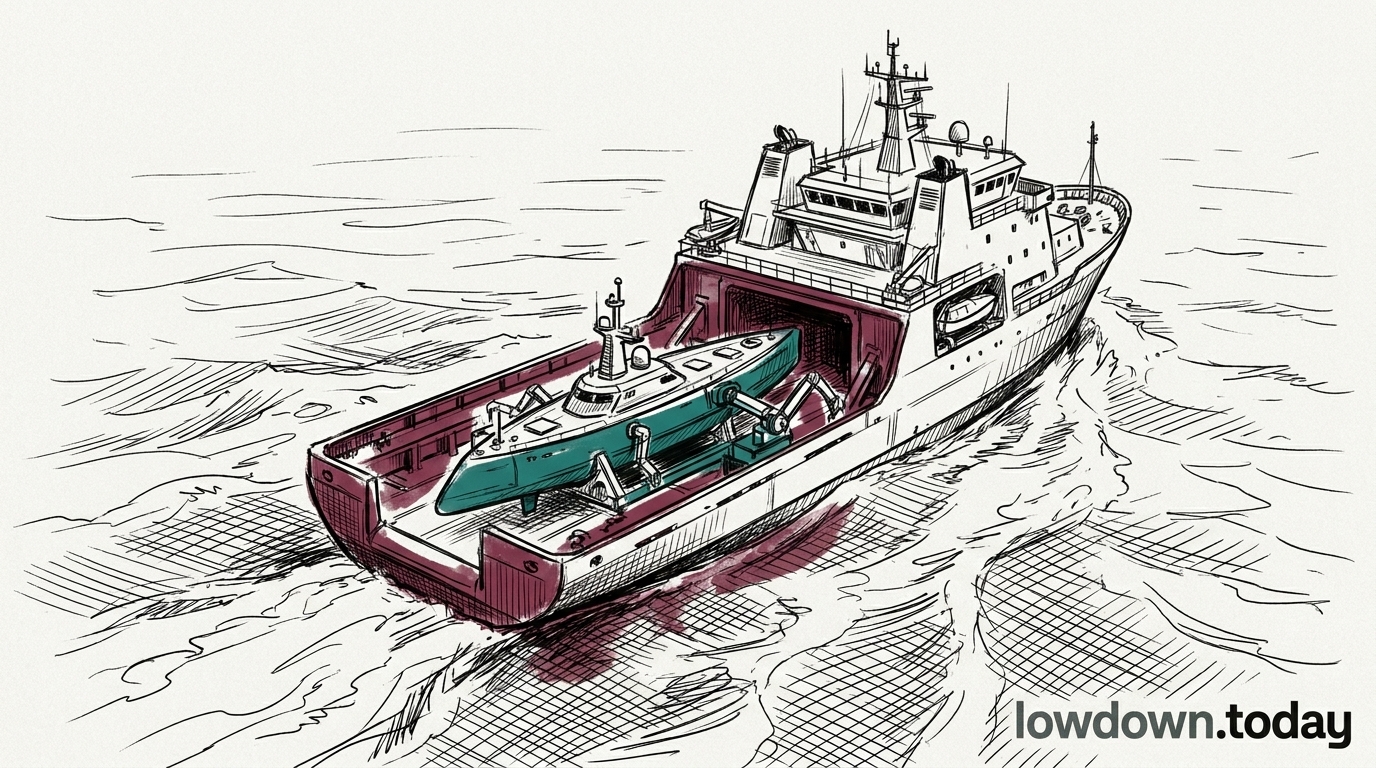
RFA Lyme Bay arrived in the Middle East on 23 June 2026 with the full allied autonomous mine-countermeasures (MCM) suite embarked, the Royal Navy confirmed1. A Royal Fleet Auxiliary Bay-class ship, Lyme Bay works as a mothership: its well-dock launches and recovers the small uncrewed boats that do the mine-hunting. In that dock sit the Royal Navy's autonomous minehunter RNMB Ariadne and the French Navy's Sirius uncrewed surface vessel (USV), the two halves of the Anglo-French programme that first trained together off Toulon at the start of the month. More than 270 personnel are aboard, over 100 of them Royal Navy mine-warfare specialists and French sailors. The ship sailed in company with the German vessels FGS Mosel and FGS Fulda, escorted by the Type 45 destroyer HMS Dragon2.
This is the package's destination, not its first outing. Ariadne sailed toward the Strait of Hormuz in late May; the fortnight's development is its arrival in theatre with a German escort alongside. No mine-clearance operation has begun, and the strait still runs at a fraction of its pre-war traffic while uncleared mines remain in the channel.
A crewless minehunter sends a robot, not a crewed hull, over suspected ordnance, removing the sailors from the most dangerous part of the job. That is the operational case, but the deployment also serves as procurement evidence. For European mine-warfare exporters, a reference deployment in a live mined strait answers the one question a trade-show stand cannot: whether the autonomy holds up where the mines are real. Thales's TSAM sonar and the Ariadne-Sirius pairing get that test here, against the US-built alternatives allied buyers are weighing elsewhere.


