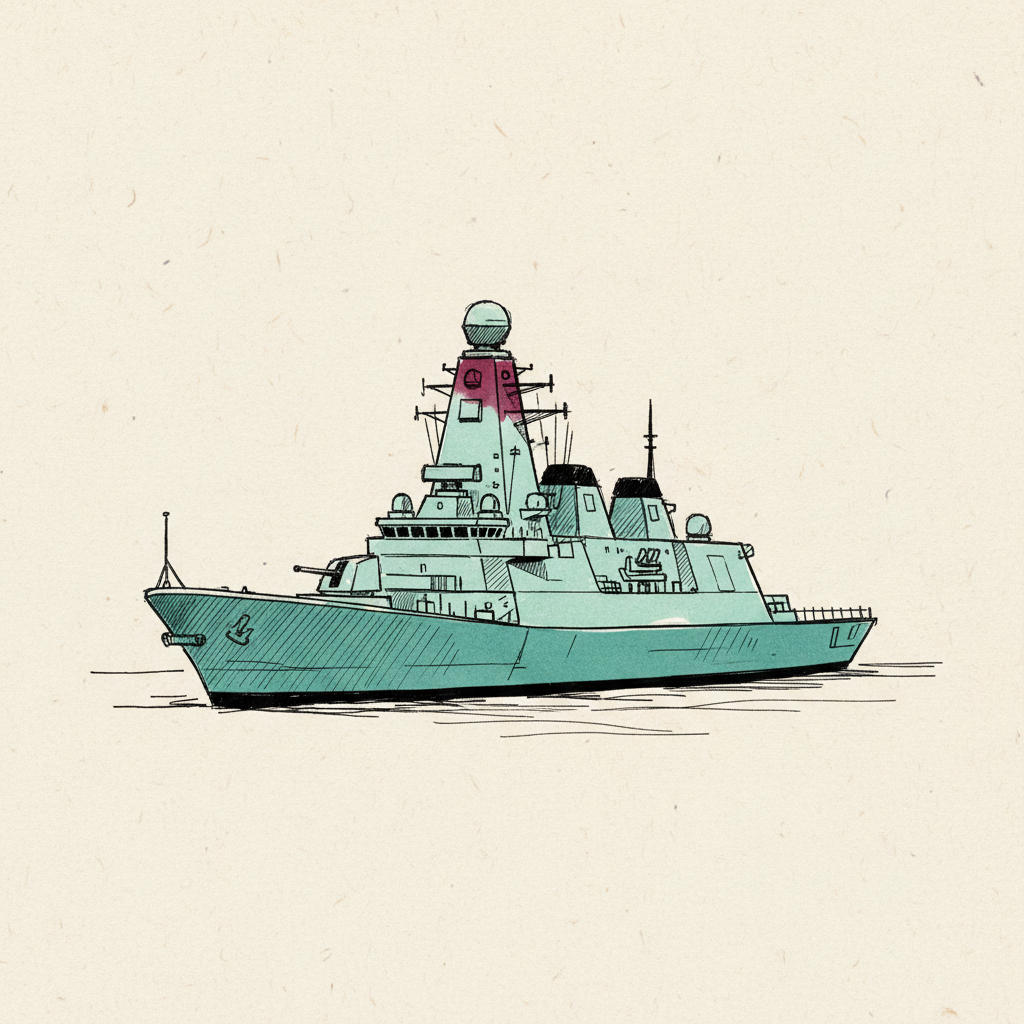
Type 45
Royal Navy's six-ship air-defence destroyer class; one deployed to Gulf amid Hormuz crisis.
Last refreshed: 18 July 2026 · Appears in 1 active topic
Can the Type 45's propulsion hold up in the Arabian Gulf's heat for a sustained mission?
Timeline for Type 45
Mentioned in: Navy retires HMS Chiddingfold at 42
Autonomous Systems: Land & SeaCommon Combat Vessel buries the Type 83 destroyer
Autonomous Systems: Land & SeaAllied robot minehunters reach the Gulf
Autonomous Systems: Land & SeaMentioned in: France pledges 80 per cent frigate readiness
Iran Conflict 2026Mentioned in: UK names Typhoons, HMS Dragon for Hormuz
Iran Conflict 2026Background
The six Type 45 destroyers (D32 HMS Daring through D37 HMS Duncan) were built by BAE Systems at yards in Govan and Portsmouth between 2006 and 2013. Displacement is approximately 8,000 tonnes full load, making them the largest surface combatants the Royal Navy operates outside carriers. Each ship carries 48 Sea Viper cells capable of engaging multiple simultaneous targets at ranges up to 120 kilometres. The Sampson radar is a dual-face active phased array capable of tracking over 1,000 targets simultaneously, a figure no legacy naval radar in Royal Navy service could approach. Ship's company is approximately 190, with space for a helicopter and a detachment of Royal Marines.
The class has faced sustained criticism over the reliability of its WR-21 intercooled recuperated gas turbines, which have required modification. In hotter-water operating environments such as The Persian Gulf, thermal management of the propulsion system has been a documented limitation. The Royal Navy's decision to deploy a Type 45 to The Gulf despite this known constraint signals that the air-defence requirement was judged to outweigh the propulsion risk, a choice that will be scrutinised if the ship's availability is reduced by the operating environment.
The Type 45 class is the Royal Navy's primary area air-defence platform, and in May 2026 one of its six hulls, HMS Dragon, was reported deployed to the Arabian Gulf in direct response to the Hormuz escalation. The deployment reflected the class's specific capability match: Type 45s were designed around the Sea Viper missile system and the Sampson AESA radar to counter saturation missile attacks, the precise threat Iran's deterrence doctrine relies on. No other ship class in the Royal Navy carries equivalent long-range area air-defence capability.
On 23 June 2026 RFA Lyme Bay arrived in the Middle East with RNMB Ariadne and the French Navy's Sirius uncrewed surface vessel embarked, escorted by Type 45 destroyer HMS Dragon, alongside German mine-countermeasures vessels FGS Mosel and FGS Fulda, assembling the most capable allied autonomous mine-countermeasures package yet in theatre with more than 270 personnel aboard. The escort role confirms Dragon's continued area air-defence cover for the wider allied mine-clearance effort months after its initial deployment.
The Type 45's eventual successor is now uncertain. The Defence Investment Plan confirmed on 30 June 2026 that the Royal Navy will field at least six Common Combat Vessels, replacing the previously planned Type 83 destroyer buy and reconceiving the successor class as control hubs for fleets of aerial, surface and underwater drones rather than a like-for-like air-defence replacement. The shift signals that Type 45's dedicated area air-defence role may not be replicated one-for-one in the next generation of Royal Navy surface combatants.
How many Type 45 destroyers does the Royal Navy have?
What is the Sea Viper missile and which ships carry it?
Why are Type 45 destroyers said to have engine problems in hot climates?
What will replace the Royal Navy's Type 45 destroyers?


