Skip to content
You can now search across every topic, entity and event.What's new
Autonomous Systems: Land & Sea
24JUN

Allied robot minehunters reach the Gulf

3 min read
16:13UTC

RFA Lyme Bay reached the Middle East on 23 June with the most advanced allied autonomous mine-countermeasures package yet assembled. The fortnight pushed undersea robots into the core of NATO's Baltic exercise, put a mine-breaching ground robot on the Eurosatory floor, and stood up Britain's first operational army UGV fleet. Production lines and cooperation deals are multiplying faster than binding government orders.

TechnologyDNVRUSI
Key takeaway

Autonomous systems reached the field this fortnight; procurement and regulation have not caught up.

This briefing mapped
Military
Competitive
Regulatory

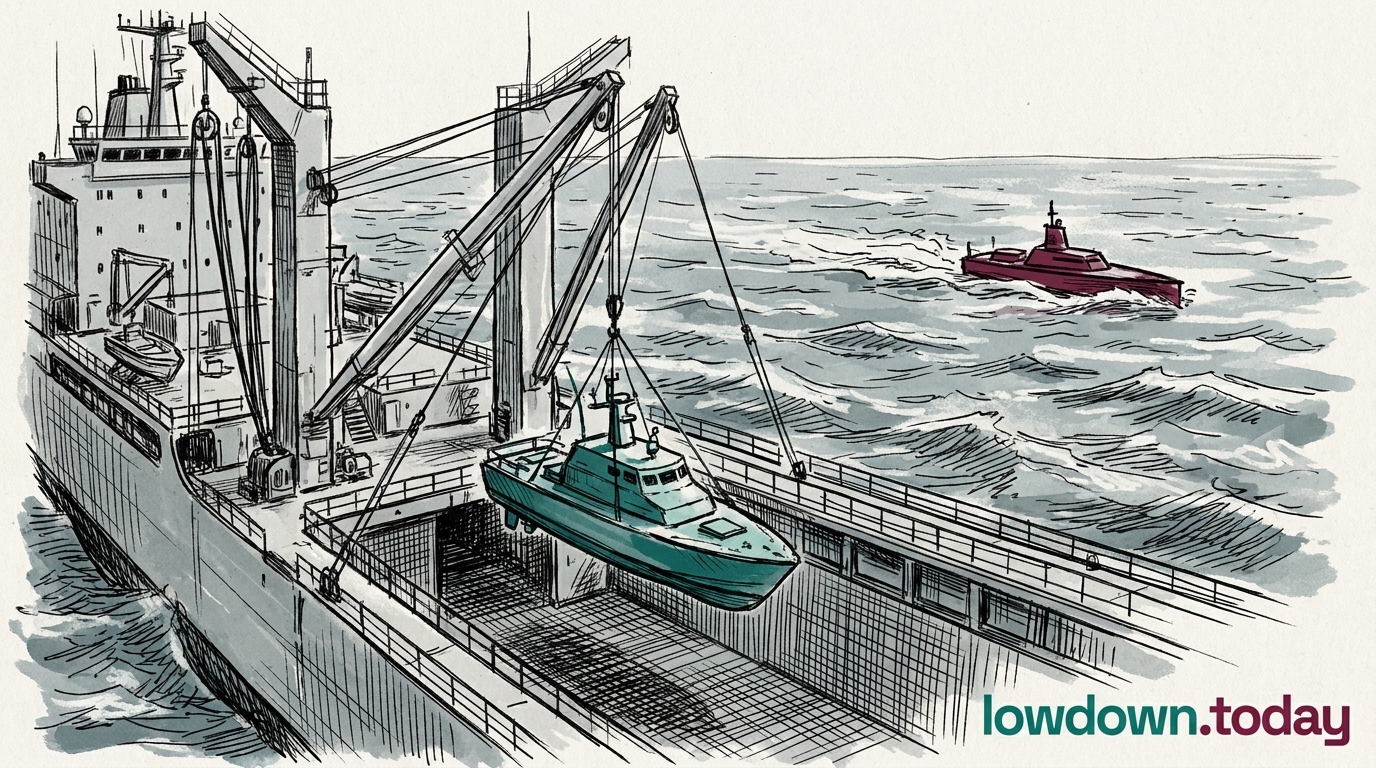
RFA Lyme Bay reached the Middle East on 23 June with RNMB Ariadne and France's Sirius drone in its well-dock, the most capable allied autonomous mine-hunting package yet sent to sea.

Sources profile:This story draws on neutral-leaning sources

Royal Fleet Auxiliary ship Lyme Bay arrived in the Middle East on 23 June. It carried two robotic mine-hunters: Royal Navy minehunter Ariadne and France's Sirius. HMS Dragon and two German naval vessels escorted them. More than 270 personnel are aboard.

The deployment puts the most capable allied autonomous mine-clearance package yet assembled near the strait of Hormuz, where Iranian minelaying has blocked commercial shipping since June. 

Sources:Royal Navy

Ukraine has set a target of 50,000 ground-robot contracts for 2026, with first-half procurement already near 25,000, roughly twice the whole of last year and the volume European armies are now building to match.

Sources profile:This story draws on neutral-leaning sources

Ukraine contracted around 25,000 ground robots in the first half of 2026. That is roughly twice its total for all of 2025. The full-year target is 50,000. In the most contested front-line sectors, robots now handle up to 90% of all supply runs.

At 50,000 units a year, Ukraine's procurement sets the volume and capability benchmarks European defence companies are building to match. Those benchmarks drove the factory openings and deals at Eurosatory this fortnight. 

The US Navy ran the Iver3 autonomous underwater vehicle off Latvia from 8 June, the first time in 55 years that uncrewed undersea systems were a core part of NATO's Baltic exercise rather than a side trial.

Sources profile:This story draws on neutral-leaning sources

NATO's annual Baltic naval exercise ran 4 to 19 June with 15 nations. For the first time in its 55-year history, an autonomous underwater robot took a drilled core role. The US Navy operated the Iver3 off Latvia from 8 to 10 June.

NATO also ran counter-robot drills and a multinational mine-disposal chain. Practising those procedures across 15 nations shows seabed defence has become a standing allied task. 

Rheinmetall, Croatia's DOK-ING and Britain's Pearson Engineering unveiled the MV-8 Komodo at Eurosatory, the first uncrewed mine-breaching system built on a next-generation ground robot, taken from first talks to show floor in under six months.

Sources profile:This story draws on neutral-leaning sources

Germany's Rheinmetall, a Croatian robotics firm, and Britain's Pearson Engineering unveiled the MV-8 Komodo mine-breaching robot at Eurosatory in Paris on 15 June. They went from first talks to show floor in under six months. Pearson is also sending two AI mine-detection systems to Ukraine after NATO trials hit over 95% detection.

The Komodo hands breaching minefields to a robot rather than a soldier. Its six-month development proves modular robot design outpaces traditional bespoke programmes. 

Finland and Sweden signed the Common Arctic Mobility agreement at Eurosatory, committing EUR79m of EU money toward serial production of the TRACKX heavy tracked robot, with RENK landing the first hardware order.

Sources profile:This story draws on neutral-leaning sources

Finland and Sweden signed a EUR115 million funding deal at Eurosatory on 15 June for an autonomous tracked vehicle. EUR79 million comes from EU defence funds. A German transmission maker won the first hardware supply contract in the same week.

That hardware order, placed in June 2026, marks the programme's first binding industrial commitment. Suppliers are tooling up for 2027 serial production before any government has signed a firm order. 

Digital Concepts Engineering won the MoD's largest UGV contract to date, 15 X-series Universal Carriers, standing up the British Army's first operational rather than experimental ground-robot fleet.

Sources profile:This story draws on neutral-leaning sources

Digital Concepts Engineering of Leicestershire won the UK Ministry of Defence's biggest ground-robot contract, for 15 X-series platforms. The vehicles have already run on Exercise Rhino Storm in Germany. The company will open the UK's first ground-robot factory at Hinckley in summer 2026.

Britain runs two domestic ground-robot lines. A second robot, the GEREON, is being built by Devon firm Supacat under a separate British Army contract. Demand supports more than one UK supplier. 

Estonia's Milrem Robotics signed two non-binding memoranda at Eurosatory, one naming its THeMIS robot a preferred French platform, one to arm Milrem UGVs with the Mark I missile, neither committing a government to buy.

Sources profile:This story draws on neutral-leaning sources

Estonian ground-robot maker Milrem Robotics signed two non-binding deals at Eurosatory on 15 June. The first names Milrem's THeMIS robot as the preferred platform for a French industrial partner's unmanned engineering work. The second targets an anti-tank missile on Milrem vehicles by end-2027. Neither commits a government buyer.

Milrem is Europe's most active ground-robot partnership-builder. The market's gap between intent agreements and funded orders remains its central challenge. 

The IMO's MASS Code is set to enter force on 1 July, yet seafarer union Nautilus International says three structural questions, liability, multi-vessel safety and jobs, remain unanswered when it does.

Sources profile:This story draws on neutral-leaning sources

A UN shipping code for crewless cargo vessels is set to enter force on 1 July 2026. Three gaps land unresolved: liability for a shore-based master when a casualty occurs. Can one master safely oversee several ships? What happens to seafarers whose postings move ashore?

Lloyd's Register in Britain and Norway's classification body have each published their own assurance frameworks. Both stepped in to fill the accountability space the UN code left open. 

Closing comments

Upward on capability, sideways on procurement commitment. The named trigger for a step-change is whether Ariadne and Sirius attempt a live mine-neutralisation in the Strait of Hormuz: a successful clearance converts the MMCM programme from a forward-positioned capability into a proven reference deployment and accelerates export interest from Gulf and Asian navies. On land, if Ukraine's second-half UGV figure holds near 25,000 and European MoDs begin distinguishing certified platforms from improvised adaptations in their procurement plans, the TRACKX 2027 serial target and the DCE-ARX dual-line model become the template. The MASS Code's liability gap escalates only if a casualty tests it before 2032.

AI-assisted, human-edited under the editorial responsibility of Bannermedia Ltd. Reviewed by Ed Woodcock on 24 June 2026. Editorial standards.

Different Perspectives
Royal Navy / UK MoD
Royal Navy / UK MoD
The Royal Navy deployed the most capable allied autonomous MCM package yet assembled to a live mined theatre on 23 June, validating its "crewed where necessary, uncrewed wherever possible" doctrine in conditions no NATO exercise can replicate. The DCE X-series contract and the Hinckley factory opening show the MoD is seeding a domestic ground-robot sector alongside its naval autonomy programme.
Nautilus International
Nautilus pressed the IMO on three gaps the MASS Code leaves open when it enters force on 1 July: liability for a shore-based master, unproven multi-vessel supervision safety, and workforce displacement as sea-going officers give way to cheaper shore operators. David Appleton stated the Code keeps a master legally responsible without specifying who answers when that master is ashore.
Finland and Sweden (Nordic EDF primes)
Finland and Sweden signed the CAM implementation agreement at Eurosatory, committing EUR79m of European Defence Fund money toward TRACKX serial production by 2027, with RENK landing the first hardware supply contract. The programme involves roughly 20 countries and 50 firms; the EDF's cross-border industrial collaboration requirement means procurement credit is distributed while accountability for meeting the 2027 target is dispersed.
Ukraine (demand signal)
Ukraine contracted around 25,000 ground robots in the first half of 2026, double its full-year 2025 figure, targeting 50,000 for the year. Its UGVs handle up to 90% of frontline logistics in the most contested sectors and carry electronic-warfare suites and guided weapons; that capability mix is the product roadmap European manufacturers are building to.
NATO / STRIKFORNATO
NATO / STRIKFORNATO
NATO ran its first BALTOPS with an AUV as a drilled core capability, including counter-AUV drills and a multinational detect-to-remediate chain across 15 nations. The alliance converted the seabed surveillance deficit the 2023 Balticconnector rupture exposed, documented by IISS as fewer than six patrol sorties per day, into a standing operational requirement.
