Skip to content
You can now search across every topic, entity and event.What's new
Autonomous Systems: Land & Sea
11JUL

Oman clears mine mission, then a stall

2 min read
10:27UTC

Oman authorised Britain and France to clear mines on its Hormuz route, then a 7 July tanker strike stalled the most capable allied robot minehunting package before it could begin.

TechnologyDeveloping
Key takeaway

Political authorisation now paces uncrewed mine clearance in the Gulf, with the technology already proven.

Oman granted the United Kingdom and France permission to clear mines on its southern Strait of Hormuz route shortly before 7 July, and officials said clearance could begin as soon as that week 1. An early-morning attack on a Qatari-owned liquefied-natural-gas carrier in the strait on 7 July set the timeline back before clearance began.

the strait of Hormuz is the narrow Gulf chokepoint through which much of the world's seaborne oil and gas passes. RFA Lyme Bay, the Royal Navy mother ship, sits in Omani waters with RNMB Ariadne and its autonomous mine-hunting systems aboard, HMS Dragon and French assets alongside, holding for a military order that has not come . RNMB Ariadne passed its trials off Portland and Gibraltar, and France's Sirius minehunting USV embarked at Toulon in June ; the missing piece now is a national military order, gated by Oman's consent, Iran's objections and allied domestic timelines.

Iran's deputy foreign minister, Kazem Gharibabadi, insists mine clearance is Iran's sole responsibility and has warned Oman against outside interference 2. The conflict itself belongs to Lowdown's Iran-conflict file; the industry beat here is narrower, that permission for an autonomous clearance debut was granted and then overtaken by events. Around 80 Iranian sea mines are thought to remain, Italy's Joint Operations Command estimates two months to clear once work starts, and the International Maritime Organization (IMO) says roughly 500 stranded ships must be evacuated first 3.

Deep Analysis

In plain English

The Strait of Hormuz is a narrow shipping lane between Iran and Oman that a fifth of the world's oil passes through. During the recent conflict, mines were laid in the water there, and around 80 are thought to remain. Oman, which controls the southern route through the strait, gave the UK and France permission to send ships and uncrewed mine-hunting robots to clear them. Before that clearance work could start, a tanker was attacked in the strait on 7 July, which pushed the timeline back again. RFA Lyme Bay, a British support ship, and its uncrewed minehunter RNMB Ariadne, are waiting nearby in Omani waters for the order to begin.

Deep Analysis
Root Causes

Iran never ratified the 1982 UN Convention on the Law of the Sea, the treaty that would otherwise settle transit-passage rights through Hormuz; Tehran's own mine-clearance claim rests on treating Omani-authorised outside clearance as a jurisdictional dispute rather than a technical favour.

Iran's mourning period for Supreme Leader Khamenei adds a second, time-limited constraint: gCaptain reports officials citing 'diplomatic sensitivities' and the need for 'more stable conditions' before allied vessels can visibly operate near Iranian-claimed waters.

Escalation

Escalatory risk is real but bounded: any allied minesweeping near Iranian-contested waters risks further tanker strikes like the one on 7 July, which has already reset the timeline once.

What could happen next?
  • Meaning

    Authorisation without a start date functions as a political signal to Tehran as much as a technical readiness milestone.

    Immediate · Assessed
  • Consequence

    The roughly 80 remaining mines and around 500 stranded ships stay in place until clearance actually starts, not merely authorised.

    Short term · Assessed
  • Risk

    Iran's deputy foreign minister has signalled that clearance by outside parties will be contested as a jurisdictional infringement, not just delayed by timing.

    Short term · Assessed
First Reported In

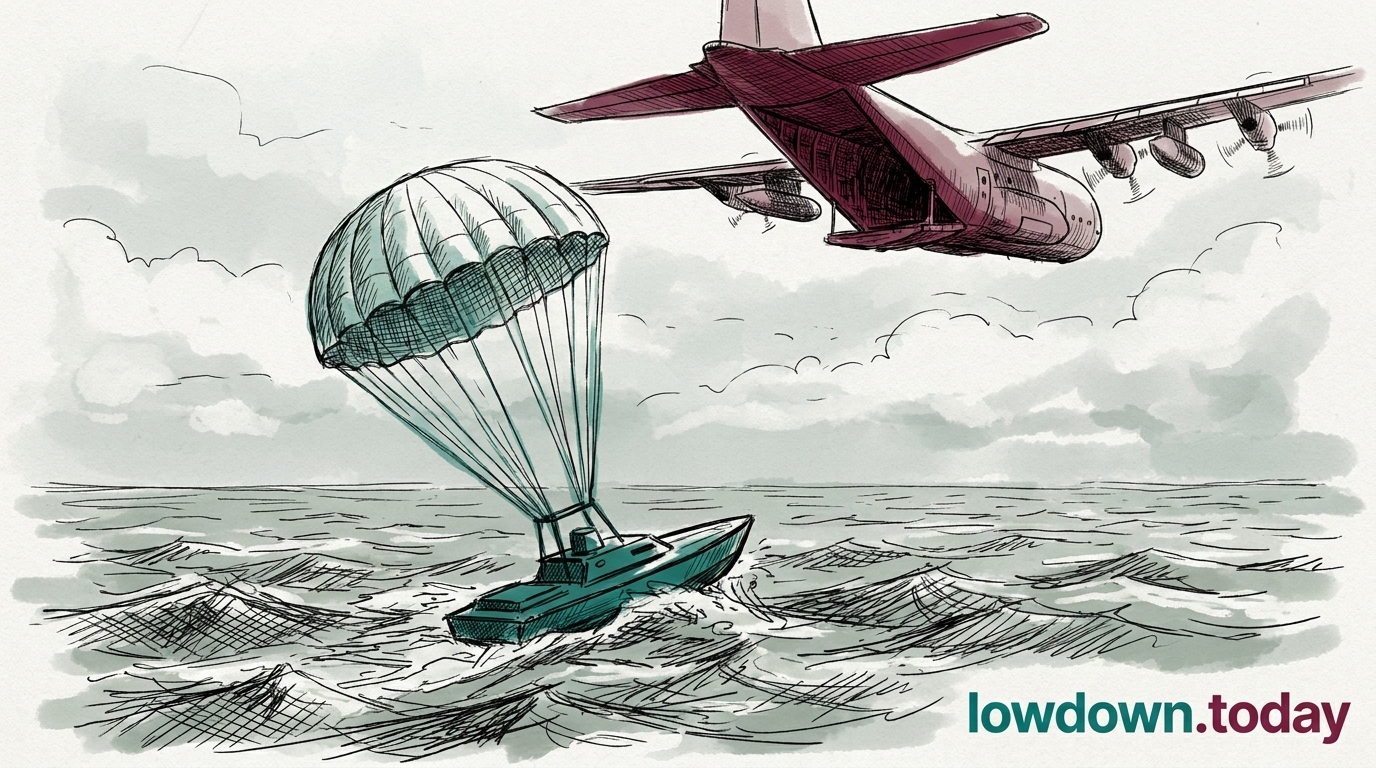
Update #6 · UK airdrops a robot boat; Gulf order stalls

Stars and Stripes· 11 Jul 2026
Read original
Different Perspectives
China (military commentary)
Chinese military commentary has called uncrewed maritime equipment 'an excellent force multiplier' that cannot overturn the fundamental logic of naval warfare, the lone voice against the Western consensus that autonomy is the central axis of naval modernisation. Beijing reads the airdrop trial as an incremental logistics fix, not London's claimed doctrinal breakthrough.
Iran (Ministry of Foreign Affairs)
Spokesman Kazem Gharibabadi said clearance of the Hormuz mines is 'Iran's sole responsibility', rejecting the Omani-authorised allied mine-clearance mission as a jurisdictional dispute rather than a technical favour. Tehran has not ratified UNCLOS, the treaty that would otherwise settle transit-passage rights through the strait.
Norway (Kongsberg Discovery)
Kongsberg Discovery's Camilla Kiss said the subsea-protection contract shows the industry 'moving from recognising the need to implementing solutions', selling fused sonar and C-Scope software to an unnamed buyer because fragmented cable, pipeline and platform ownership means no single navy commissions this the way it commissions a warship.
Ukraine (Trinity Robotics)
Trinity Robotics doubled its Konyk One production target to 2,200 units and opened French joint-venture talks, co-founder Oleksii Konik said, because wartime demand outpaces what factories inside a live-fire war zone can safely hold. Ukraine is answering the authority gap other actors face by manufacturing around it.
United Kingdom (Ministry of Defence and Royal Navy)
The Royal Navy proved it can airdrop a mine-hunting robot from any A400M into Sea State 4 waters, working round a front line of just six Type 45 destroyers and eight Type 23/26 frigates rather than waiting for more hulls. First Sea Lord Gwyn Jenkins's 'uncrewed wherever possible' doctrine gets a delivery method; it still lacks a named operational deployment.
Nautilus International
Nautilus International pressed the unresolved liability gaps as the MASS Code entered force, noting a master stays legally responsible without saying who answers when ashore. Entry into force changed nothing an operator may legally do, leaving the seafarer-displacement question open.