Skip to content
You can now search across every topic, entity and event.What's new
Autonomous Systems: Land & Sea
13JUN

Lyme Bay embarks France's mine-hunting drone

4 min read
11:07UTC

RFA Lyme Bay embarked France's Sirius mine-hunting drone at Toulon in early June, the first time Britain and France have run their crewless mine-clearance kit together at sea.

TechnologyDeveloping
Key takeaway

Two allied navies running one autonomy package at sea is worth more to the supplier base than any demo.

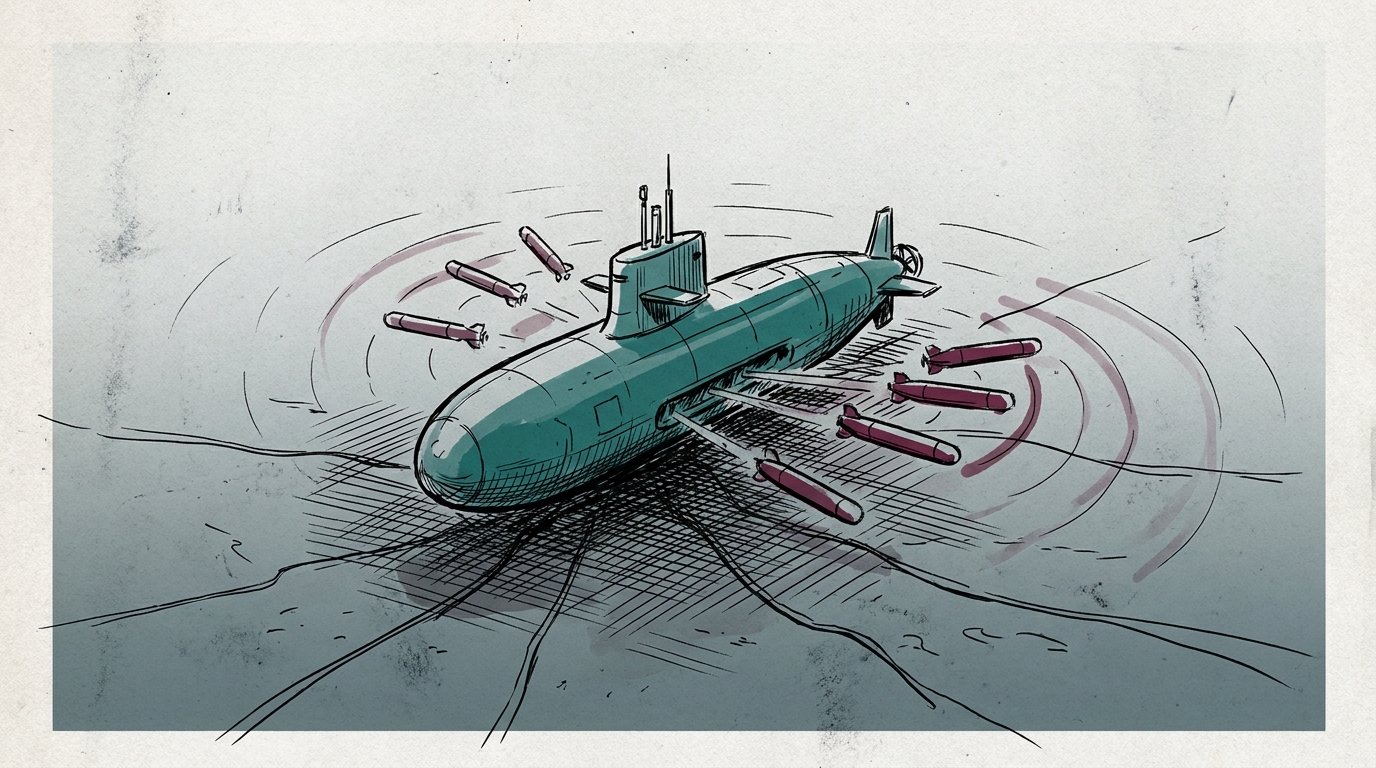
RFA Lyme Bay called at Toulon in early June 2026 and embarked the French Navy's Sirius, an uncrewed surface vessel (USV, a crewless boat) for mine countermeasures (MCM, clearing sea mines), alongside the Royal Navy's own RNMB Ariadne. The two navies had integrated their autonomous mine-hunting kit aboard a single mothership under operational conditions for the first time 1.

Both craft come from the Anglo-French maritime mine-countermeasures (MMCM) programme, run since 2015 and built around Thales sonar. The programme had previously validated each nation's systems separately. Putting them on one deck tests the control stations, data links and crews as a single package, which is where allied autonomy programmes usually struggle rather than at the platform level. Commander Dan Herridge described the exercise as bringing together people, platforms and technology at short notice 2.

The integration itself is the new beat here, distinct from RNMB Ariadne's first mothership docking off Gibraltar in May . A working combined toolkit gives Thales and the wider supplier base an export reference: a buyer in a third navy can point to Toulon and ask for the same package. That carries more commercial weight than the status of any single mission.

The Sirius and Ariadne package has not yet run a live mine-hunting operation, and allied systems can pass integration trials and still falter in a contested environment. Toulon proved the kit fits together; only a mine cleared under pressure will prove it works. the strait of Hormuz closure sits in the background as the operational pressure behind the timetable, but it is the Iran-conflict desk's story, not this one.


Deep Analysis

In plain English

Naval mines sit on or near the seabed and destroy ships that strike them. Sailors who sweep for mines do so above live munitions, making mine-clearance one of the most dangerous tasks in naval warfare. Since 2015, the Royal Navy and French Navy have been jointly building autonomous surface drones to do that job without a crew on board, under a bilateral programme called MMCM (Maritime Mine Counter-Measures). Britain's robot mine-hunter is called RNMB Ariadne. France's version is called Sirius. Both are equipped with sonar made by Thales, a French defence company. In early June 2026, the British support ship RFA Lyme Bay called at the French naval base at Toulon and picked up Sirius, alongside Ariadne which was already on board. For the first time, both drones were operated together from the same ship in a real-world deployment context rather than a controlled harbour exercise. This matters because Lyme Bay is sailing toward the Strait of Hormuz, where Iran has threatened to lay mines. If the integration works, two allied navies can clear that strait together using robots rather than sending sailors into a minefield.

Deep Analysis
Root Causes

The Anglo-French MMCM programme launched in 2015 because both navies faced the same industrial constraint: post-2008 defence budgets precluded sole-nation development of autonomous mine-countermeasures at the cost of a full production run.

France's DGA (Direction Générale de l'Armement) and the UK's DE&S (Defence Equipment and Support) agreed a jointly funded development with Thales as the common sonar integrator, but with separate platform primes (Thales for Sirius's hull and ECA Group for associated tooling on the French side, BAE Systems and L3Harris UK for Ariadne's platform).

The Hormuz backdrop accelerated this integration timetable. IRGCN mine-laying capability in the Strait of Hormuz was assessed by the US Fifth Fleet at Bahrain as a credible threat to tanker traffic following the formal Strait closure declaration in June 2026.

The Royal Navy's doctrine of 'crewed where necessary, uncrewed wherever possible' requires a live at-sea integration before Lyme Bay enters a potential minefield environment, making the Toulon embarkation operationally driven rather than a scheduled programme milestone.

What could happen next?
  • Precedent

    Successful joint operation of French and British autonomous mine-hunting systems from one mothership establishes the first documented bilateral autonomous MCM C2 interoperability protocol, a prerequisite for any broader NATO autonomous MCM architecture.

    Short term · Assessed
  • Opportunity

    Thales gains a live operational export reference for its SAMDIS and TSAM sonar suite deployed on allied autonomous platforms, strengthening its position in the Japanese, South Korean, and Australian autonomous MCM competitions expected to open in 2026-27.

    Medium term · Assessed
  • Risk

    If Ariadne and Sirius cannot pass mine-hunt coordinates across their respective data buses without human relay in a Hormuz deployment, the programme's claimed operational readiness will require revision and the export reference will be weakened.

    Immediate · Suggested
First Reported In

Update #3 · Europe bids for the AUKUS seabed layer

Naval News· 13 Jun 2026
Read original
Causes and effects
This Event
Lyme Bay embarks France's mine-hunting drone
A working at-sea integration hands Thales and the Anglo-French supplier base an export reference a brochure cannot match.
Different Perspectives
NATO (alliance demand)
NATO converted its GIUK surveillance deficit, exposed by the 2023 Balticconnector rupture and documented by the IISS as fewer than six maritime patrol sorties per day, into a standing operational requirement through Task Force X-Arctic, with DIANA selection serving as the accelerator that bridges start-up development to alliance procurement timelines.
Nautilus International and Lloyd's Register (seafarer labour and classification assurance)
Lloyd's Register's certification of Herne and RNMB Ariadne positions it as the assurance gatekeeper for UK autonomous naval systems, while Nautilus International continues to press for a human master aboard any vessel where crew are present; the FAVOR project funded by Horizon Europe is now the academic arena where that tension will be resolved into policy.
HII and L3Harris (US prime incumbents)
US primes secured the AUKUS Pillar II named-platform slots by using existing US Navy delivery contracts as qualification evidence, a certification baseline European suppliers could not match in April 2026; HII has simultaneously embedded in the UK market through Babcock's ARMOR Force initiative, establishing switching costs before European reference sales mature.
UK Ministry of Defence and Royal Navy
The Royal Navy co-signed the AUKUS naming of two US-built vehicles while simultaneously deploying the most operationally advanced Anglo-French autonomous MCM package yet assembled aboard RFA Lyme Bay; the MoD's posture is strong on operations and doctrine, with the hardware procurement gap at the AUKUS platform layer the outstanding question for the next Signature Project.
Kongsberg and DRASS (European prime suppliers)
Kongsberg and DRASS read the AUKUS Pillar II Signature Project as an opening rather than a closure, targeting the host-platform and payload slots US primes did not fill on 30 May. Their ILA Berlin timing, ten days after the naming, is a deliberate signal to procurement authorities that the competition is not settled.
EU / Horizon Europe (FAVOR regulatory programme)
The EU funded FAVOR through Horizon Europe to fill the technical and workforce gaps the MASS Code's principles-only adoption left open, with LJMU leading a consortium spanning Belgian, Dutch, and Greek partners. The timing confirms Horizon Europe's post-Brexit UK association agreement is operational: LJMU is leading an EU maritime research call for the first time since 2020.