Skip to content
Briefings are running a touch slower this week while we rebuild the foundations.See roadmap
Autonomous Systems: Land & Sea
29MAY

UK's robot navy sails for Hormuz

2 min read
08:47UTC

On 19 May the First Sea Lord set the Royal Navy's autonomy doctrine; eight days later a crewless minehunter docked inside its mothership and sailed toward a potential Strait of Hormuz mission. The IMO adopted the first global code for crewless cargo ships, and Ukraine's appetite for ground robots is pulling European production. Maritime and land autonomy stopped being a procurement line this month and became a posture.

Key takeaway

Autonomy moved from procurement line to operational posture in May 2026, ahead of regulation and doctrine on every front.

This briefing mapped
Loading map…
Military
Regulatory
Competitive

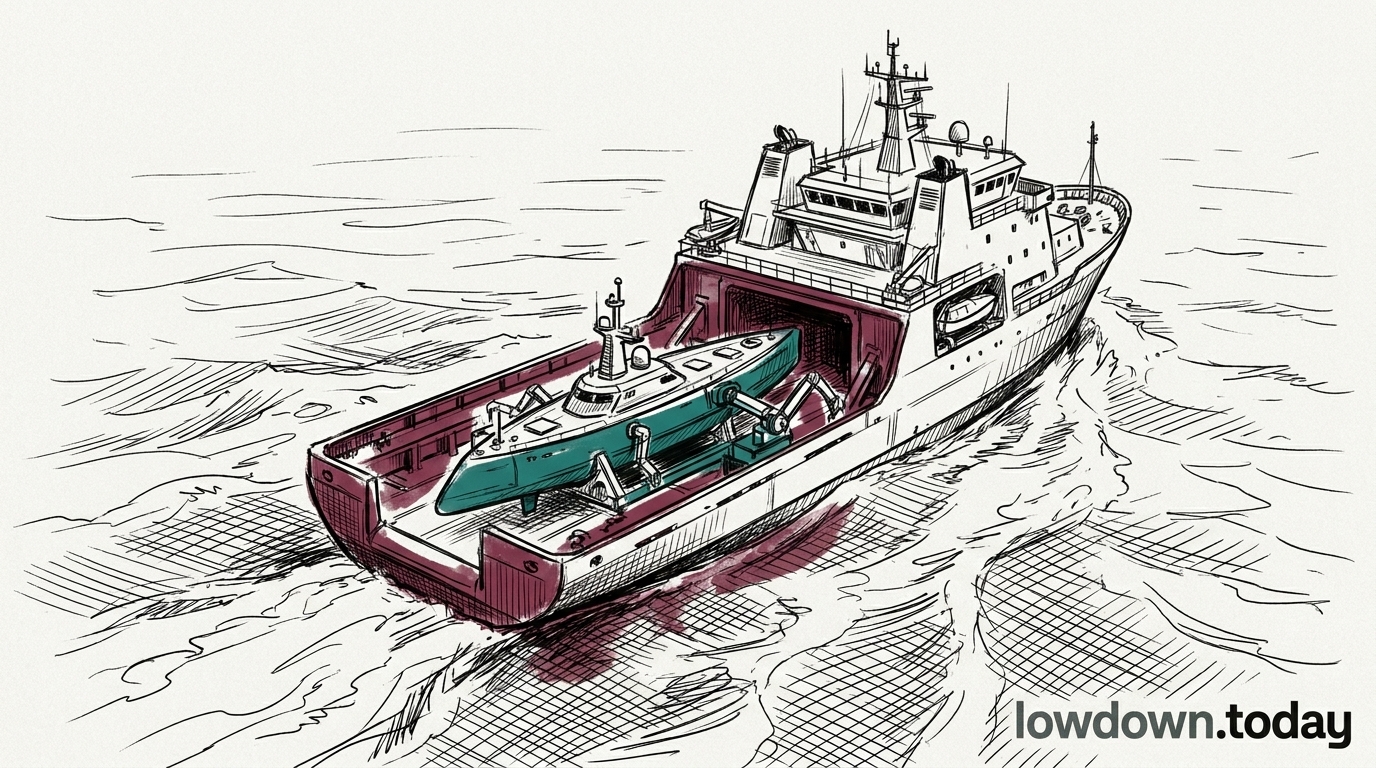
On 27 May the crewless minehunter RNMB Ariadne docked inside RFA Lyme Bay off Gibraltar on its first attempt, as the mothership sailed toward a potential Strait of Hormuz mission.

Sources profile:This story draws on neutral-leaning sources from Netherlands
Netherlands

The Royal Navy's robot minehunter Ariadne docked into its support ship Lyme Bay off Gibraltar on 27 May. It was the first time a crewless minehunter was recovered into a mothership at sea. Lyme Bay is heading toward the strait of Hormuz, through which about a fifth of global oil passes.

The Royal Navy's manned minehunter fleet has shrunk faster than robotic replacements arrived. Ariadne fills that gap: without it, the alternative was a crewed hull in the threat zone. 

The IMO adopted the first global code for autonomous cargo ships on 22 May in London. It is voluntary until 2032 and keeps a human master legally on the hook from ashore.

Sources profile:This story draws on neutral-leaning sources

The International Maritime Organization (IMO) adopted the first global rules for crewless cargo ships on 22 May in London. The rules are voluntary from 1 July 2026 and mandatory from 2032. A human master ashore remains legally responsible.

Classification societies DNV (Det Norske Veritas) and Lloyd's Register already certify autonomous vessels under their own class rules, so the IMO is formalising existing practice. Seafarers' unions warn the six-year voluntary gap lets operators outrun enforcement. 

Germany's ARX Robotics won an order on 6 May to quintuple its GEREON ground-robot fleet for Ukraine, which has said it wants 25,000 ground robots in the first half of 2026.

Sources profile:This story draws on neutral-leaning sources from United States
United States

ARX (a German ground robot firm) announced on 6 May it will expand its fleet for Ukraine to roughly five times its current size. Ukraine wants 25,000 ground robots in the first half of 2026 for logistics, resupply, casualty evacuation and surveillance.

The company has teamed with UK firm Supacat to build a self-driving Jackal vehicle in Britain. Turkey's Havelsan is chasing the same European market after completing eight-robot swarm trials of its Barkan 3 in May. 

At the Combined Naval Event from 19 to 21 May, US shipbuilder HII pushed its uncrewed underwater vehicles toward the Royal Navy through British partner Babcock under the ARMOR Force initiative.

Sources profile:This story draws on neutral-leaning sources from Netherlands
Netherlands
Sources:Naval News
Closing comments

Sideways on the autonomy technology trajectory, with a defined upward trigger on the operational and regulatory fronts. The technology commitment is already made; what remains is whether the Hormuz mission transitions from deterrence to active mine-clearance, which would supply the first public proof-of-concept for the mothership model and move the Royal Navy's export pitch from possible to demonstrated. On the regulatory side, the first flag-state MASS Code certification after 1 July 2026 sets the legal baseline from which commercial autonomous shipping diverges from the IMO framework; whichever flag state moves first defines the compliance floor for the Experience Building Phase.

Different Perspectives
Royal Navy / UK Ministry of Defence
General Sir Gwyn Jenkins set the service's autonomy doctrine on 19 May and the RNMB Ariadne deployment followed eight days later, connecting doctrine to hardware in under a fortnight. For the MoD, a successful Hormuz debut for autonomous mine countermeasures would justify accelerating the uncrewed programme of record and retiring ageing Hunt and Sandown-class manned minehunters sooner.
International Maritime Organization
The IMO adopted the MASS Code at MSC 111 on 22 May after years of preparation, but DNV and Lloyd's Register class rules pre-dated it by several years. Secretary-General Arsenio Dominguez's goal-based model deliberately left the technical means to flag states, which is also why the mandatory date was set six years out.
Nautilus International
The seafarers' union argued at MSC 111 that the master should remain aboard while any crew are present, contesting the bridge-empty model the MASS Code permits. The six-year non-mandatory gap leaves enforcement pressure on seafarers before liability law is settled.
Ukraine armed forces
Ukraine's 25,000-robot target reflects a doctrine adapted to drone-saturated airspace above 30 metres, where Russian loitering munitions contest air logistics and ground robots fill the resupply role. The fivefold ARX order is the first confirmed European production response to that demand.
Thales / French defence industry
Thales leads the Anglo-French MMCM programme that produced RNMB Ariadne, and its TSAM sonar is the mine-detection system aboard. A successful Hormuz operational debut converts a development contract into an export reference, and France's naval procurement community has a direct commercial interest in the mission proceeding rather than remaining a deterrence posture.
HII / US defence industry
HII used the Combined Naval Event to lock in a UK industrial presence through Babcock's ARMOR Force initiative and an expanded Portchester hub, ahead of an expected NATO-wide UUV procurement wave following seabed-infrastructure attacks in 2023-24. The strategic logic is to establish switching costs for Royal Navy procurement before European alternatives secure equivalent reference sales.

