Skip to content
Briefings are running a touch slower this week while we rebuild the foundations.See roadmap
Autonomous Systems: Land & Sea
29MAY

Robot minehunter now sails for Hormuz

4 min read
08:47UTC

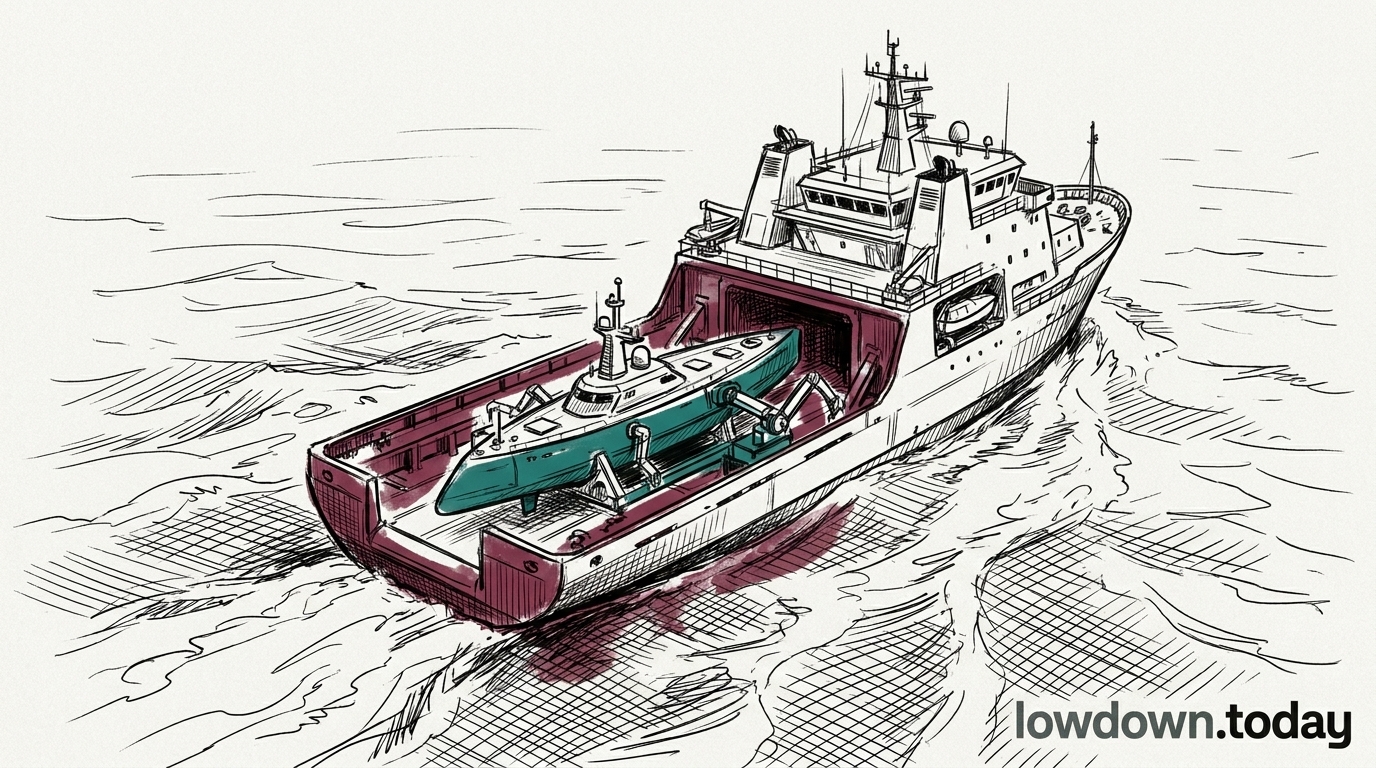
On 27 May the crewless minehunter RNMB Ariadne docked inside RFA Lyme Bay off Gibraltar on its first attempt, as the mothership sailed toward a potential Strait of Hormuz mission.

TechnologyDeveloping
Key takeaway

A crewless Royal Navy minehunter has deployed toward Hormuz but has not yet cleared a single mine.

On 27 May the autonomous minehunter Royal Navy Motor Boat (RNMB) Ariadne docked inside the Royal Fleet Auxiliary support ship RFA Lyme Bay off Gibraltar on its first attempt, the first time the Royal Navy has recovered a crewless minehunter into a mothership at sea. 1 Lyme Bay had sailed from Gibraltar two days earlier toward a potential mine-clearance mission in the Strait of Hormuz, the channel through which roughly a fifth of the world's oil moves. A minehunter is the ship that finds and destroys sea mines; doing it without a crew aboard is the point. The mission has not begun clearance work. The Royal Navy describes the deployment as strictly defensive, intended to restore commercial shipping confidence, so treat it as a potential operational debut, not a result.

Eight days earlier, on 19 May, the First Sea Lord, General Sir Gwyn Jenkins, gave the Royal Navy its autonomy doctrine at the Combined Naval Event in Farnborough: "crewed where necessary, uncrewed wherever possible, integrated always". 2 That eight-day gap is what gives the words teeth. A statement on a conference stage commits nothing. A 12-metre uncrewed boat steaming toward Iran's doorstep commits a hull, a crew ashore, and a strategically critical task.

Ariadne carries Thales Towed Synthetic Aperture Multiviews (TSAM) sonar to find mines and a remotely operated neutraliser to destroy them, so no sailor sits above a mine to clear it. Travelling in the same force package are Project Beehive uncrewed surface vessels (USV), boats with no crew aboard, built by Britain's Kraken Technology Group and ordered in March under a 12.3 million pound contract.

The mine-hunting capability sits inside the separate Anglo-French Maritime Mine Countermeasures (MMCM) programme, Thales-led, and has been in development for years. In May 2026 the Royal Navy decided to send it toward Hormuz, the step a development programme does not require. The hard engineering problem solved on 27 May was the recovery: launching an uncrewed boat is routine, but bringing a 12-metre vessel back into a moving dock in open water, first time, is the integration milestone the navy's future minehunting plan rests on.

Deep Analysis

In plain English

Finding underwater mines traditionally required a small ship to sail slowly through the danger area with a crew on board the whole time. The new approach puts a robot boat on that job instead, controlled remotely from a safer vessel that stays further back. RNMB Ariadne is the Royal Navy's first such robot minehunter. On 27 May it successfully docked itself back inside the larger ship RFA Lyme Bay while both were at sea near Gibraltar. That docking test matters because a robot that cannot reliably return to its base ship is operationally useless. Lyme Bay is now heading toward the Strait of Hormuz, the narrow waterway through which about a fifth of the world's oil travels, where there is concern that mines could be laid to disrupt traffic.

Deep Analysis
Root Causes

Two structural constraints are driving the timing. First, the MMCM programme's contracted delivery schedule placed Ariadne on track for initial operating capability in 2026, and the Hormuz tension created an operational pull that coincided with that schedule rather than being engineered to meet it.

Second, the Royal Navy lacks enough manned minehunters to sustain a persistent Hormuz presence without unacceptable crew-risk. The Hunt-class and Sandown-class fleets have shrunk through decommissioning faster than the MMCM programme could deliver replacements. Ariadne's deployment fills a genuine capability gap: the alternative was either a manned vessel in the threat zone or no mine-countermeasures coverage at all.

What could happen next?
  • Precedent

    A successful Hormuz autonomous mine-countermeasures mission would be the first combat-credible UAS mothership operation by a Western navy, setting the template for future force-package architecture.

    Short term · Suggested
  • Risk

    Ariadne's command-link vulnerability to electronic warfare in a genuine mining scenario has not been publicly tested; a lost vehicle would set back UK autonomous mine warfare procurement and the broader MMCM programme.

    Immediate · Suggested
  • Opportunity

    A live operational record strengthens the export case for the TSAM sonar and the broader MMCM architecture to Gulf states and Indo-Pacific navies facing similar mine threats.

    Medium term · Suggested
First Reported In

Update #1 · UK's robot navy sails for Hormuz

UK Defence Journal· 29 May 2026
Read original
Causes and effects
This Event
Robot minehunter now sails for Hormuz
It is the first time the Royal Navy has recovered a crewless minehunter into a mothership at sea, turning a stage-managed autonomy doctrine into a deployed capability.
Different Perspectives
HII / US defence industry
HII used the Combined Naval Event to lock in a UK industrial presence through Babcock's ARMOR Force initiative and an expanded Portchester hub, ahead of an expected NATO-wide UUV procurement wave following seabed-infrastructure attacks in 2023-24. The strategic logic is to establish switching costs for Royal Navy procurement before European alternatives secure equivalent reference sales.
Thales / French defence industry
Thales leads the Anglo-French MMCM programme that produced RNMB Ariadne, and its TSAM sonar is the mine-detection system aboard. A successful Hormuz operational debut converts a development contract into an export reference, and France's naval procurement community has a direct commercial interest in the mission proceeding rather than remaining a deterrence posture.
Ukraine armed forces
Ukraine's 25,000-robot target reflects a doctrine adapted to drone-saturated airspace above 30 metres, where Russian loitering munitions contest air logistics and ground robots fill the resupply role. The fivefold ARX order is the first confirmed European production response to that demand.
Nautilus International
The seafarers' union argued at MSC 111 that the master should remain aboard while any crew are present, contesting the bridge-empty model the MASS Code permits. The six-year non-mandatory gap leaves enforcement pressure on seafarers before liability law is settled.
International Maritime Organization
The IMO adopted the MASS Code at MSC 111 on 22 May after years of preparation, but DNV and Lloyd's Register class rules pre-dated it by several years. Secretary-General Arsenio Dominguez's goal-based model deliberately left the technical means to flag states, which is also why the mandatory date was set six years out.
Royal Navy / UK Ministry of Defence
General Sir Gwyn Jenkins set the service's autonomy doctrine on 19 May and the RNMB Ariadne deployment followed eight days later, connecting doctrine to hardware in under a fortnight. For the MoD, a successful Hormuz debut for autonomous mine countermeasures would justify accelerating the uncrewed programme of record and retiring ageing Hunt and Sandown-class manned minehunters sooner.