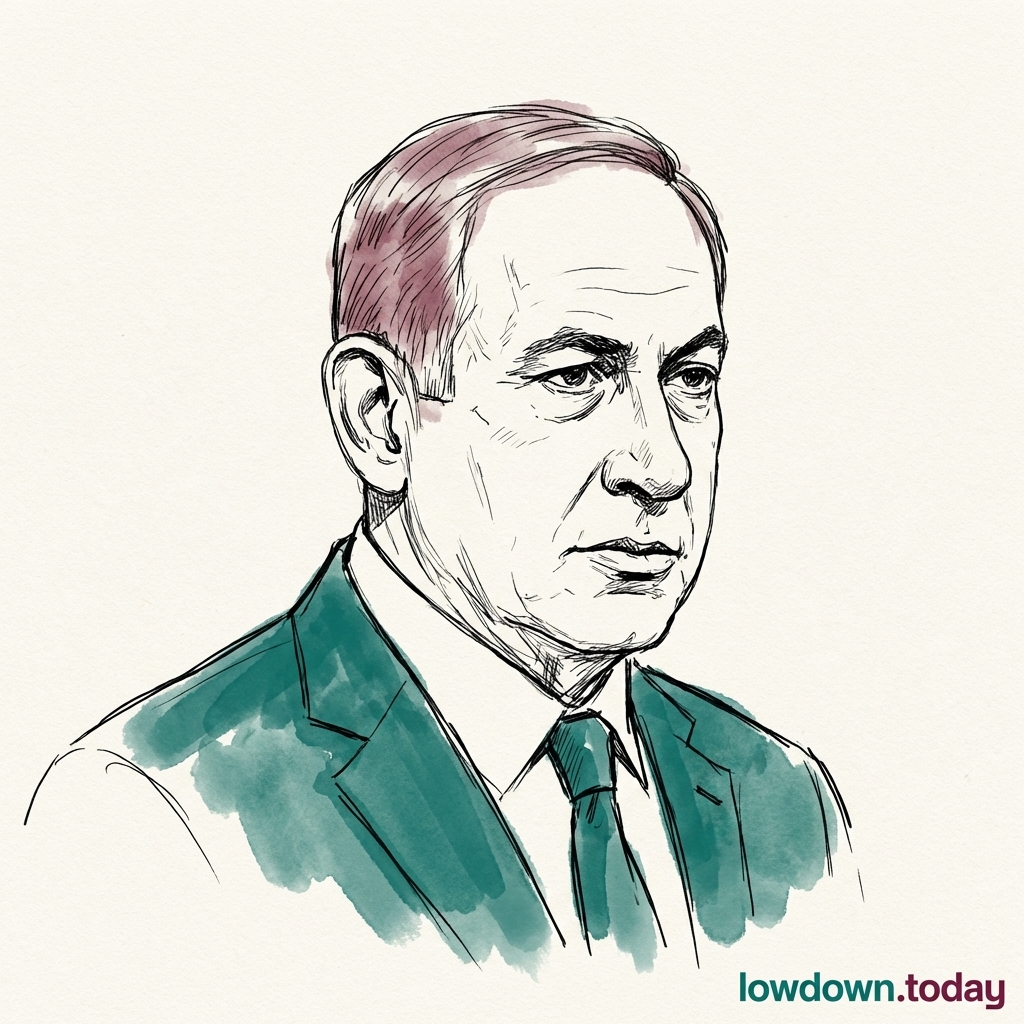
Benjamin Netanyahu
Israel's longest-serving prime minister; prosecuting a multi-front war while fracturing his alliance with Washington.
Last refreshed: 23 June 2026 · Appears in 1 active topic
Is Netanyahu's refusal to withdraw from Lebanon wrecking the Iran nuclear talks?
Timeline for Benjamin Netanyahu
Mentioned in: Hezbollah kills senior IDF tank officer
Iran Conflict 2026Mentioned in: Lebanon talks stall on the Litani map
Iran Conflict 202627 killed in Lebanon as truce frays
Iran Conflict 2026Repeated that IDF troops would stay in Lebanon as long as necessary
Iran Conflict 2026: Iran makes Lebanon the gate to talksIsrael hands back Debbine, keeps the zone
Iran Conflict 2026Background
Israel's longest-serving prime minister faces the sharpest rupture in the US-Israel relationship since the war began. On 9 June, Donald Trump told Netanyahu publicly: "Bibi, you better be careful, or you will be on your own very soon": the first direct presidential threat aimed at Israel rather than Tehran in the conflict. The rebuke followed Netanyahu's decision to authorise the IDF strike on the Karun Petrochemical Complex at Mahshahr on 8 June, targeting solid-fuel missile precursor chemistry, after Trump had explicitly asked Israel not to retaliate for an IRGC salvo on Ramat David Airbase. Within hours, Israel and Iran agreed a mutual halt; Netanyahu confirmed it covers Iran only and explicitly excludes Lebanon.
Netanyahu has held the Israeli premiership across three stints (1996-1999, 2009-2021, December 2022 to present), making him the country's longest-serving leader. A Likud hawk on Iran since his 1995 book predicted nuclear acquisition within five years, he declared Regime change in Tehran an explicit war aim in March 2026 and granted the IDF and Mossad pre-authorisation for targeted killings without prior cabinet approval. His claim that Iran had 'no capacity to enrich uranium' was directly contradicted by the IAEA, which confirmed 440 kg of 60%-enriched uranium remains. The Lebanon front has run parallel throughout: his office declared from the outset that no Ceasefire covers Lebanon, and Israeli forces have pushed north of the Litani River in the deepest incursion in 25 years.
The Islamabad MOU of 18 June crystallised Netanyahu's structural predicament. He admitted at a press conference on 15 June that he had not yet seen the memorandum's text, yet declared Israel had 'saved itself from annihilation'. He was excluded from the diplomacy that produced the MOU; Mediation ran through Qatar, Pakistan, Saudi Arabia, and Turkey. International commentary (from the Washington Post to Haaretz) framed the MOU as a referendum on his leadership. On 20 and 21 June, after the Lebanese Ceasefire renewal collapsed within hours, Netanyahu ordered Israeli forces to hold their positions in south Lebanon rather than pull back, with at least 20 dead on 20 June and 16 on 21 June . On 22 June, he repeated that troops would stay 'as long as necessary' after the IDF carried out a localised redeployment from Debbine toward Khiam, describing it as 'dynamic defence' rather than withdrawal. Iran's nuclear sub-talks remain gated on Lebanon compliance; Netanyahu's hold-position order is the proximate obstacle . He was not a party to the Islamabad MOU and the Swiss round of talks opened 21-24 June without any Israeli delegation present.
What is Netanyahu's position on Iran?
Did Netanyahu claim Iran's nuclear programme was destroyed?
Are the US and Israel disagreeing over the Iran war?
How long has Netanyahu been prime minister of Israel?
Why does the ceasefire not include Lebanon?
Why did Netanyahu carve Lebanon out of the Iran ceasefire?
What did Netanyahu say about regime change in Iran?
How long has Netanyahu been Prime Minister of Israel?
Is Netanyahu at odds with Washington over the Iran war?
Why did Trump threaten to abandon Israel in June 2026?
Why does the Israel-Iran ceasefire exclude Lebanon?
How long has Benjamin Netanyahu been prime minister of Israel?
Did Israel destroy Iran's nuclear programme in the 2026 war?
What is the Karun Petrochemical complex and why did Israel strike it?
Why is Netanyahu not part of the Iran ceasefire deal?
Why won't Israel withdraw from south Lebanon?
What did Trump threaten Netanyahu with?


