
Skip to content
You can now search across every topic, entity and event.What's new
Russia-Ukraine War 2026
16JUN

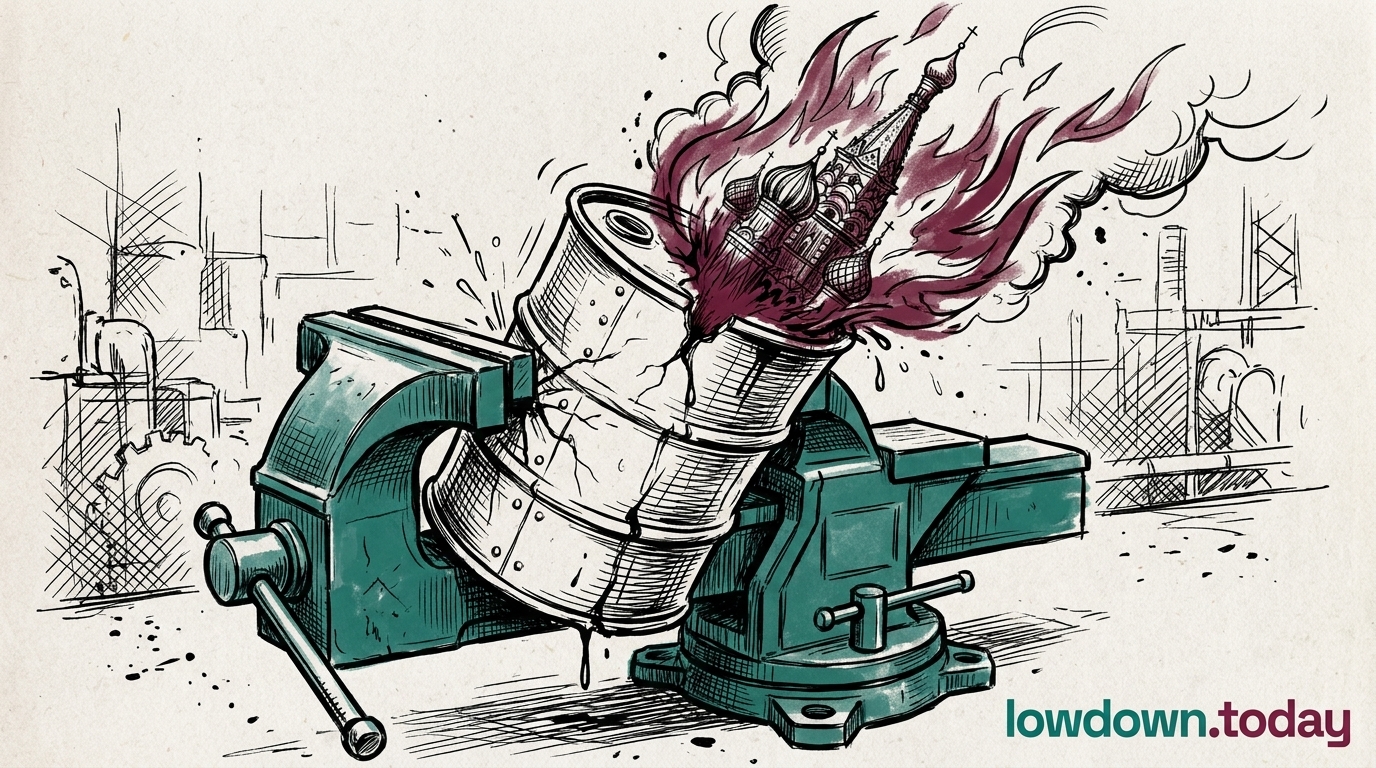
Day 1574: Oil vise shuts as Russia torches the Lavra

4 min read
10:25UTC

Western pressure closed on Russia's war economy from three directions this week: the Iran ceasefire collapsing the Hormuz price premium, the US crude waiver expiring with no successor, and Royal Marines boarding a shadow tanker in the Channel. Russia, unable to move a stalled front, set Kyiv's holiest cathedral ablaze two nights before the G7.

Key takeaway

Russia escalated symbolically as Western economic pressure closed from three directions at once.

This briefing mapped
Loading map…
Military
Economic
Diplomatic
Infrastructure

Russia fired 611 drones and 70 missiles at Ukraine overnight on 14-15 June, killing 11 people and setting the Dormition Cathedral inside Kyiv's holiest monastery ablaze two days before the G7.

Sources profile:This story draws on neutral-leaning sources from United States
United States
LeftRight

Russian forces struck the Kyiv-Pechersk Lavra during an overnight barrage on 14-15 June, killing 11 people. One missile hit the Dormition Cathedral inside the monastery complex; emergency crews put out the fire.

The attack landed two days before the G7 summit in France. Russia denied hitting the monastery, blaming a faulty US interceptor. Open-source analysts point to Iskander-M crater patterns at the site. 

Ukraine intercepted just 15 of 34 Iskander-M ballistic missiles in the 14-15 June barrage, the worst ballistic result of 2026, because the interceptor that stops them is rationed across two wars.

Sources profile:This story draws on mixed-leaning sources from United States
United States
LeftRight

Ukraine shot down only 15 of 34 Iskander-M ballistic missiles fired overnight on 14-15 June. The interceptor that stops Iskanders, called Patriot Advanced Capability-3, is rationed across two wars.

US output runs at roughly 600 rounds per year, with 94% already allocated to other buyers. Ukraine's supply is frozen behind a White House export ban, so each Russian salvo now has a better chance of arriving. 

General License 134C, the US Treasury waiver covering Russian-origin crude, expires at 12:01am EDT on Wednesday 17 June with no successor in sight, stripping shadow-fleet cargoes of their last US legal cover.

Sources profile:This story draws on neutral-leaning sources from United States
United States

The third consecutive 30-day US permit allowing buyers to take Russian oil legally expires at midnight on 17 June, and no fourth permit has been announced.

Losing the permit raises legal risk for buyers and insurers. It compounds the price pressure from the Iran ceasefire ending the Hormuz supply premium in the same week. 

Russia's flagship Urals crude averaged $82.02 a barrel in May, down 12% on April, as Tuapse refinery exports ran 91% below a year earlier and China cut its Russian crude imports by nearly a quarter.

Sources profile:This story draws on neutral-leaning sources

Russia's main export crude averaged .02 a barrel in May 2026, down 12% from April. China cut Russian crude purchases 23% month-on-month and the Hormuz price premium faded as the Iran ceasefire approached.

Russia's total fossil-fuel earnings still rose 2% because Baltic port shipments recovered 49%. Both the price leg and the volume leg face simultaneous pressure now, tightening the squeeze on Russia's war finances. 

Royal Marines rappelled from helicopters onto the Cameroon-flagged tanker Smyrtos in the English Channel on Sunday 14 June, Britain's first boarding of a Russian shadow-fleet vessel in its own waters.

Sources profile:This story draws on neutral-leaning sources from United States
United States

The G7 opened at Evian-les-Bains on Monday 15 June with Ukraine top of the agenda, a day after Trump called Putin and Zelenskyy separately and pledged to refocus on the war now the Iran deal is done.

Sources profile:This story draws on neutral-leaning sources from United States
United States

G7 leaders opened their summit in Evian-les-Bains on 15 June with Ukraine at the top of the agenda. Trump called both Putin and Zelenskyy on 14 June and said he would refocus on Ukraine after the Iran deal.

The G7 agreed to tie further Russia sanctions to peace-talk progress. Putin repeated his precondition that a treaty on Russian terms must come before any summit. The NATO meeting in Ankara on 7-8 July is the next test. 

Europe's largest nuclear plant lost all off-site power for the 19th time on Thursday 11 June after a substation attack, as the sixth IAEA-brokered repair ceasefire broke within days of letting work begin.

Sources profile:This story draws on neutral-leaning sources from Austria
Austria

The Zaporizhzhia Nuclear Power Plant in southern Ukraine lost all external electricity for the 19th time on 11 June when a substation was struck. Russian forces have occupied the plant since March 2022.

The UN nuclear watchdog (IAEA) brokered a sixth local ceasefire to repair the main power line; the truce broke within days. The 330 kV Ferosplavna-1 backup line and diesel generators are maintaining cooling. Six repair ceasefires have now been brokered and broken. 

Britain announced a £210m export-finance deal on Tuesday 16 June for Urenco to supply Ukraine's Energoatom enough enriched uranium to run its Soviet-era reactors for two years, ending dependence on Russian fuel.

Sources profile:This story draws on neutral-leaning sources

Britain announced a £210m export-finance deal on 16 June for Urenco, an Anglo-Dutch-German uranium enrichment company, to supply enriched uranium to Ukraine's Energoatom. The supply covers two years of operation for Ukraine's Soviet-era water-water energetic reactor (VVER) units.

Ukraine has been cutting its nuclear fuel dependence on Russia since 2014. The Urenco deal removes the last major supply-chain lever Moscow held over Ukrainian reactors. 

Russia sent 85 Shahed-type drones at Kharkiv, Donetsk and Odesa on Thursday 11 June, wounding 60 people in Kharkiv Oblast including nine children, three days before the far larger 14-15 June barrage.

Sources profile:This story draws on centre-left-leaning sources from Qatar
Qatar

Russia sent 85 Shahed-type drones at Kharkiv, Donetsk, and Odesa on 11 June, wounding 60 people in Kharkiv Oblast including nine children. The barrage came three days before the larger 611-drone attack that struck the Kyiv monastery.

Shahed drones cost Russia roughly $20,000 each. Shooting one down with an air-defence missile can cost 50 to 100 times more. Russia uses them in large numbers to wear down Ukraine's interceptor stocks as much as to cause direct damage. 

Sources:Al Jazeera

The EU held back the €9.1bn first tranche of its €90bn loan to Ukraine on unmet technical conditions, even as it disbursed a separate €2.8bn Ukraine Facility payment on 8 June.

The EU delayed the first €9.1bn payment from its €90bn loan to Ukraine because Ukraine had not yet met specific technical conditions. A separate €2.8bn payment from a different EU fund was made on 8 June.

The delay does not cancel the loan, but timing matters: if conditions take weeks to satisfy, Ukraine's defence budget faces a gap at its most expensive period. 

ISW assessed Russia net-lost about 91 square miles in the four weeks to 9 June as its offensive stalled, while Meduza flagged the Dobropillia sector as Moscow's new pressure point in western Donetsk.

Sources profile:This story draws on neutral-leaning sources from United States
United States
Closing comments

Upward on the symbolic and economic-warfare register simultaneously. Russia's 611-drone, 70-missile barrage timed two nights before the G7 follows its documented 2024-2026 pattern of clustering strikes at Western diplomatic events; the 2 June 656-drone record and the 14-15 June barrage form a two-week escalation ladder ahead of Evian, with the NATO Ankara summit on 7-8 July 2026 as the next trigger. On the economic front, GL 134C's expiry at 12:01 a.m. EDT on 17 June 2026 and the Smyrtos interdiction represent a step-change in enforcement forcing shadow-fleet adaptation within weeks. The mechanism that tips this further upward: ZNPP's single 330 kV Ferosplavna-1 backup line failing during a 20th blackout, forcing the IAEA into emergency protocols and injecting nuclear-safety escalation into the G7/NATO diplomatic lane.

Different Perspectives
Russia
Russia
Moscow denied targeting the Kyiv-Pechersk Lavra and blamed a malfunctioning US-supplied Patriot interceptor for the cathedral fire, a counter-narrative inserted directly into the G7 summit media cycle. The denial follows the documented IMEMO framing that all barrage targets were legitimate military objectives.
Ukraine
Ukraine
Zelenskyy attended the G7 at Evian and proposed a direct Putin summit while 140,000 households in Kyiv lost power and the Lavra's Dormition Cathedral burned; Metropolitan Epiphanius called it an attack "against history, against Christianity." Kyiv's immediate priority is closing the PAC-3 export gap that left 19 of 34 Iskander-M ballistic missiles unintercepted.
United States
United States
Trump called both Putin and Zelenskyy separately on 14 June, pledged to re-engage on Ukraine now the Iran deal is done, and the G7 tied future Russia sanctions to peace-talk progress, giving Washington leverage over both parties' negotiating posture.
United Kingdom
United Kingdom
Britain conducted its first maritime interdiction of the Russian shadow fleet, with Royal Marines seizing the Smyrtos in the English Channel on 14 June, and simultaneously announced a £210m Urenco uranium deal to break Ukraine's dependence on Russian nuclear fuel.
European Union
European Union
The EU delayed the €9.1bn first tranche of its €90bn Ukraine loan on unmet technical conditions, while disbursing a separate €2.8bn Facility payment on 8 June; the G7 sanctions-to-talks linkage now runs parallel to EU enforcement.
IAEA
IAEA
The IAEA's sixth brokered repair ceasefire at ZNPP collapsed within days of enabling initial work on the 750 kV Dniprovska line, leaving Europe's largest nuclear plant on a single 330 kV backup with 19 total blackouts recorded since the Russian occupation began.