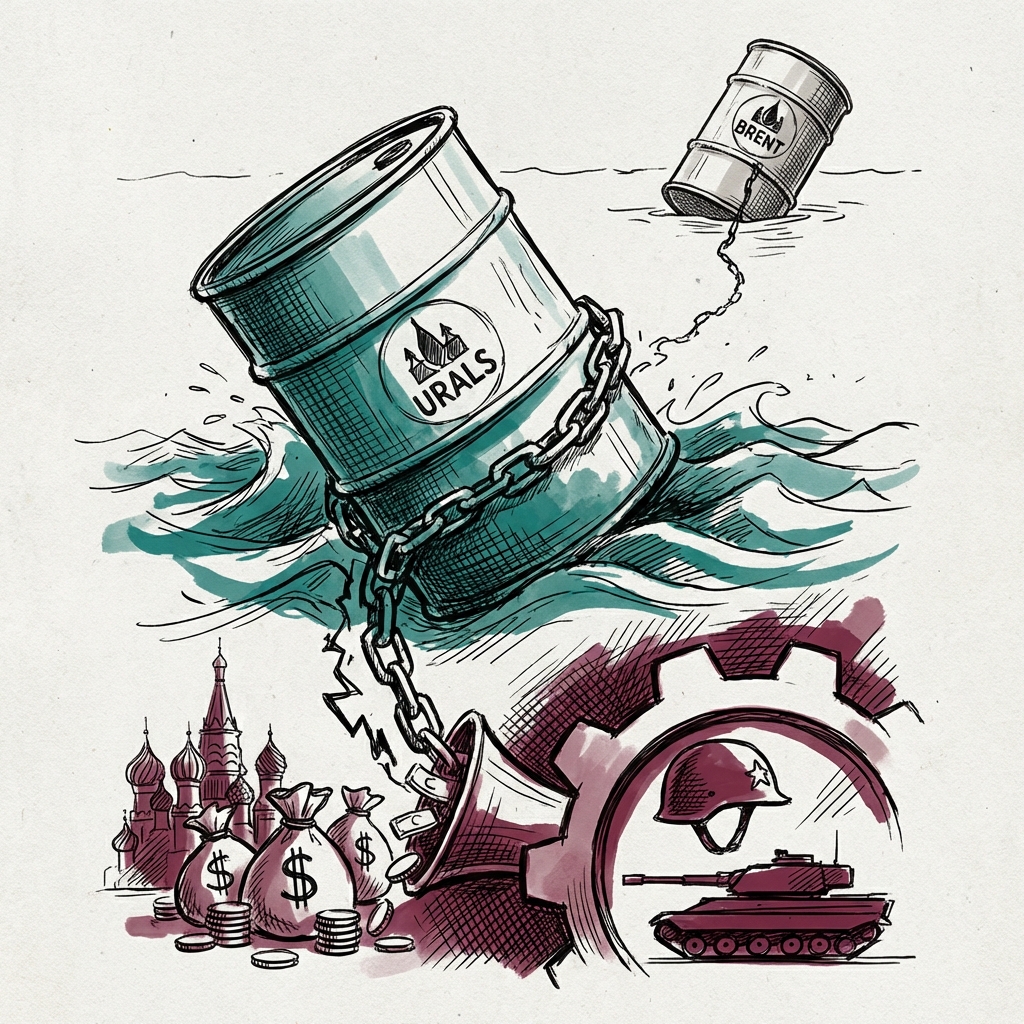
Urals
Russia's crude benchmark; whipsawed from $41.66 to $71.40 in July on the unreplaced US waiver.
Urals, Russia's export crude benchmark, climbed from $41.66 in early July to $71.40 on 23 July 2026, as the US licence permitting legal purchase stayed unrenewed for 36 days.
Last refreshed: 22 October 2026 · Appears in 2 active topics
Urals below Russia's budget line with no OFAC action: is market price the new sanctions?
Timeline for Urals
Mentioned in: Russia plans record 17.1tn for defence
Russia-Ukraine War 2026Mentioned in: Banks stopped buying Russia's war debt
Russia-Ukraine War 2026Urals into India narrows to $1-2
European Oil MarketsMentioned in: Urals crude nearly triples in weeks
Russia-Ukraine War 2026Mentioned in: EU freezes $44 Russia oil cap 12 months
European Oil MarketsBackground
Urals is Russia's medium-sour crude export benchmark, loaded principally from the Baltic terminals of Ust-Luga and Primorsk and the Black Sea terminal at Novorossiysk. Since 2022 it has traded under a G7 price cap regime, currently frozen at $44.10 a barrel, that is intended to let Russian crude keep flowing while limiting the revenue Moscow earns per barrel.
Oil and gas revenue makes up around 30% of the Russian federal budget, so the size of the Urals discount to Brent functions as a direct measure of fiscal pressure on Moscow: a wide discount squeezes government income even without any new sanctions action, while a narrow one signals the cap and enforcement regime losing bite. India and China have become the benchmark's primary buyers since the EU's import ban, and both routinely negotiate larger discounts to compensate for the freight and insurance costs of shadow-fleet delivery.
Licence gaps whipsaw the Urals price
As a benchmark, Urals now swings on legal risk as much as on crude fundamentals: a sequence of US Treasury general licences, each narrower than the last, has repeatedly authorised then cut off Western buyers from handling Russian cargoes, and when GL 134C expired on 17 June with no successor, buyers weighed unrenewed legal cover against non-Western insurance rather than walking away. The benchmark's own price recorded that swing directly: from $41.66 in early July, it climbed inside three weeks to touch $71.40 on 23 July, the sharpest move Urals has logged this year.
The grade's discount to Brent has moved just as sharply by delivery point: Indian buyers paid over $10 a barrel below Brent on 7 July, and by 29 July an unnamed-sources wire put that delivered discount at $1-2, crediting Hormuz risk appetite among Indian buyers. That read has no loading-point corroboration for the same week, so Urals's own basis discount cannot yet be called settled.
Reference
What is KEBCO and how does it relate to Urals crude?
How does Urals oil fund Russia's war?
Why did Urals crude price nearly triple in July 2026?
Why is the Urals discount different in India and at the Baltic loading point?
What is the G7 oil price cap on Russian crude in 2026?
How much has Russia's oil export dropped in 2026?
What share of Russian oil moves on shadow tankers?


Written with AI from Lowdown's published reporting. Not individually reviewed by an editor. Updated 22 October 2026. Editorial standards.