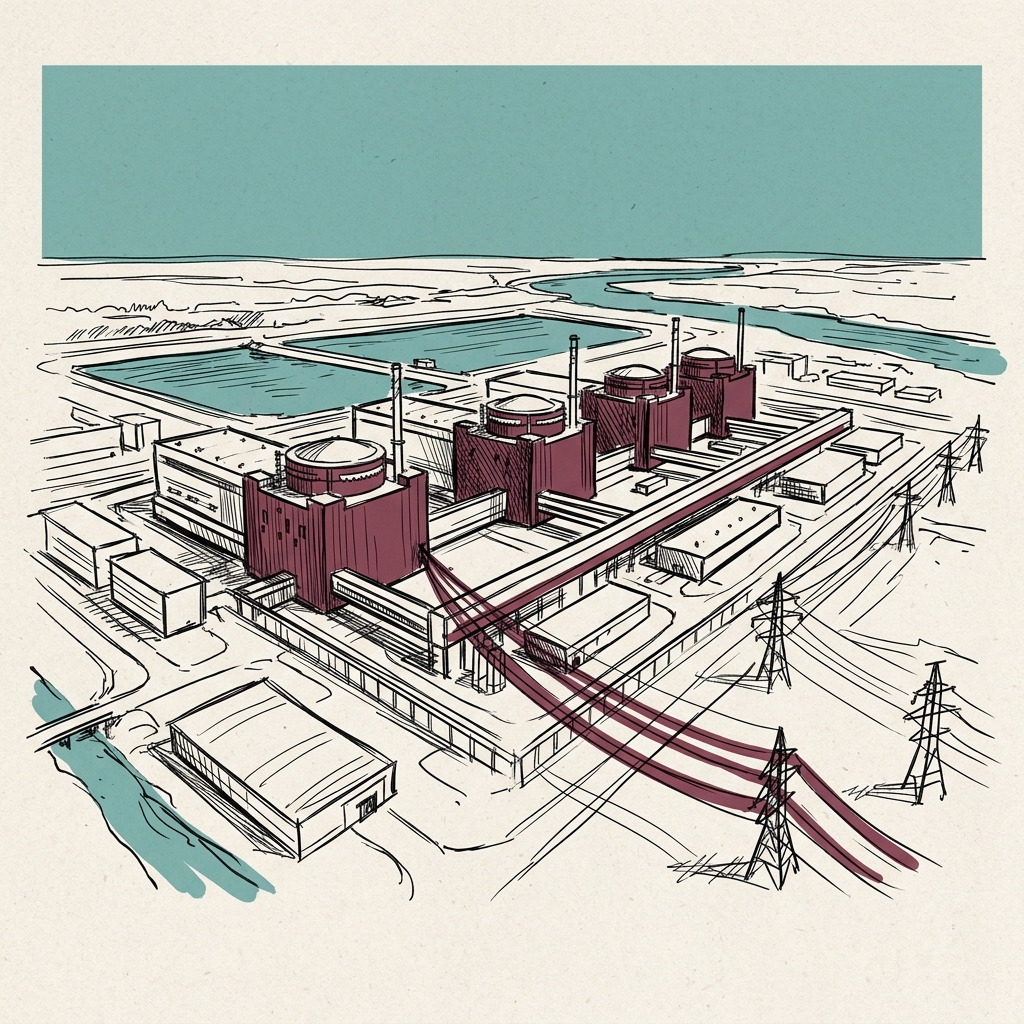
Zaporizhzhia Nuclear Power Plant
Europe's largest nuclear power plant, at Enerhodar; Russian-occupied since March 2022, reactors shut down.
The Zaporizhzhia plant lost its last off-site power line on 20 August, the 26th such loss since 2022, and ran cooling on two diesel generators until a seventh IAEA-brokered local Ceasefire let crews restore power around 8 September.
Last refreshed: 12 October 2026 · Appears in 1 active topic
How many more times can Zaporizhzhia lose its last power line?
Timeline for Zaporizhzhia Nuclear Power Plant
Mentioned in: Russian strikes cut Ukraine's grid links
Russia-Ukraine War 2026Zaporizhzhia loses its last line for nineteen days
Russia-Ukraine War 2026Lost off-site power for the 22nd time
Russia-Ukraine War 2026: Zaporizhzhia loses power for 22nd timeDrone kills chief engineer at Enerhodar
Russia-Ukraine War 2026Fire station falls at Zaporizhzhia plant
Russia-Ukraine War 2026Background
The Zaporizhzhia Nuclear Power Plant at Enerhodar, on the Dnipro in southern Ukraine, is Europe's largest nuclear power station, with six VVER-1000 reactors and a capacity of 5,700MW. Russian forces have held it since March 2022, and the IAEA has kept inspectors on site since September 2022. All six reactors are in cold shutdown.
Shut-down reactors still need outside power to cool their fuel and spent fuel, so the plant's safety rests on its power lines and its diesel generators. It has lost all off-site power 26 times since 2022, most recently on 20 August 2026, and each loss puts it on emergency diesel. On 30 and 31 May a drone hit the turbine building beside reactor 6, the first confirmed strike on a reactor-adjacent structure.
The plant's dependence on single lines makes it a measure of the wider grid war. In October Ukraine's Energy Ministry said Russia had turned to the high-voltage lines that move power between regions.
One line keeps the reactors cool
The plant's six reactors are shut down but still need power to cool their fuel, and for much of 2026 it has depended on a single 330kV line, Ferosplavna-1, after the main 750kV line went down on 24 March. When that line failed on 20 August, staff cut running generators from four to two and ran cooling pumps intermittently; by 29 August about ten days of diesel remained, the regulatory minimum.
A seventh local Ceasefire on 5 September let Ukrainian technicians demine the ground and repair the line, and power returned around 8 September. That left the plant on one connection again, the configuration that failed in August. By mid-July the IAEA had counted 22 losses of off-site power, ten of them in three months.
Drones now strike inside the perimeter
Attacks on the site moved closer to its safety systems in the summer. A drone strike on 30 June damaged the fire station that backs the plant's emergency response, significantly cutting its firefighting capacity, which IAEA inspectors confirmed on 1 July.
On 15 July a drone struck a vehicle at the EDGE of the site and killed chief engineer Alexander Yakovlev and his driver. IAEA Director General Rafael Grossi condemned the attack without assigning blame. In late August inspectors logged three more impacts in one week, near the cooling pond and at the dry spent-fuel store and the sprinkler system.
Moscow licensed two reactors to 2036
Russia has used paperwork to entrench its hold on the plant. In early April its nuclear regulator, Rostekhnadzor, issued 10-year operating licences for units 1 and 2, committing Moscow to running the site under Russian law until 2036. Rosatom said the reactors cannot restart while fighting continues.
Ukraine's regulator and international nuclear bodies reject Rostekhnadzor's authority over a plant inside Ukrainian territory, so the licences are a claim any settlement must explicitly overturn. Meanwhile the plant's survival depends on IAEA-brokered local ceasefires, such as the one in April that allowed repairs to the backup line.
How long has Zaporizhzhia been running on a single power line?
Was the Zaporizhzhia nuclear plant hit by a drone in May 2026?
What would happen if Zaporizhzhia lost all external power?
Is the Zaporizhzhia nuclear plant safe right now?
Who controls the Zaporizhzhia nuclear plant?
Was the Zaporizhzhia nuclear plant's fire station damaged in July 2026?
How many times has Zaporizhzhia lost off-site power?

