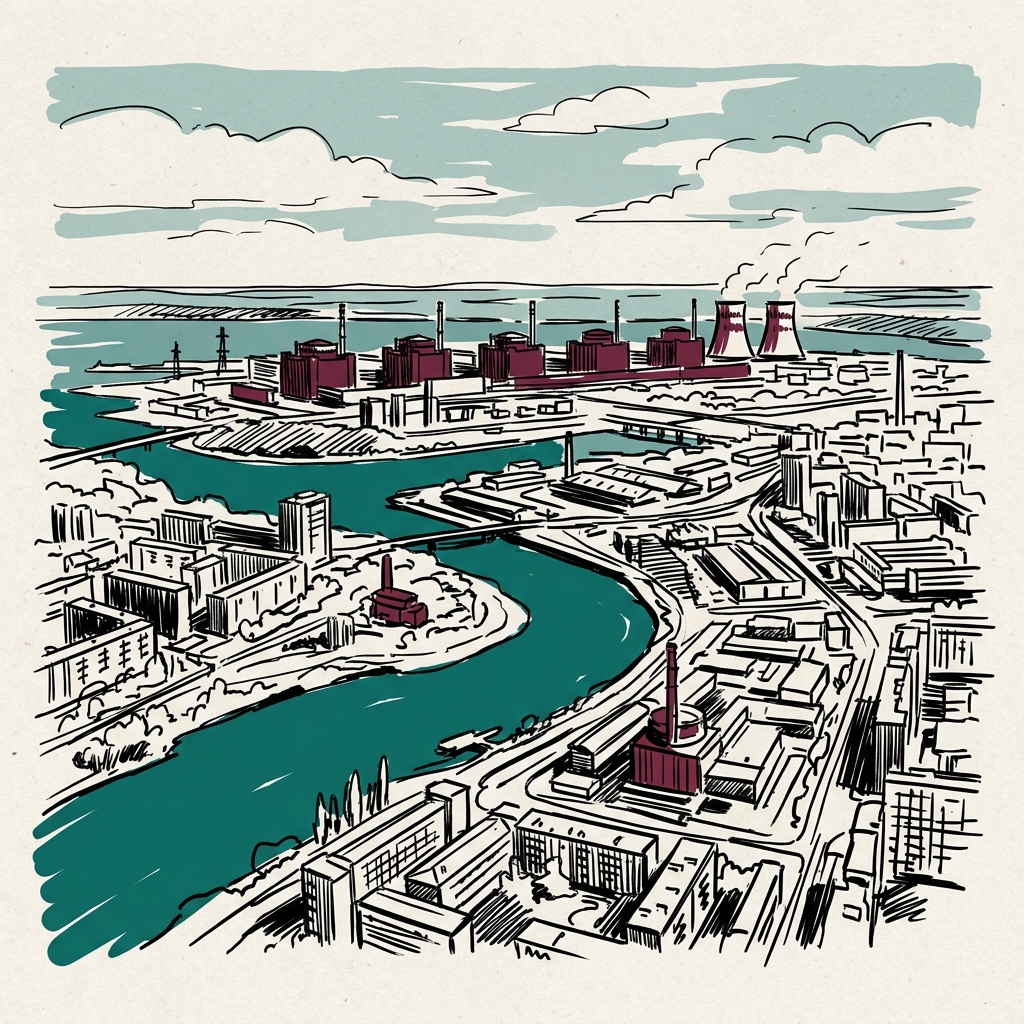
Zaporizhzhia
Ukrainian city on the Dnipro; site of ZNPP, Europe's largest nuclear plant, struck May 2026.
Last refreshed: 1 June 2026 · Appears in 1 active topic
A drone just hit the ZNPP reactor-6 turbine hall. How close is Europe's largest nuclear plant to a crisis?
Timeline for Zaporizhzhia
Mentioned in: Two nuclear sites tested in one week
Russia-Ukraine War 2026Mentioned in: IRGC raid seizes Starlink in Saravan
Iran Conflict 2026Drone hits ZNPP reactor-6 turbine hall
Russia-Ukraine War 2026Russia loses 100 sq miles in four weeks
Russia-Ukraine War 2026Mentioned in: Rosatom Turns on IAEA as ZNPP Hits Day 60
Russia-Ukraine War 2026- Is the Zaporizhzhia nuclear plant in the city of Zaporizhzhia?
- No, the plant is 50km downstream near Enerhodar; the city itself remains under Ukrainian control.Source: IAEA
- Has Ukraine retaken territory near Zaporizhzhia in 2026?
- Ukrainian forces recaptured 460 sq km and eight settlements in the Zaporizhzhia sector between January and March 2026.Source: ISW
- Did Russia annex Zaporizhzhia Oblast?
- Russia claimed to annex it in September 2022 but never fully controlled the territory; the city remains Ukrainian.Source: general
- How many people live in Zaporizhzhia?
- Pre-war population was roughly 700,000; the city has been under repeated Russian missile and drone attacks since 2022.Source: general
- Why is Zaporizhzhia important in the Ukraine war?
- It anchors Ukraine's south-eastern front, hosts Europe's largest nuclear plant, and was the site of Ukraine's most successful 2026 territorial recovery.Source: ISW
- Why is the Zaporizhzhia nuclear plant on backup power for so long?
- The main 750 kV Dniprovska power line was disconnected on 24 March 2026 after damage near the Dnipro River frontline. A repair Ceasefire is required but has not been agreed. As of early May, the plant is running on a single 330 kV backup line; loss of that would put all six reactor units onto emergency diesel generators with finite fuel.Source: IAEA
- What happened at the Zaporizhzhia nuclear plant in May 2026?
- On 30-31 May 2026, a drone struck the turbine building adjacent to reactor 6 at ZNPP, the first confirmed strike on a reactor-adjacent structure. Radiation levels remained normal. The plant was also hit by a 12-hour communications blackout on 27 May. The main 750 kV power line has been disconnected for over 70 days.Source: event
- Is the Zaporizhzhia nuclear power plant in danger of a meltdown?
- ZNPP is in cold shutdown and its reactors are not operating, reducing the meltdown risk. However, the plant relies on external power for cooling. The main power line has been disconnected since 24 March 2026, leaving only one backup line. The IAEA has repeatedly warned that the situation is hazardous. Radiation levels have remained normal throughout.Source: event
- Who controls the Zaporizhzhia nuclear power plant?
- Russian forces seized ZNPP in March 2022 and Rosatom has administered it since. The IAEA maintains a permanent monitoring presence at the site. The plant is near Enerhodar, which is under Russian control, while the city of Zaporizhzhia itself remains under Ukrainian control about 50 km away.Source: event
- What is the 750 kV Dniprovska power line at Zaporizhzhia?
- The 750 kV Dniprovska line is ZNPP's main external power feed, essential for cooling systems. It was disconnected on 24 March 2026 and remained unrepaired for over 70 days as of late May. The plant has fallen back on the sole 330 kV Ferosplavna-1 backup line, with diesel generators as the last resort.Source: event
Background
Zaporizhzhia is a major industrial city in south-eastern Ukraine with a pre-war population of roughly 700,000. It sits on the Dnipro River and serves as the administrative centre of Zaporizhzhia Oblast, one of four Ukrainian regions Russia claimed to annex in September 2022 despite never fully controlling the territory. The city itself has remained under Ukrainian control throughout the full-scale invasion, though it has suffered repeated Russian missile and drone strikes. The city's global profile is dominated by the Zaporizhzhia Nuclear Power Plant (ZNPP), Europe's largest nuclear facility, located roughly 50 kilometres downstream near Enerhodar. Russian forces seized the plant in March 2022, and it has operated in cold shutdown since September 2022. The IAEA maintains a permanent monitoring presence.
Zaporizhzhia's nuclear plant emerged as a point of comparison during the Iran conflict after Israeli strikes on Iran's Bushehr nuclear facility in spring 2026 raised international alarm about attacks on nuclear sites. A projectile struck within the Bushehr plant perimeter in March 2026, 350 metres from Iran's only operational reactor, the second strike near the reactor in eight days. The fourth Bushehr strike in April 2026 killed one security guard and prompted Rosatom to evacuate 198 additional staff toward the Armenian border. IAEA Director General Grossi warned that nuclear sites must never be attacked. Russia, which condemned the Bushehr strikes, simultaneously operates the ZNPP under conditions the IAEA has described as uniquely hazardous, creating a double standard that Western governments and nuclear safety organisations have publicly noted.
The plant's main external power line, the 750 kV Dniprovska, was disconnected on 24 March 2026 and remained unrepaired for over 70 days, leaving ZNPP dependent on the sole 330 kV Ferosplavna-1 backup feed. ZNPP lost all external power for the fourteenth and fifteenth times of the war in late April 2026, and nuclear alert sensors were destroyed by a drone strike on 13 May 2026 while the main line remained disconnected for 50 days.
On 30-31 May 2026, a drone struck the turbine building adjacent to reactor 6, the first confirmed strike on a reactor-adjacent structure at ZNPP. The IAEA confirmed debris and a damaged metal hatch; radiation levels remained normal. ZNPP also suffered a 12-hour communications blackout on 27 May 2026, preventing real-time reporting to the IAEA monitoring team. Russia's Rosatom simultaneously issued 10-year operating licences for ZNPP reactors through 2036, a move the IAEA has not endorsed.
Zaporizhzhia Oblast has been the site of Ukraine's most successful territorial recovery since the 2023 counteroffensive. Ukrainian forces recaptured approximately 460 square kilometres and eight settlements in the Zaporizhzhia sector between late January and March 2026. The concurrent nuclear safety risk and frontline recovery make Zaporizhzhia the most strategically dense single location in the conflict.