
Skip to content
Iran Conflict 2026
18APR

Day 50: Hormuz opens and closes in 24 hours

10 min read
14:57UTC

Iran declared the Strait of Hormuz open at 05:00 GMT on 17 April; Trump replied the US blockade would remain in full force; Iran's joint military command reimposed restrictions within 24 hours and IRGC gunboats fired on an Indian-flagged tanker. GL-U lapses at 00:01 EDT on Saturday on a Treasury Secretary's cable-TV quote, with no published instrument; Paris was 51 nations, not 40; and the WPR clock hits 29 April with Senator Josh Hawley now signalling an AUMF vote. Forty-nine days of war; zero Iran executive instruments signed.

Key takeaway

Forty-nine days of war, zero signed instruments; four unsigned deadlines converge in eleven days.

In summary

Iran declared the Strait of Hormuz open at 05:00 GMT on 17 April, then IRGC gunboats fired on an Indian-flagged super tanker within 24 hours and Iran's joint military command reimposed restrictions, citing US "breaches of trust". Brent crude fell 9.07% to $90.38 on the announcement and recovered almost entirely when the strait closed again, pricing a press conference rather than physical passage. Four deadlines with no executive instruments behind any of them now converge inside eleven days: GL-U lapses at 00:01 EDT on Saturday, the Iran ceasefire expires 22 April, the Lebanon truce around 26 April, and the WPR 60-day clock on 29 April.

This briefing mapped
Loading map…
Military
Regulatory
Diplomatic
Legal
Humanitarian

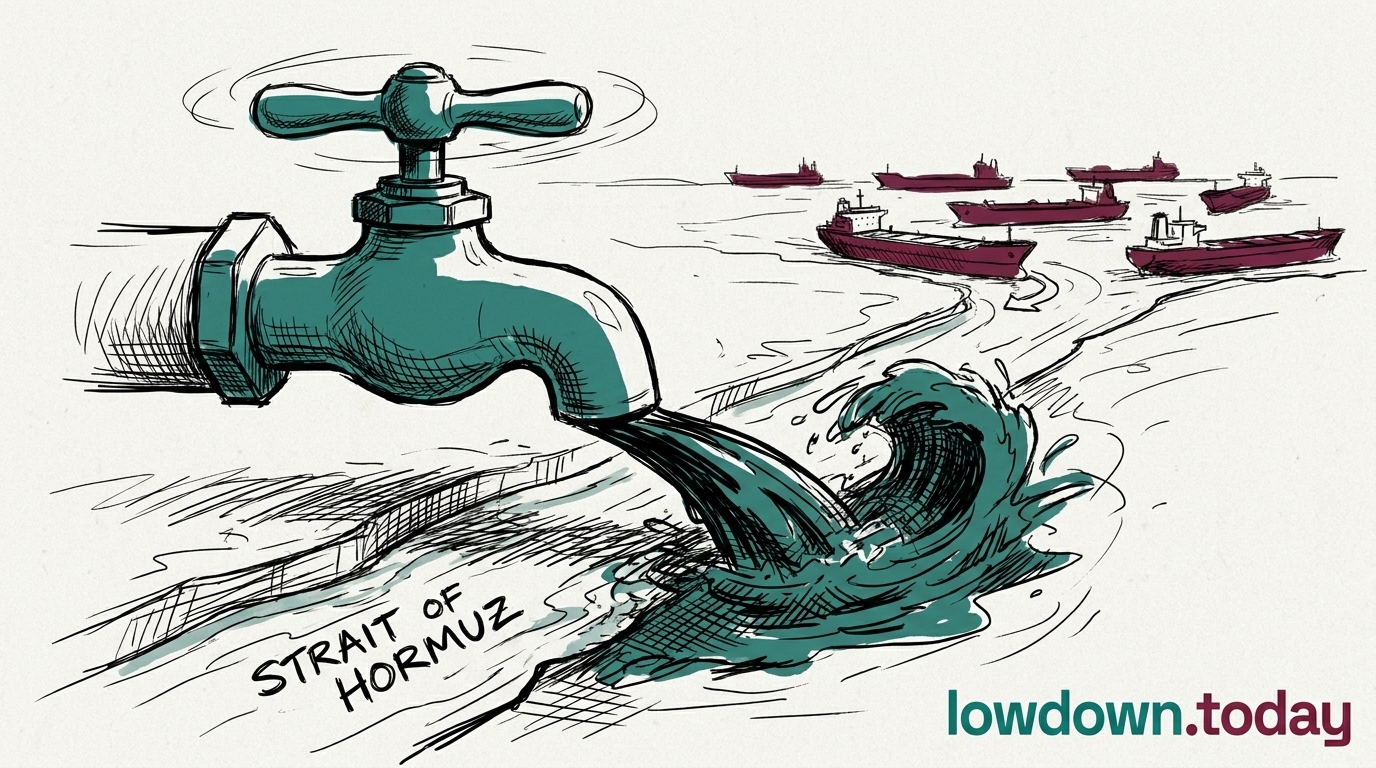
Iran declared the strait open at 05:00 GMT on 17 April. Within a day IRGC gunboats were firing on an Indian-flagged super tanker.

Sources profile:This story draws on mixed-leaning sources from United States and United Arab Emirates
United StatesUnited Arab Emirates
LeftRight

Abbas Araghchi announced at 05:00 GMT on 17 April that the Strait of Hormuz was "completely open for the remaining period of ceasefire, on the coordinated route as already announced by Ports and Maritime Organisation" 1. Hours later Donald Trump said the US naval blockade "will remain in full force" until a complete deal is reached. On 18 April Iran's joint military command stated that "control of the Strait of Hormuz has returned to its previous state under strict management and control of the armed forces", citing US "breaches of trust" 2. That CENTCOM order narrowed to Iranian ports supplied the breach-of-trust language Tehran cited when it closed the window.

UK Maritime Trade Operations (UKMTO), the Royal Navy's maritime reporting body, confirmed that two Islamic Revolutionary Guard Corps (IRGC) gunboats opened fire on a tanker transiting the strait on 18 April; an Indian-flagged super tanker was among the vessels forced to turn around 3. The only ship recorded transiting during the open window was the empty cruise vessel Celestyal Discovery. Kpler and Windward logged transits falling from 15 on 15 April to 8 on 17 April, the opposite of what an opening announcement would predict.

Brent crude fell 9.07% to $90.38 on the announcement and reversed almost completely when the strait closed again. The Truth Social blockade post of Day 45 and the CENTCOM carve-out remain the only US instruments in play; neither has been signed. Brent has now priced two statements and one gunboat incident inside a single session, while Kpler transits fell. The insurance market is pricing the gap between press conferences and passage, and the IRGC gunboat strike has imported a flag-state, India, directly into the blockade diplomacy three days before the GL-U lapse window.

Explore the full analysis →

US Treasury Secretary Scott Bessent told Tribune India on 16 April that General License U would not be renewed; OFAC signed a Russia replacement the next day and excluded Iran by name. No Federal Register instrument followed for Iran.

Sources profile:This story draws on mixed-leaning sources from India
India
LeftRight

US Treasury Secretary Scott Bessent, the cabinet official responsible for the Office of Foreign Assets Control (OFAC) sanctions framework, told Tribune India on 16 April: "We will not be renewing the general license on Russian oil and Iranian oil. That was oil that was on the water prior to March 11th. All that has been used" 1. The Federal Register carried zero Iran or OFAC documents between 15 and 18 April. The White House presidential-actions index for 15 April listed nine Enbridge Energy pipeline permits and a budget sequestration order, with nothing on Iran .

General License U (GL-U), the Treasury authorisation that kept Iranian crude in transit legal under a narrow wind-down rule, therefore lapses at 00:01 EDT on Sunday 19 April with no replacement instrument and no published wind-down schedule. Approximately 325 tankers carrying roughly $31.5 billion of cargo lose legal cover at that moment . Secondary-sanction exposure shifts to Indian refiners and third-country buyers from the same minute, and compounds on top of the IRGC enforcement exposure already pricing the corridor since the blockade began .

OFAC Director Bradley T. Smith signed General License 134B (GL 134B) on 17 April at 14:38 EDT, authorising the delivery and sale of Russian-origin crude and petroleum products loaded on vessels as of that date, valid through 12:01 EDT on 16 May 2026 2. The instrument supersedes GL 134A, dated 19 March 2026 and expired on 11 April. GL 134B explicitly excludes from its authorisation "Any transaction involving a person located in or organized under the laws of the Islamic Republic of Iran" and separately bars any transaction involving "Iranian-origin goods or services" prohibited under the Iranian Transactions and Sanctions Regulations (31 CFR part 560). Russia received a signed 30-day wind-down by the same OFAC machinery that produced nothing for Iran.

Scott Bessent said on 16 April that Treasury would not renew the Russian or Iranian general licence; the signed instrument published the following day extended Russia's wind-down and wrote Iran out by name. Treasury signed paper for Russia on the same day Iran's compliance window was narrowing to hours. Compliance officers at Indian state refiners, Chinese teapots, and commodity trading houses will each apply their own reading of "Bessent said" because no OFAC instrument enumerates the prohibited-transactions scope for Iran, the grace period, or the replacement. Enforcement discretion sits with the first OFAC designation published after Sunday, whenever that arrives. The 49-day zero-Iran-instrument record the White House index confirms now includes a regulatory cliff built inside that same silence, and a Russia parallel that shows the machinery was available.

Explore the full analysis →

A Macron-Starmer joint statement published on GOV.UK on 17 April put the Hormuz coalition at 51 nations. Most coverage is still running the 40-nation figure.

The Macron-Starmer joint statement published on GOV.UK on 17 April gave the Hormuz coalition at 51 nations, not the 40 reported in the first wave of coverage 1. The 27% upward correction is a primary-source fact from the UK government's own publication platform that has not yet displaced the 40-nation figure in most wire copy. The statement characterises the mission as "strictly defensive" and makes deployment contingent on "a sustainable ceasefire agreement".

Italy, France, the UK and Germany were named; the Gulf Cooperation Council (GCC) and Saudi Arabia were not. The United States was not in the room and will be "briefed on the outcome". Military chiefs from the 51-nation coalition will meet at Northwood, the UK Permanent Joint Headquarters in north-west London, in the week of 20 April to draft rules of engagement . Over a dozen countries have offered assets, logistics or finance.

The deployment trigger binds the mission to whichever architecture emerges from the 22 April ceasefire expiry question, which is the same ceasefire Tehran is currently running a 24-hour open-and-close cycle on. Rules of engagement written at Northwood by UK and French officers will reflect European legal preferences drawn from UNCLOS transit-passage doctrine, the same legal spine the European Union used when it rejected Trump's Hormuz toll joint venture earlier in the war. In international maritime law, the first credible multilateral text usually holds; any later US arrangement will either reach into this framework or argue round it.

Explore the full analysis →
Briefing analysis
What does it mean?

Forty-nine days into the Iran war, the pattern across every event in this update is the same: statements move markets, fire IRGC gunboats, fill parliamentary records, and produce coalition counts; signed instruments from either side do not exist. The Hormuz 24-hour cycle is the sharpest instance. Iran's Foreign Minister declared the strait open at 05:00 GMT; Trump said the blockade remained; IRGC gunboats fired on an Indian tanker; Iran's joint military command closed the strait again, all inside one trading session, and Brent recovered its entire 9.07% fall before London closed.

GL-U lapses Saturday on a cable-television quote with no Federal Register text, leaving 325 tankers and $31.5 billion of cargo in a sanctions grey zone OFAC has not defined in 49 days. The Northwood ROE drafting week of 20 April will produce the first credible multilateral Hormuz text of the war, and it will be written by British and French officers without the Pentagon in the room. An AUMF floor vote at the 29 April WPR deadline would be the first US executive instrument of the war, produced under the most adversarial legislative conditions available.

Watch for
  • Whether any emergency Treasury instrument or OFAC designation appears after 00:01 EDT Saturday, defining the GL-U enforcement perimeter. Whether the 22 April ceasefire receives a signed extension or lapses with Rezaei's Hormuz-control precondition still on the record. Whether Northwood produces a draft ROE text that attracts Gulf basing commitments from GCC states before the deadline stack resolves. Whether Congress produces an AUMF floor vote or a fifth WPR attempt before the 29 April clock.

Ebrahim Rezaei told Iranian media that Tehran will not extend the ceasefire unless the extension hands Iran control of the Strait of Hormuz.

Sources profile:This story draws on centre-left-leaning sources from Qatar
Qatar

Ebrahim Rezaei, spokesman for Iran parliament's national security committee, told Iranian media that Tehran will not agree to extend the ceasefire unless the extension includes Iranian control of the Strait of Hormuz 1. AP and Bloomberg reported an "in-principle" two-week extension based on unnamed regional mediators. White House press secretary Karoline Leavitt confirmed that Washington had not formally requested an extension: "The US has not formally requested a ceasefire extension." No signed text has been published.

The wire reporting rests on unnamed mediators; the Iranian parliamentary track is on the record through Rezaei. In Iranian decision-making under wartime Mojtaba Khamenei , a precondition stated publicly by the national security committee spokesman is a harder ceiling than an unattributed mediator claim, because the latter cannot be ratified through the institutional chain the former represents. Asim Munir's Tehran shuttle secured monitoring movement through the general-officer channel, but monitoring is not the ceasefire instrument.

Tasnim News Agency characterised Reuters and AP sourcing on the extension as "psychological operations by the American negotiating team". Tehran used the same register to deny the Day 3 enrichment-ban claim and the Day 40 Hormuz reopening claim, which places the in-principle extension story inside the Iranian state media bucket for hostile messaging rather than diplomacy. Rezaei's precondition and the Trump-stated US blockade posture cannot both be satisfied by Tuesday evening.

Explore the full analysis →
Sources:Al Jazeera

Trump told reporters on 17 April that Iran had 'agreed to everything', including handing over its enriched uranium. Tehran denied it within hours.

Sources profile:This story draws on mixed-leaning sources from United States
United States
LeftRight

Donald Trump told reporters on 17-18 April that Iran had "agreed to everything", including handing over its enriched uranium stockpile to the United States, and said a deal could be "finalised in the next day or two". Asked whether he might fly to Islamabad to seal it, he said "I may" 1. Iran's Foreign Ministry spokesperson responded within hours: "Iran's enriched uranium is not going to be transferred anywhere."

Abbas Araghchi had previously confirmed, in the 13 April CBS interview, that Iran cannot currently enrich uranium at any surviving facility because of strike damage at Natanz, Esfahan and Fordow. The stockpile being discussed is materiel from destroyed plants, not the output of an operational programme. Mojtaba Khamenei's written position that nuclear weapons are "a matter of life and not a matter for negotiation" remains the institutional ceiling any civilian negotiator would have to break through; an uranium handover would breach that position on the most sensitive materiel Iran still possesses.

This is the fourth instance in 49 days of Trump claiming Iranian agreement only for Iran to deny it within hours. Day 3: enrichment ban (denied, with Khamenei's written statement the doctrinal cover). Day 40: Hormuz reopening (did not reopen). Day 48: war "very close to over" . Day 49: uranium transfer (denied same day). Tasnim News Agency's "psychological operations" framing now applies to US presidential statements at the level of doctrine, not rhetoric, and the Brent market is discounting each claim faster: the swing from the 17 April opening lasted hours, not days.

Explore the full analysis →
Sources:The Hill·CNN
Causes and effects
Why is this happening?

The Trump administration's 49-day absence from the Federal Register on Iran reflects a structural choice: any executive instrument creates a discoverable paper record that defines the war's legal architecture, constrains future negotiating positions, and becomes a target for congressional oversight and litigation.

Running the war on social-media posts and spokesperson statements preserves maximum executive discretion at the cost of counterparty legibility. GL-U lapses into that same void: it expires by its own terms without requiring a published instrument, meaning Treasury achieves a sanctions tightening without a text that OFAC compliance officers, Indian state refiners, or Chinese commodity houses can read.

A 10-day Israel-Lebanon ceasefire took effect at 17:00 local on 17 April. An Israeli strike killed one civilian in Kounine within 24 hours.

Sources profile:This story draws on centre-leaning sources from France
France
LeftRight

A 10-day Israel-Lebanon ceasefire took effect at 17:00 local on Friday 17 April . Benjamin Netanyahu told his cabinet that Israel Defense Forces (IDF) troops would not withdraw from the 10-kilometre southern Lebanon "security zone" during the truce and that the ceasefire did not apply to Hezbollah operations 1. An Israeli strike killed one civilian in Kounine, a village in southern Lebanon, within the first 24 hours. The Lebanese Army reported multiple Israeli violations, including intermittent shelling in southern villages.

Trump posted on Truth Social that Israel was "PROHIBITED" from bombing Lebanon after Netanyahu's cabinet remark that the Lebanon fight was "not over" . The truce itself was announced through the same Truth Social channel, not through a published text with Lebanese counter-signatures. Hezbollah is explicitly outside the agreement, which leaves no armed Lebanese party bound to the ceasefire the Israeli prime minister has already partially disowned.

The Lebanon truce expires around 26-27 April, four days after the Iran ceasefire expires on 22 April. Two verbal truces are now stacked on top of each other, neither backed by a published bilateral text, both announced from a US president's social-media account rather than from a State Department readout. The Iran 22 April expiry and the Lebanon 26-27 April expiry land inside the four-deadline convergence window this briefing's WPR and GL-U sections set out.

Explore the full analysis →
Sources:Euronews

Senator Josh Hawley told reporters on 15 April that Congress should vote on a military authorisation at the end of 60 days of Iran hostilities.

Sources profile:This story draws on neutral-leaning sources

The Senate blocked a fourth War Powers Resolution (WPR) 47-52 on 15 April . Senator Josh Hawley (Republican of Missouri) told reporters afterwards: "at the end of 60 days, I think we need to vote on a military authorization" 1. Hawley added that Donald Trump "does have to come back to Congress" at the 60-day mark and either file a report or seek authorisation.

The WPR 60-day clock, triggered by the 28 February start of hostilities, runs out on Wednesday 29 April, eleven days from this briefing. The House came within one vote of ordering withdrawal on 16 April, failing 213-214 . Thomas Massie (R-KY) crossed to support withdrawal and three Democrats who had opposed the 12 April House version, Juan Vargas, Greg Landsman and Henry Cuellar, flipped to support this one. Members of both caucuses have moved in opposite directions on consecutive votes, which means the headline partisan alignment is churning, not hardening.

A Republican senator moving from blocking WPR withdrawals to signalling an authorisation vote opens a third path a Trump-aligned chamber can walk without defecting on headline partisanship. An Authorization for Use of Military Force (AUMF) vote on the floor would produce the first signed Iran instrument of the war, under maximally adversarial legislative conditions, and would collapse the verbal-track architecture every prior section of this briefing documents. Roll Call and NOTUS have placed Majority Leader John Thune on the record as working options. The historical comparison is February 2020, when an Iran WPR passed the Senate 55-45 with eight Republican crossovers; Trump vetoed and the override failed. The arithmetic on withdrawal runs closer in 2026, but the two-thirds veto geometry has not moved.

Explore the full analysis →
Sources:Roll Call

Netblocks recorded Iran's nationwide internet shutdown at its 49th consecutive day on 17 April, the longest such outage in recorded global history.

Sources profile:This story draws predominantly on Russia state media, with sources from Russia
Russia

Iran's internet blackout reached its 49th consecutive day on 17 April, the longest nationwide shutdown in recorded global history per NetBlocks, the internet governance observatory that tracks state-ordered disruption . The running total published by NetBlocks stood at 1,152 cumulative blackout hours. Connectivity sat at roughly 1% of pre-war levels. Fazlollah Ranjbar, an Iranian MP, told state media on 17 April that "it may not be advisable for the Internet to be available under such circumstances" 1. NetBlocks put the cumulative economic cost at $1.8 billion as of 16 April.

A senior Iranian MP publicly endorsing the shutdown as considered policy moves the blackout from a technical emergency measure into the domestic political record, which is where the 221-0 Majlis vote to suspend IAEA cooperation already sits. Ranjbar's on-record defence on 17 April is what shifts the framing from stop-gap to declared policy. Possession of a Starlink terminal is punishable by death and Iran has deployed military-grade jamming across major cities. An Iranian official said on 12 April there was no timeline for restoration.

A population that cannot verify either the civilian government's position or the Mojtaba Khamenei succession claim against each other is the domestic half of the same verification vacuum the nuclear negotiation is stuck in. The Asim Munir four-country monitoring framework would give the outside world eyes on the programme; the blackout keeps Iran's own public in the dark about what is happening in the same institutions. Business-only internet packages through state channels cover trade flows but not civil society.

Explore the full analysis →
Sources:TASS

In Brief

  • Siri Island storage tank (approximately 1 million barrel capacity) heavily damaged and on fire per Windward synthetic-aperture radar imagery on 15 April; no official cause reported; unreported in news coverage .
  • USS Gerald R. Ford aircraft carrier transited the Suez Canal and is now operating in the Red Sea; US forces authorised to pursue Iran-linked vessels in Indo-Pacific regions.
  • Windward counted 23 ships turned around by the US blockade since 13 April, up from 21.
  • Approximately 700 ships remain stuck in the Persian Gulf, including 250 tankers holding 165 million barrels.
  • Tasnim News Agency characterised Reuters and AP sourcing on the ceasefire extension as "psychological operations by the American negotiating team".
  • The four-country monitoring framework Asim Munir proposed remains nameless; Pakistan is implicitly one member; no others publicly confirmed.
  • The White House presidential-actions index for 15 April: nine Enbridge Energy pipeline permits and a budget sequestration order; zero Iran.

Watch For

  • Whether the GL-U lapse produces any emergency Treasury instrument, OFAC delisting, or State Department secondary-sanction announcement after 00:01 EDT on 19 April.
  • Whether OFAC publishes an Iran parallel to GL 134B before or after the 19 April GL-U expiry, or whether the Iran carve-out in GL 134B hardens into a standing policy distinction renewed through subsequent instruments.
  • Whether the 22 April Iran ceasefire gets a signed extension, a verbal extension only, or lapses entirely.
  • Whether Hormuz stays closed, reopens again, or produces a mass-casualty mine or gunboat incident before the ceasefire expiry.
  • Whether Congress produces a floor vote on AUMF or a third WPR attempt before the 29 April clock.
  • Whether Chinese or Indian tanker routing shifts after the GL-U lapse and the Bessent secondary-sanctions warning.
Closing comments

The IRGC gunboat attack on an Indian-flagged tanker on 18 April is the first direct flag-state escalation of the blockade period. Combined with the GL-U lapse Saturday and the Hormuz transit collapse (8 on the open day versus 15 two days earlier), the strait is physically more restricted after the announcement of an opening than before it. The Lebanon truce fraying within 24 hours of taking effect, with Hezbollah outside the agreement, adds a second front where verbal ceasefires are already producing casualties. Escalation direction: upward on both maritime and land tracks, with the four-deadline convergence window creating maximum institutional pressure between 19 and 29 April.

Different Perspectives
Iran (Foreign Ministry)
Araghchi declared Hormuz open on 17 April then Iran's joint military command reimposed restrictions within 24 hours, citing US breaches of trust, while the IRGC fired on an Indian tanker. Iran's parliamentary security committee simultaneously set Hormuz control as a non-negotiable ceasefire extension precondition, leaving the civilian and military tracks at odds over what any deal would actually contain.
United States (White House)
Trump stated the US blockade would remain in full force after Araghchi's opening announcement, then told reporters Iran had agreed to everything including a uranium handover; Iran denied it within hours. White House press secretary Leavitt confirmed the US had not formally requested a ceasefire extension, removing diplomatic cover from the in-principle deal reported by wire services.
United Kingdom (Starmer government)
Starmer co-signed the GOV.UK joint statement confirming a 51-nation Hormuz coalition and will host military chiefs at Northwood in the week of 20 April to draft rules of engagement without US participation. Britain is now co-writing the post-war Hormuz legal architecture while the Pentagon is scheduled only to be briefed on the outcome.
France (Macron government)
Macron co-chaired the 17 April Paris summit and co-signed the GOV.UK statement correcting the coalition count to 51 nations, with French officers participating in Northwood ROE drafting. France filed a flag-state protest over Hormuz toll interdiction earlier in the war and is now the co-author of the multilateral text that any future US arrangement will have to negotiate against.
Israel (Netanyahu government)
Netanyahu told his cabinet on 17 April that IDF troops would not withdraw from the southern Lebanon security zone during the 10-day truce and that the ceasefire did not cover Hezbollah operations; an Israeli strike killed a civilian in Kounine within 24 hours. Netanyahu's carve-outs directly contradict Trump's Truth Social post prohibiting Israel from bombing Lebanon.
Lebanon (Lebanese Army / Hezbollah)
The Lebanese Army reported multiple Israeli violations including the Kounine civilian death within the first 24 hours of the truce. Hezbollah was explicitly excluded from the agreement and has published no position on its terms, leaving the truce without any armed Lebanese party bound to it.
