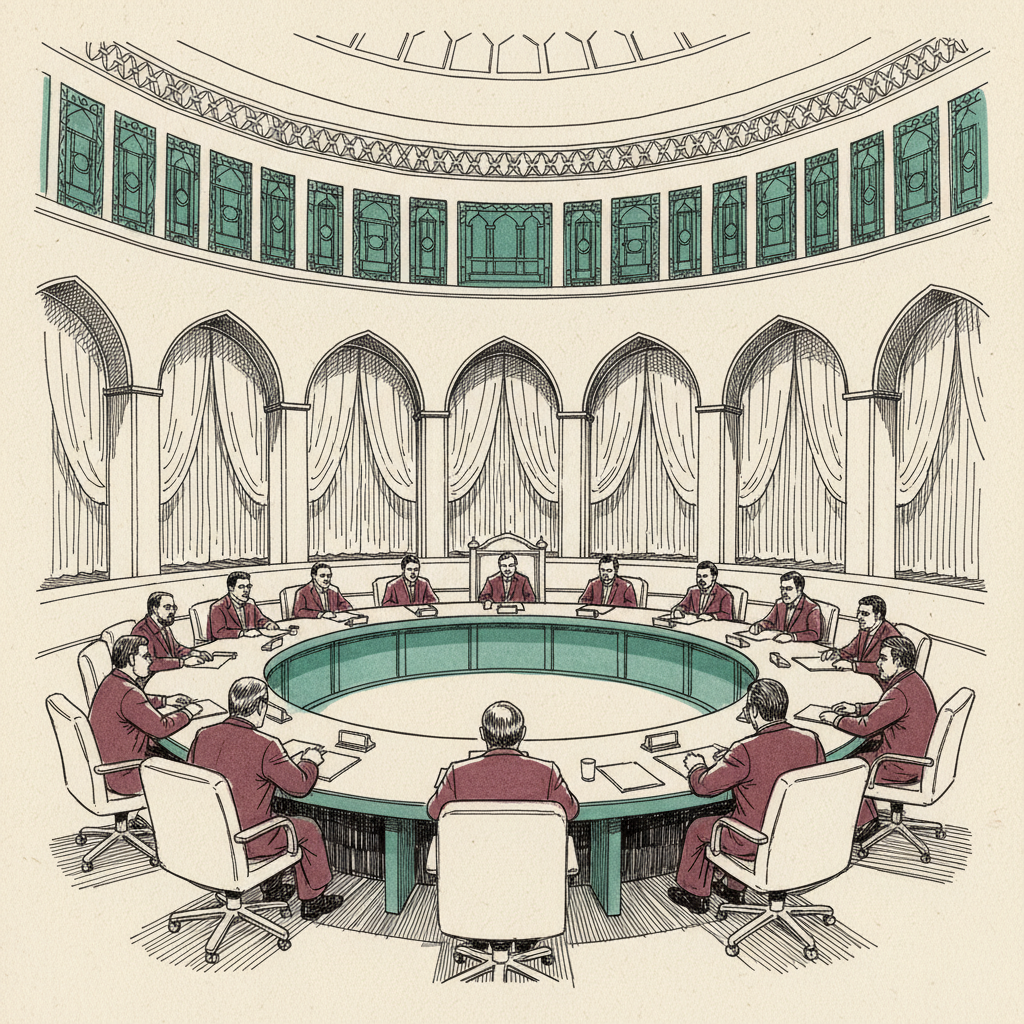
Iran parliament's national security committee
Iran's Majlis committee that sets parliamentary redlines on nuclear, Hormuz, and Ceasefire policy.
Iran's parliamentary National Security Committee took up an expanded Hormuz transit bill on 6 August 2026 that would bar Israel-linked cargo and impose fines up to 20% of cargo value, paid in rial; Washington rejected the plan within days.
Last refreshed: 22 September 2026 · Appears in 1 active topic
Has Iran's parliament made a negotiated Hormuz settlement structurally impossible?
Timeline for Iran parliament's national security committee
Held a meeting on Hormuz management
Iran Conflict 2026: Iran's parliament claims the strait tooHeld the bill for review and merger
Iran Conflict 2026: Majlis weighs 20% fine on Israel-linked cargoMentioned in: Rial bill, yuan portal, two ships
Iran Conflict 2026Mentioned in: PGSA withholds its tariff four days on
Iran Conflict 2026Mentioned in: Tasnim corroborates €50m Majlis bounty bill on Trump
Iran Conflict 2026Background
Iran's parliament national security and Foreign Policy committee is the principal body through which the Islamic Consultative Assembly articulates positions on military and diplomatic affairs. It coordinates the legislative redlines Iran's negotiating Teams cannot credibly cross without losing parliamentary legitimacy, though ultimate operational authority rests with the Supreme National Security Council and The Supreme Leader's office.
Since the conflict began, the committee has driven an active wartime legislative agenda: advancing the bill to file for NPT withdrawal, supporting suspension of IAEA access, and backing successive stages of the Hormuz toll law, culminating in the 12-article Hormuz sovereignty law ratified on 2 May 2026.
Ebrahim Azizi, a Conservative lawmaker aligned with Iran's hardline establishment, has chaired the committee since 2020 and has previously declared all US and Israeli bases legitimate targets. The committee holds and merges Hormuz-related bills rather than authoring the toll regime itself, keeping it the forum for statute rather than day-to-day administration.
Committee merges a harder Hormuz bill
On 6 August the committee took up an expanded Hormuz bill for review and merger. Its terms would block shipping tied to Israel, or to any state Iran holds responsible for damage against it, unless compensation is settled first, with penalties reaching a fifth of a cargo's value and transit charges billed in the domestic currency.
The Trump administration rejected the plan within days, while CENTCOM's enforcement tally against vessels breaching the existing blockade kept rising. The committee holds and merges the bill rather than authoring it outright, keeping it the forum through which Iran's harder Hormuz line gets written into statute, distinct from the Persian Gulf Strait Authority that runs the toll regime day to day.
What does Iran's parliament want before agreeing to a ceasefire extension?
Who is Ebrahim Rezaei and what does he want from the Iran ceasefire?
What is Iran's parliament national security committee and what power does it have?
What legislation has Iran's parliament national security committee passed during the 2026 conflict?
What did Iran's parliament demand before agreeing to a ceasefire extension?
What is Iran's 12-article Hormuz sovereignty law?
How does Iran's national security committee relate to the IRGC?
Who chairs Iran's Majlis national security committee in 2026?
What legislation has Iran's Majlis security committee passed during the 2026 conflict?
What is the €50 million Majlis bounty bill on Trump?
How does Iran's parliamentary security committee constrain ceasefire negotiations?
What is Iran's Majlis national security committee reviewing now?
Who chairs Iran's Majlis national security committee?
Why does the Majlis national security committee matter for ceasefire talks?
What Hormuz law did the committee ratify in May 2026?
What did Iran's parliament national security committee discuss on 16 August 2026?



Written with AI from Lowdown's published reporting. Not individually reviewed by an editor. Updated 22 September 2026. Editorial standards.