
Skip to content
Briefings are running a touch slower this week while we rebuild the foundations.See roadmap
Iran Conflict 2026
6APR

Day 38: Pakistan's Ceasefire Plan Fills the Vacuum

5 min read
09:43UTC

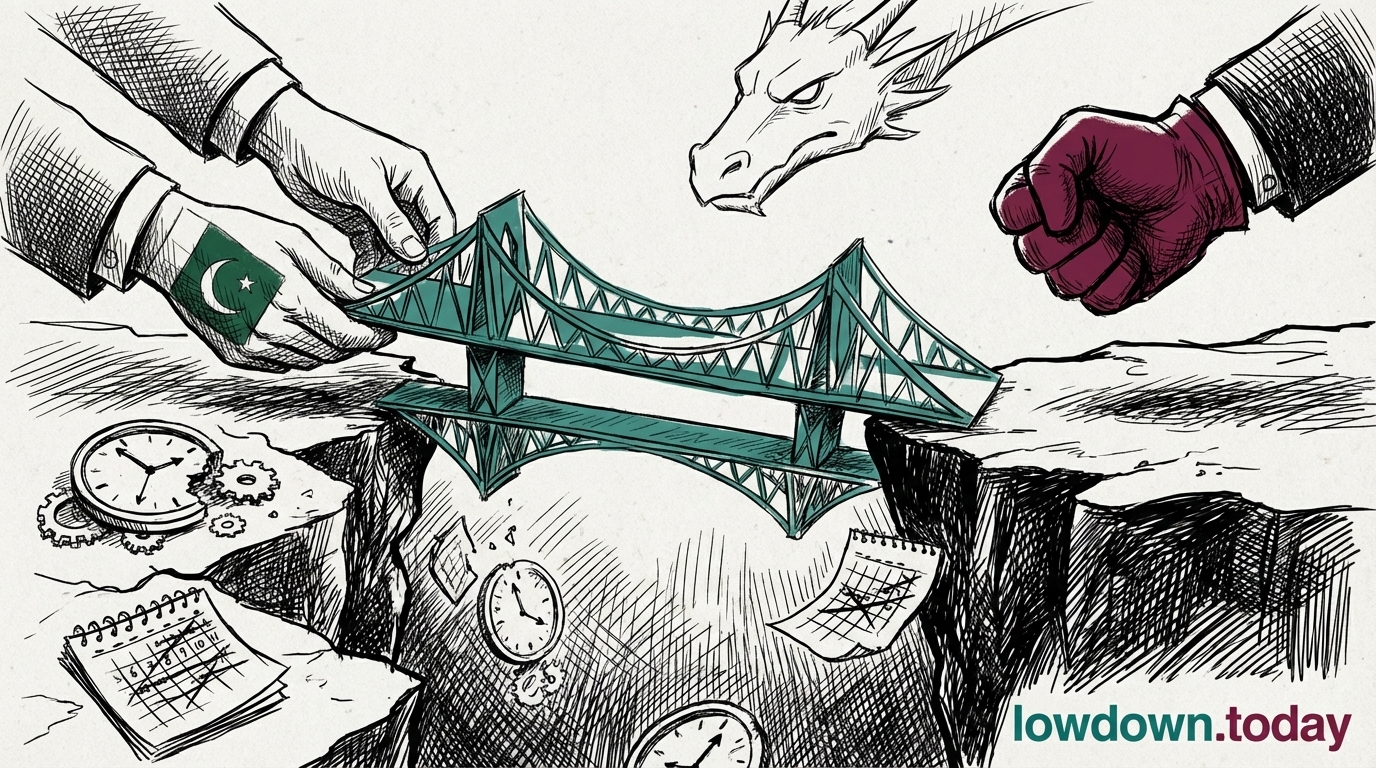
Pakistan has produced the first concrete ceasefire framework of the war, the Islamabad Accord, offering a two-tier plan of immediate ceasefire followed by a 15-to-20-day comprehensive settlement. The plan arrives as Trump extends his Hormuz deadline for the fifth time, Iran builds a permanent customs authority over the Strait, and US interceptor stocks approach critical depletion thresholds.

Key takeaway

Diplomatic initiative shifted from Washington to Islamabad, but Iran's military council holds the veto.

This briefing mapped
Loading map…
Diplomatic
Economic
Military
Legal
Humanitarian

The Islamabad Accord offers specific terms for the first time in six weeks of conflict, but Iran's military council holds the veto.

Sources profile:This story draws on mixed-leaning sources from Israel, Hong Kong SAR China and 1 more
IsraelHong Kong SAR ChinaUnited States
LeftRight

Pakistan assembled the Islamabad Accord, a two-tier ceasefire framework calling for an immediate ceasefire followed by a 15-to-20-day comprehensive settlement period. Iran would abandon nuclear weapons pursuit in exchange for sanctions relief, frozen asset releases, and immediate Strait of Hormuz reopening. Pakistan is positioned as sole diplomatic channel.

This is the first concrete diplomatic framework with specific terms since the war began on 28 February. It shifts the diplomatic initiative from Washington to a Pakistan-China axis and creates a potential off-ramp from Trump's serial deadline extensions. 

Briefing analysis

Primary parallel: The Tashkent Declaration of January 1966, where the Soviet Union mediated a ceasefire between India and Pakistan after the 1965 war. The mediation succeeded because both belligerents had exhausted their offensive capacity and faced economic pressure. Pakistani Prime Minister Ayub Khan and Indian PM Lal Bahadur Shastri signed under Soviet pressure, but Shastri died hours later and the agreement's terms were never fully implemented. The lesson: third-party mediation produces signatures when military exhaustion is bilateral. When one side retains capacity and institutional incentive to continue, frameworks remain paper.

Counter-parallel: The Algiers Accords of 1981 (Iran hostage crisis) succeeded because Iran's revolutionary government faced simultaneous Iraqi invasion and needed the frozen assets the US held. The financial incentive structure aligned with the diplomatic framework. The Islamabad Accord's sanctions relief and frozen assets attempt to recreate this alignment, but the IRGC's wartime authority gains may outweigh the financial incentive for the actors who hold the veto.

Five deadlines in six weeks, zero enforcement. The coercive mechanism has become diplomatic cover for continued talks.

Sources profile:This story draws on centre-left-leaning sources from United States
United States

Trump extended his Hormuz deadline for the fifth time, moving the expiry to Tuesday 8pm ET (8 April). He told Axios the US is in deep negotiations and threatened to blow up everything if no deal materialises. This is the fifth reformulation of the same threat in six weeks.

Serial non-enforcement has eliminated the deadline as a coercive instrument. Future threats lack credibility. The Islamabad Accord may offer Trump an exit from the deadline cycle without requiring him to either strike or formally back down. 

Sources:Time·Axios

The IRGC built a customs authority, not a blockade. The infrastructure is designed for permanence, and the currency is yuan.

Sources profile:This story draws on neutral-leaning sources

Iran's Strait of Hormuz toll system has matured from improvised blockade into a functioning customs authority. The IRGC charges $1 per barrel in yuan or stablecoins, with a VLCC paying roughly $2 million per transit. The Hormozgan Provincial Command runs background checks, applies a five-tier country classification, and requires flag changes, VHF passcodes, and patrol escorts. Weekly transits rose to 53, up from 36, but remain over 90% below the pre-war 966.

The toll system's institutional detail (background checks, flag requirements, VHF passcodes, escort protocols) reveals infrastructure built for permanence, not negotiating leverage. Iran is not using Hormuz to bargain; it is building a revenue-generating customs authority over international waters. The Islamabad Accord's demand for immediate reopening collides directly with this institutional investment. 

The Mahshahr strike marks a shift from targeting export infrastructure to civilian fuel supply, destroying an estimated 70% of Iran's gasoline production capacity.

Sources profile:This story draws on neutral-leaning sources

The Israel Defence Forces struck the Mahshahr Petrochemical Complex on 5 April, Iran's largest, responsible for an estimated 70% of domestic gasoline production. The same day, IDF strikes hit air defence systems and ballistic missile arrays in Tehran and the al-Shalamcheh border crossing between Iraq and Iran.

Previous Israeli operations focused on export infrastructure: refineries, terminals, pipeline nodes. Mahshahr supplies the domestic market. Destroying 70% of a country's gasoline production capacity is a material reduction in the civilian population's access to fuel and transportation. The distinction between strategic and civilian-impact targeting has narrowed to the point of disappearing. 

Sources:Alma Center

All six GCC members affirmed Article 51 rights against Iran, establishing a legal framework for collective military action while insisting diplomacy remains the preferred path.

Sources profile:This story draws on neutral-leaning sources

The full Gulf Cooperation Council collectively affirmed UN Charter Article 51 self-defence rights at the 50th Extraordinary Ministerial Council, citing Iranian attacks on civilian airports, oil facilities, desalination plants, and ports. The statement simultaneously declared that dialogue and diplomacy remain the optimal path.

This expands the legal framework from Saudi Arabia's individual Article 51 invocation to a collective Gulf position. Article 51 does not require Security Council approval; it enables a state, and its allies, to act in collective self-defence against armed attack. The GCC has now positioned the legal instrument. Whether any member state converts that instrument into military action remains an open question. 

THAAD exhaustion may have arrived silently. Arrow-3 stocks at 81% depletion. JASSM-ER reserves for a Taiwan contingency spent in Iran.

Sources profile:This story draws on neutral-leaning sources

RUSI's early-March projection of THAAD exhaustion within one month may have been reached. The Payne Institute estimates one-third of the THAAD stockpile has been consumed. Annual production capacity is roughly 100 interceptors. Arrow-3 stocks remain at 81% depletion or worse. The US has consumed over 1,000 JASSM-ERs from Pacific Command stocks, leaving an 18-to-30-month restock gap.

The convergence of Arrow-3 depletion, projected THAAD exhaustion, and JASSM-ER consumption from Pacific stocks represents a strategic munitions crisis across both offence and defence simultaneously. The US is fighting a war of attrition with weapons it cannot replace on any operationally relevant timeline. 

A cruise missile targeting a warship 126 kilometres offshore marks Hezbollah's shift from mass-volume rockets to precision anti-ship weapons.

Sources profile:This story draws on centre-left-leaning sources from Qatar
Qatar

Hezbollah fired a cruise missile at an Israeli warship 126 kilometres off the Lebanese coast on 5 April, representing a capability escalation from mass-volume rocket barrages to precision anti-ship targeting. At least 14 people were killed in Israeli strikes across Lebanon the same day, including a family of six.

This represents a qualitative capability escalation. Hezbollah's previous record was 600 projectiles in 24 hours, a mass-volume approach. A cruise missile targeting a specific naval vessel at 126 kilometres demonstrates precision guidance and anti-ship capability that changes the threat calculus for Israeli naval operations in the eastern Mediterranean

Sources:Al Jazeera

Iran's official death toll crossed 2,000. The last independent count was 7,300. The organisation that provided it has not reported since 31 March.

Sources profile:This story draws on neutral-leaning sources

HRANA (Human Rights Activists News Agency) has resumed reporting on Iranian casualties. Hengaw, the more credible independent casualty monitor, remains silent since approximately 31 March. Iran's official death toll has crossed 2,000; Hengaw's last figure was 7,300. The gap between official and independent counts continues to widen without anyone able to verify either.

Independent casualty verification is essential for accountability, humanitarian response, and international legal proceedings. With Hengaw silent, the Planet Labs imagery blackout in effect, and IAEA access suspended, three independent verification mechanisms have been eliminated simultaneously. 

Sources:Alma Center

Brent crude eased to $110.47 from its $116 peak, but remains 64% above pre-war levels with the strait operating at a fraction of normal capacity.

Sources profile:This story draws on centre-left-leaning sources from United States
United States

Brent Crude traded at $110.47 per barrel, retreating from the $116 peak on 28 March. The pullback may reflect ceasefire hopes from the Islamabad talks, though the strait of Hormuz remains over 90% below pre-war transit volumes.

The price retreat, while modest, is the first sustained pullback since the war began. It suggests markets are pricing in a non-zero probability of ceasefire from the Islamabad talks. However, with Hormuz at roughly 5% of pre-war transit volumes, the fundamental supply disruption remains unchanged. 

Sources:CNBC

The al-Shalamcheh strike targets a logistics corridor that connects Iranian supply lines to Iraqi territory, broadening the campaign's geographic scope.

Sources profile:This story draws on neutral-leaning sources

The IDF struck the al-Shalamcheh border crossing between Iraq and Iran on 5 April, targeting a logistics corridor connecting Iranian supply lines to Iraqi territory.

The strike on a border crossing affects Iraqi sovereignty and commerce alongside the intended disruption of Iranian logistics. Iraq was exempted from Hormuz restrictions just one day earlier , indicating Baghdad is caught between Iranian and Israeli military actions with diminishing ability to protect its own infrastructure. 

Sources:Alma Center

Beijing's strategic coordination with Islamabad gives the ceasefire framework geopolitical weight that previous mediation attempts lacked.

Sources profile:This story draws on centre-leaning sources from Hong Kong SAR China
Hong Kong SAR China
LeftRight

China pledged strategic coordination with Pakistan on the Iran ceasefire mediation effort, per the South China Morning Post. Beijing's backing gives the Islamabad Accord geopolitical weight and deepens China's active role in the conflict, alongside its position as the currency of Hormuz transit.

China's role has shifted from passive observer to active participant. Beijing is simultaneously the backer of the primary mediation channel, the provider of the currency used for Hormuz tolls, and a permanent UNSC member capable of blocking resolutions. This positions China as the indispensable external actor in any resolution of the conflict. 

Closing comments

Mixed. The Islamabad Accord is the strongest de-escalatory signal since the war began. But the Mahshahr strike escalates targeting logic, interceptor depletion raises the risk of successful future attacks, and the IRGC's structural incentive to continue fighting has not changed. The most dangerous scenario is not an accord failure but an accord that the IRGC uses to buy time for further institutional consolidation.

Different Perspectives
Iran / IRGC
Iran / IRGC
The IRGC military council blocks ceasefire negotiations that would end its wartime authority. Tehran has not responded to the Islamabad Accord; silence preserves optionality while the toll system generates revenue.
United States / Trump
Five deadline extensions without enforcement have exhausted coercive credibility. Trump claims deep negotiations but the action is the extension itself. The Islamabad Accord may offer a face-saving exit.
Pakistan
Pakistan
Islamabad positioned itself as sole mediation channel and produced the war's first concrete ceasefire framework. Pakistan secured 20-vessel Hormuz deals while brokering peace terms.
China
China
Beijing pledged strategic coordination with Pakistan on mediation. The yuan is the currency of Hormuz transit. China is simultaneously the backer, the banker, and the UNSC gatekeeper.
Saudi Arabia / GCC
Saudi Arabia / GCC
The GCC collectively invoked Article 51 self-defence rights but simultaneously affirmed dialogue as the optimal path. Legal framework established; operational commitment absent.
Israel
Israel
The IDF expanded targeting from export infrastructure to domestic fuel production at Mahshahr, shifting the campaign's humanitarian impact. Strikes also hit Tehran air defences and the Iraq-Iran border crossing.