Skip to content
Briefings are running a touch slower this week while we rebuild the foundations.See roadmap
Iran Conflict 2026
7APR

US carriers slip out of strike range

3 min read
10:19UTC

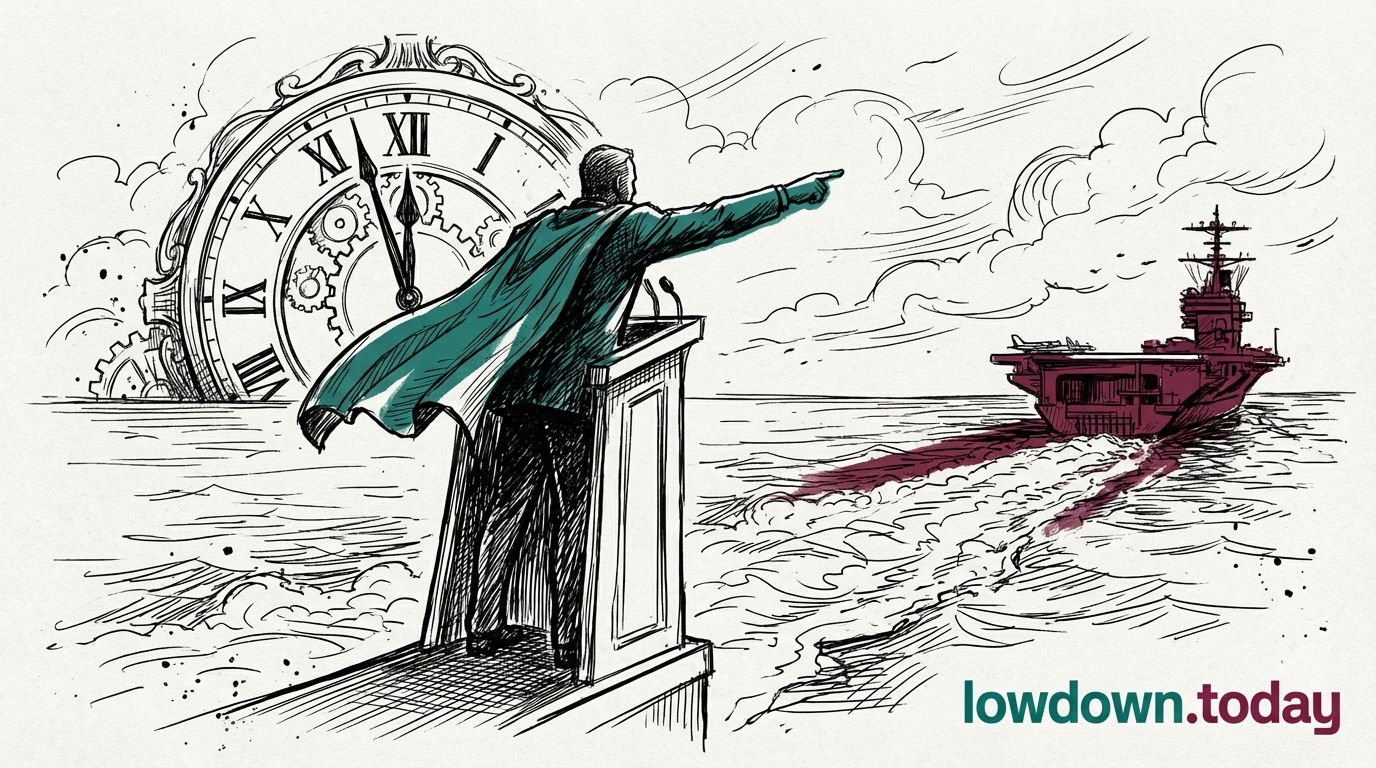
On the morning Donald Trump's fifth Hormuz ultimatum was due to expire, the two US carriers most likely to enforce it moved further from Iran than at any point in the war.

ConflictDeveloping
Key takeaway

The carriers needed to enforce tonight's deadline are now too far away to enforce it credibly.

The USS Gerald R Ford has repositioned south to the Central Red Sea off Jeddah, and USS Abraham Lincoln has shifted to waters off Salalah in southern Oman, placing both carriers more than 1,100 km from Iran's coast, up from under 350 km earlier in the campaign 1. Both platforms are now outside the operational envelope they would need to be inside to deliver any decisive strike.

The Pentagon attributes the move to prudent force protection following an Iranian gunboat engagement of an Abraham Lincoln escort vessel. A reasonable reader can take that at face value, or note that the platforms most likely to deliver any decisive blow have moved themselves out of the missile envelope just as the deadline rhetoric peaks.

The pattern matters more than any single reposition. Donald Trump's fifth Hormuz ultimatum follows the 6 April power-grid deadline and a second replacement that itself ran out . Each previous expiry produced an extension, the rhetoric escalated each cycle, and the operational ceiling stayed flat. The carrier reposition is the operational counterpart to that rhetorical pattern: louder threat, longer leash for the platforms that would have to back it up.

Deep Analysis

In plain English

Aircraft carriers are the US military's most powerful strike platforms, capable of launching hundreds of sorties a day. To do that effectively against Iran, they need to be within roughly 350–500 km , close enough for planes to reach targets and return. Both carriers are now more than 1,100 km away. The Pentagon says this is a precaution after Iranian boats engaged one of the escort ships. That is plausible. It also means that on the day a US ultimatum is supposed to expire, the ships that would enforce it are no longer in position to do so quickly. Think of it like a bank robber announcing a heist and then moving the getaway car three towns over on the day of the job.

Deep Analysis
Synthesis

The reposition makes explicit what the deadline pattern had implied since the second extension: the US has not found a military solution inside the constraints it has set for itself. The carriers' presence at 350 km was the most credible physical expression of the threat. Their absence at 1,100 km is the most credible physical expression of the limit.

Root Causes

The reposition reflects three converging pressures: the accumulation of Iranian anti-ship capability over six weeks of combat operations, including the IRGC's demonstrated willingness to engage escort vessels; the depletion of US interceptor stocks that makes damage-absorption progressively more costly; and the political constraint that any significant US naval loss on deadline day would transform a war of choice into a war of reaction.

The deeper structural cause is the mismatch between a carrier-centric power-projection doctrine and an adversary that has spent forty years building area-denial systems specifically designed to exploit that doctrine's vulnerability. The carriers were always the most legible US threat signal and the most legible target. Moving them resolves that tension by removing the target, at the cost of removing the signal.

Escalation

The reposition reduces the escalation risk of a miscalculation strike but simultaneously lowers the ceiling on what any US military action in the next 48 hours can actually achieve.

The missile-stockpile picture compounds this: THAAD stocks are assessed at one-third depleted and Arrow-3 at 81% or worse, meaning both sides have reduced offensive and defensive headroom simultaneously. The overall escalation direction is ambiguous , less immediate trigger risk, but a wider gap between rhetoric and available force.

What could happen next?
  • Consequence

    Iran's IRGC threat calculus on Hormuz will not be revised downward; the physical withdrawal reinforces Tehran's assessment that the deadlines are not backed by imminent force.

    Immediate · 0.82
  • Risk

    If Trump issues a sixth extension and orders the carriers back towards the Iranian coast, the repositioning cycle becomes a visible signal of domestic political rather than operational decision-making, further eroding deterrent credibility.

    Short term · 0.71
  • Precedent

    The reposition establishes that US carrier groups will not absorb anti-ship engagement risk at close range as the price of deadline credibility, narrowing the available toolkit for any future Iran coercive action.

    Medium term · 0.68
First Reported In

Update #61 · Carriers retreat; Iran codifies Hormuz

Forces News· 7 Apr 2026
Read original
Different Perspectives
Islamabad (Pakistan Armed Forces and Foreign Ministry)
Munir's cancellation reflects Islamabad's assessment that no bridging formula survives the collision of Khamenei's uranium directive, Rubio's Hormuz red line, and the sequencing gap simultaneously; Naqvi's relay role signals continued Pakistani engagement without a mandate to close any of the three gaps.
Lloyd's of London war-risk market
Published PGSA coordinates give underwriters the cartographic input to model tanker route exposure inside the claimed zone; OFAC's Sunday GL V ruling determines whether Hengli-Singapore dollar-clearing routes carry secondary-sanctions risk from Monday, adding a compliance layer to the existing kinetic war-risk premium.
Hengaw Human Rights Organisation
Zaleh's trial lasted 'only a few minutes' before a conviction on PDKI membership charges at Naqadeh; the pattern of solitary detention, coerced confession, and minutes-long hearing is consistent with wartime political-charge architecture the organisation has documented across the Kurdish northwest.
Gulf Arab states (UAE, Bahrain, Kuwait)
The UAE has not published counter-coordinates to the PGSA's Hormuz zone map, leaving Emirati silence as the maritime-law response to Iran's charted boundary claim. Abu Dhabi's published position now defaults by omission toward implied acceptance of the zone's cartographic fact.
Beijing's Ministry of Commerce
MOFCOM's blocking order covers Hengli and four other designated refineries on the mainland but does not extend to the dollar-clearing layer in Singapore, making Sunday's GL V expiry the first live test of whether Beijing's sanctions-defiance architecture reaches the place where dollars settle.
The White House
The White House
Trump's verbal track on Iran has produced no signed Iran-specific presidential instrument across 84 days; both financial-sector EOs signed on 19 May are unrelated to Hormuz or the IRGC. Rubio's public naming of the Hormuz toll architecture as a deal-killer is the administration's most concrete new position this week.