Skip to content
Briefings are running a touch slower this week while we rebuild the foundations.See roadmap
Iran Conflict 2026
23MAR

58% of Britons oppose US use of UK bases

3 min read
05:40UTC

YouGov finds a three-to-one margin against US use of British bases — a problem for a prime minister who overrode his own attorney general's legal advice to grant it.

ConflictDeveloping
Key takeaway

British public opposition to base use now exceeds peak Iraq War levels, leaving the government without a defensible political constituency.

Fifty-eight per cent of Britons oppose US use of UK bases for strikes on Iran; 21% support it 1. The YouGov poll, reported by Middle East Eye, measured public sentiment after PM Starmer authorised "specific and limited defensive operations" from RAF Fairford in Gloucestershire and the joint US-UK facility on Diego Garcia — reversing his 28 February refusal to grant base access.

The three-to-one opposition ratio compounds pressure from multiple directions. Attorney General Lord Hermer advised that the US-Israeli operation does not accord with international law 2 — advice that shaped Starmer's initial refusal before he overrode it. Chatham House argued the government's distinction between "defensive" and "offensive" base use "blurs the line between lawful self-defence and unlawful war on Iran" 3. Hours after the authorisation became public, Iran launched two intermediate-range ballistic missiles at Diego Garcia — converting a legal abstraction about "defensive" base use into a direct threat to British military personnel. The last time a British Prime Minister faced comparable domestic opposition over Middle Eastern military cooperation was Tony Blair's support for the 2003 Iraq invasion, which produced a million-person march and defined the remainder of his premiership.

The parliamentary response is already organising. Jeremy Corbyn has tabled a bill requiring parliamentary approval before foreign nations can use British military bases. A cross-party Coalition — the Green Party, the left-wing "Your Party," independent MPs and Labour backbenchers — is forming around opposition to UK involvement. Starmer faces a bind with no comfortable exit: withdrawing base access after Iran's Diego Garcia strike would read as capitulation to missile coercion; maintaining it deepens his exposure to a legal challenge his own attorney general's advice supports, and places him against public opinion by a nearly three-to-one margin. The 21% who back base access is lower than the Conservative Party's current polling share — Starmer cannot even count on the opposition's voters to support his position.

Deep Analysis

In plain English

YouGov surveyed the British public and found nearly three in five oppose letting the US use British military bases for strikes on Iran — with only one in five in support. This matters because it means the Prime Minister's decision has almost no political base behind it. In democracies, governments can sometimes proceed against public opinion on national security grounds, but the 3-to-1 split here is unusually stark. The 21% support figure is lower than recorded approval for comparable UK military involvements in living memory, including the 2011 Libya intervention and the 2001 Afghanistan deployment.

Deep Analysis
Synthesis

The 21% support figure is more analytically significant than the 58% opposition. It indicates the government cannot rely even on traditionally interventionist centre-right opinion to defend this decision — unlike Iraq, where Blair retained substantial Conservative support that provided political cover. A government proceeding against 3-to-1 public opposition with no meaningful cross-party support is politically isolated in a way that directly accelerates the parliamentary coalition forming around Event 15 and the Corbyn bill in Event 14.

Root Causes

Two decades of accumulated public distrust following Iraq and Afghanistan have structurally altered British public opinion on Middle East military action. The Chilcot Inquiry (2016) institutionalised the critique of executive decision-making on Iraq, creating a reference frame against which any subsequent Middle East intervention is automatically measured. The current 21% support figure suggests this is a settled public disposition, not a swing-vote issue that political communication could reverse.

What could happen next?
  • Risk

    A government proceeding against 3-to-1 public opposition on base use faces acute by-election vulnerability in constituencies with large Muslim communities or strong Stop the War histories — the electoral cost accrues slowly but compounds.

    Short term · Assessed
  • Meaning

    The 21% support figure represents the lowest recorded approval for UK involvement in a US-led Middle East operation, marking a structural rather than situational shift in British public opinion with consequences beyond this conflict.

    Long term · Suggested
  • Consequence

    Polling at this level provides Corbyn's bill and the cross-party coalition with democratic legitimacy that makes parliamentary procedural obstruction more costly for the government than for its opponents.

    Immediate · Assessed
First Reported In

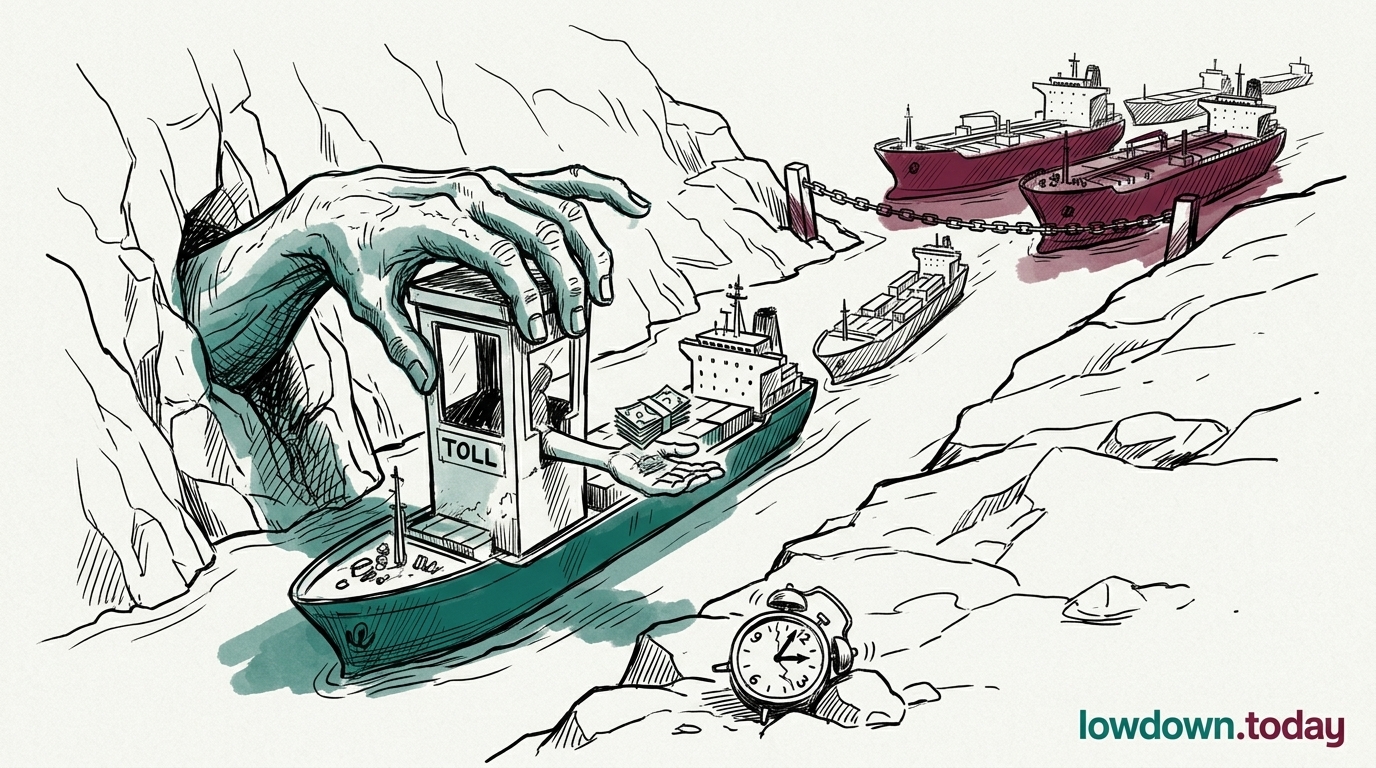
Update #45 · Ultimatum expires; Iran tolls Hormuz at $2m

Middle East Eye· 23 Mar 2026
Read original
Causes and effects
This Event
58% of Britons oppose US use of UK bases
Public opinion at this margin constrains Starmer's ability to deepen UK involvement and strengthens the parliamentary coalition seeking legislative checks on base access — at a moment when the US is actively using British facilities and Iran has demonstrated it can strike them.
Different Perspectives
Gulf shipping and insurance markets
With Hormuz and Bab el-Mandeb both hostile at once, war-risk underwriters face their first dual-chokepoint pricing problem; the rerouting hedge that absorbed one closure is gone for Israeli-linked hulls. Any deal that reopens Hormuz without a Houthi stand-down clause delivers only partial shipping relief.
Russia and China
Russia and China
Russia and China met IAEA chief Grossi jointly in Geneva on 5 June to coordinate an advance blocking position against Washington's censure resolution, the first documented instance of proactive pre-session obstruction rather than reactive post-vote dissent. Beijing's move came four days after OFAC designated Shanghai Qianye Energy under Iran energy sanctions.
Saudi Arabia
Saudi Arabia
Saudi Arabia was left out of the emergency $4.01 billion Patriot waiver Qatar received on 2 May as its own PAC-3 stocks ran near-empty from intercepting Iranian salvoes over Aramco facilities. Riyadh is on a standard 18-month FMS queue behind a production line booked through 2030, with no equivalent priority to Qatar's Al Udeid basing role.
Houthis (Ansar Allah)
The Houthis declared a complete ban on Israeli Red Sea navigation on 8 June and struck Jaffa, their first attack on Israeli territory since April, seven days after the Tasnim authorisation to activate other fronts including Bab el-Mandeb. The declaration put both chokepoints under hostile authority simultaneously.
Iran
Iran
Iran agreed the 9 June mutual halt after the Mahshahr exchange and coordinated with Russia and China to block Washington's IAEA censure resolution, using the Board as a second front while the bilateral pause held on the military one. Tehran's acceptance of the Lebanon carve-out contradicts the linkage position it stated on 1 June.
Benjamin Netanyahu and the IDF
Israel struck the Karun Petrochemical plant at Mahshahr on 8 June over Trump's explicit objection, then agreed a halt with Iran the following day scoped on Israeli terms with Lebanon carved out. Netanyahu's posture is that the IDF will not accept Iranian missile factories as off-limits regardless of US diplomatic timelines.