Skip to content
Briefings are running a touch slower this week while we rebuild the foundations.See roadmap
Iran Conflict 2026
23MAR

UK cross-party revolt against Iran war

3 min read
05:40UTC

Greens, independents, a new left-wing party, and Labour's own backbenchers are coalescing against Starmer's Iran policy — backed by 58% of the British public and the attorney general's own legal doubts.

ConflictDeveloping
Key takeaway

Labour backbencher numbers are the decisive variable; coalition breadth without them is insufficient to constrain the government.

A cross-party parliamentary Coalition is forming to oppose British involvement in the Iran conflict. The bloc comprises the Green Party, the new left-wing "Your Party," independent MPs, and Labour backbenchers — parties and factions that share little on domestic policy but have converged on a single position: that Starmer's authorisation of US operations from British bases lacks legal authority, democratic mandate, and public support.

The Coalition's breadth follows a pattern in British politics around Middle Eastern military action. 139 Labour MPs voted against Blair on Iraq in 2003 — the largest governing-party rebellion in modern parliamentary history. In 2013, 30 Labour MPs joined Conservative rebels to defeat David Cameron's motion for Syria strikes outright. In neither case did the rebellion's direct parliamentary arithmetic matter as much as the erosion of governing credibility. Starmer reversed his initial 28 February refusal to grant base access within days. That reversal has since been publicly undermined by Lord Hermer's legal advice that the US-Israeli operation does not accord with international law and by Chatham House's analysis questioning the defensive-offensive distinction 1. Each Labour backbencher who joins the Coalition makes the next policy reversal harder to sustain and the current one harder to defend.

The Coalition has the numbers behind it. 58% of Britons oppose US use of UK bases against 21% in favour 2. That margin makes opposition to British involvement a low-risk position for most MPs and a high-risk one for the government. The Green Party and independents face no party discipline costs; Labour backbenchers do, but the electoral arithmetic favours dissent in most constituencies outside the party leadership. The emergence of "Your Party" as a distinct left-wing entity suggests the anti-war position is generating organised institutional form — a dynamic last seen when the Iraq war contributed to the fracturing of Labour's electoral base and, over a decade, to Corbyn's own rise to the party leadership in 2015.

The Coalition's immediate parliamentary tools are limited: Corbyn's base-access bill, oral questions, opposition day debates, and public pressure. But the government's vulnerability is structural. Starmer authorised base access on executive authority alone, without a parliamentary vote, against his own attorney general's legal advice 3, with majority public opposition, while maintaining that the operations are "defensive" — a characterisation that Iranian missiles striking Diego Garcia have rendered difficult to sustain in plain language. The Coalition does not need a parliamentary majority to force the government onto ground it cannot hold.

Deep Analysis

In plain English

A group of MPs from different parties — including members of a new left-wing party, the Greens, independent MPs, and some Labour MPs who disagree with their own government — is forming to oppose UK involvement in the Iran operations. Cross-party coalitions of this kind are unusual in British politics, where party loyalty is strong and career incentives punish rebellion. In 2013, a similar coalition succeeded in blocking David Cameron's plans for Syria strikes — the only time Parliament has stopped a UK government from taking military action in modern history. The key question is how many Labour MPs will break with their own government, since that determines whether the coalition reaches the critical mass needed to win a vote.

Deep Analysis
Synthesis

The coalition's composition reveals that the Iran crisis is providing organisational infrastructure to a post-2024 realignment of the British left that was already structurally under way. 'Your Party' plus Labour backbenchers plus Greens plus independents represents the non-Labour left beginning to cohere into a durable parliamentary bloc — with consequences for UK party politics that extend well beyond this conflict. The Iran vote is accelerating a realignment that might otherwise have taken years to consolidate into a visible force.

Root Causes

Labour's 2024 general election victory was partly built on recapturing votes from Muslim communities and the anti-war left that had defected over Gaza and the Corbyn expulsion. Starmer's Iran decision fractures precisely that electoral coalition, activating a structural tension between Labour's constituency base in urban, diverse seats and its foreign policy positioning. The emergence of 'Your Party' as a separate left vehicle suggests this fracture was already forming before the Iran crisis accelerated it.

What could happen next?
  • Consequence

    If the coalition forces a parliamentary vote and the government narrowly wins, it nonetheless establishes a precedent that base-use authorisation is a matter of parliamentary concern — weakening the Royal Prerogative argument permanently regardless of the immediate outcome.

    Short term · Assessed
  • Risk

    Labour backbenchers calculating constituency-level electoral risk face pressure that intensifies with each week of rising UK casualty exposure and worsening polling — the coalition's size is likely to grow rather than stabilise as the conflict continues.

    Short term · Assessed
  • Precedent

    A successful coalition vote would entrench the 2013 Syria precedent as constitutional convention, making parliamentary approval for military base use a de facto requirement even without the Corbyn statute passing.

    Medium term · Suggested
  • Meaning

    The Iran crisis is providing organisational identity and parliamentary visibility to a post-Corbyn left realignment already structurally forming — with long-term consequences for UK party competition that extend well beyond this conflict.

    Long term · Suggested
First Reported In

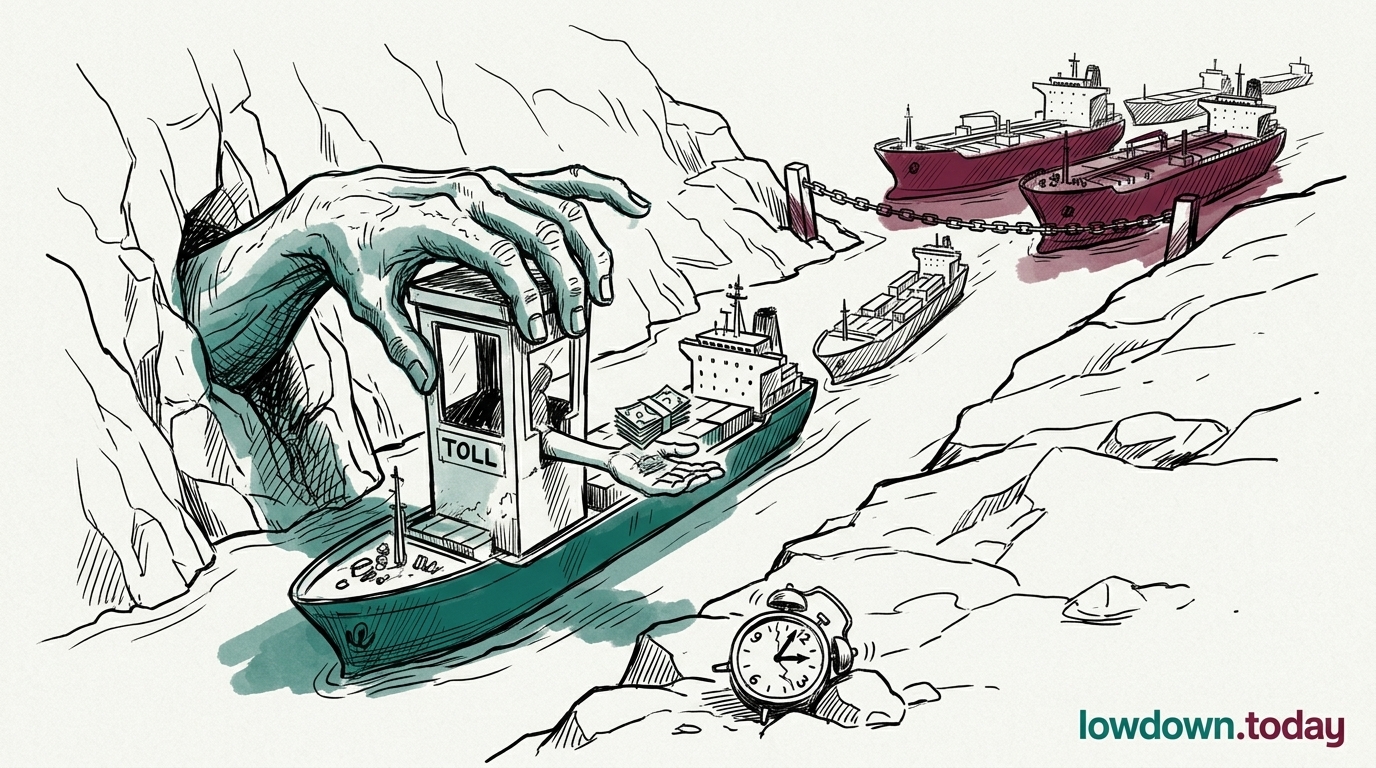
Update #45 · Ultimatum expires; Iran tolls Hormuz at $2m

Middle East Eye· 23 Mar 2026
Read original
Causes and effects
This Event
UK cross-party revolt against Iran war
The coalition draws from parties with no shared domestic platform, which indicates the war opposition has broader political roots than any single party's ideology. Labour backbench rebellions on Middle Eastern military action — Iraq in 2003, Syria in 2013 — have historically forced policy reversals or inflicted lasting damage on governing authority.
Different Perspectives
Gulf shipping and insurance markets
With Hormuz and Bab el-Mandeb both hostile at once, war-risk underwriters face their first dual-chokepoint pricing problem; the rerouting hedge that absorbed one closure is gone for Israeli-linked hulls. Any deal that reopens Hormuz without a Houthi stand-down clause delivers only partial shipping relief.
Russia and China
Russia and China
Russia and China met IAEA chief Grossi jointly in Geneva on 5 June to coordinate an advance blocking position against Washington's censure resolution, the first documented instance of proactive pre-session obstruction rather than reactive post-vote dissent. Beijing's move came four days after OFAC designated Shanghai Qianye Energy under Iran energy sanctions.
Saudi Arabia
Saudi Arabia
Saudi Arabia was left out of the emergency $4.01 billion Patriot waiver Qatar received on 2 May as its own PAC-3 stocks ran near-empty from intercepting Iranian salvoes over Aramco facilities. Riyadh is on a standard 18-month FMS queue behind a production line booked through 2030, with no equivalent priority to Qatar's Al Udeid basing role.
Houthis (Ansar Allah)
The Houthis declared a complete ban on Israeli Red Sea navigation on 8 June and struck Jaffa, their first attack on Israeli territory since April, seven days after the Tasnim authorisation to activate other fronts including Bab el-Mandeb. The declaration put both chokepoints under hostile authority simultaneously.
Iran
Iran
Iran agreed the 9 June mutual halt after the Mahshahr exchange and coordinated with Russia and China to block Washington's IAEA censure resolution, using the Board as a second front while the bilateral pause held on the military one. Tehran's acceptance of the Lebanon carve-out contradicts the linkage position it stated on 1 June.
Benjamin Netanyahu and the IDF
Israel struck the Karun Petrochemical plant at Mahshahr on 8 June over Trump's explicit objection, then agreed a halt with Iran the following day scoped on Israeli terms with Lebanon carved out. Netanyahu's posture is that the IDF will not accept Iranian missile factories as off-limits regardless of US diplomatic timelines.