Skip to content
Briefings are running a touch slower this week while we rebuild the foundations.See roadmap
Iran Conflict 2026
23MAR

Iran links Hormuz to power grid survival

3 min read
05:40UTC

Tehran has linked any future reopening of the Strait of Hormuz to the physical reconstruction of power plants Trump has threatened to destroy — a conditional closure that could last years if the ultimatum is carried out.

ConflictDeveloping
Key takeaway

Linking Hormuz to power plant reconstruction creates a precondition no US administration can publicly accept.

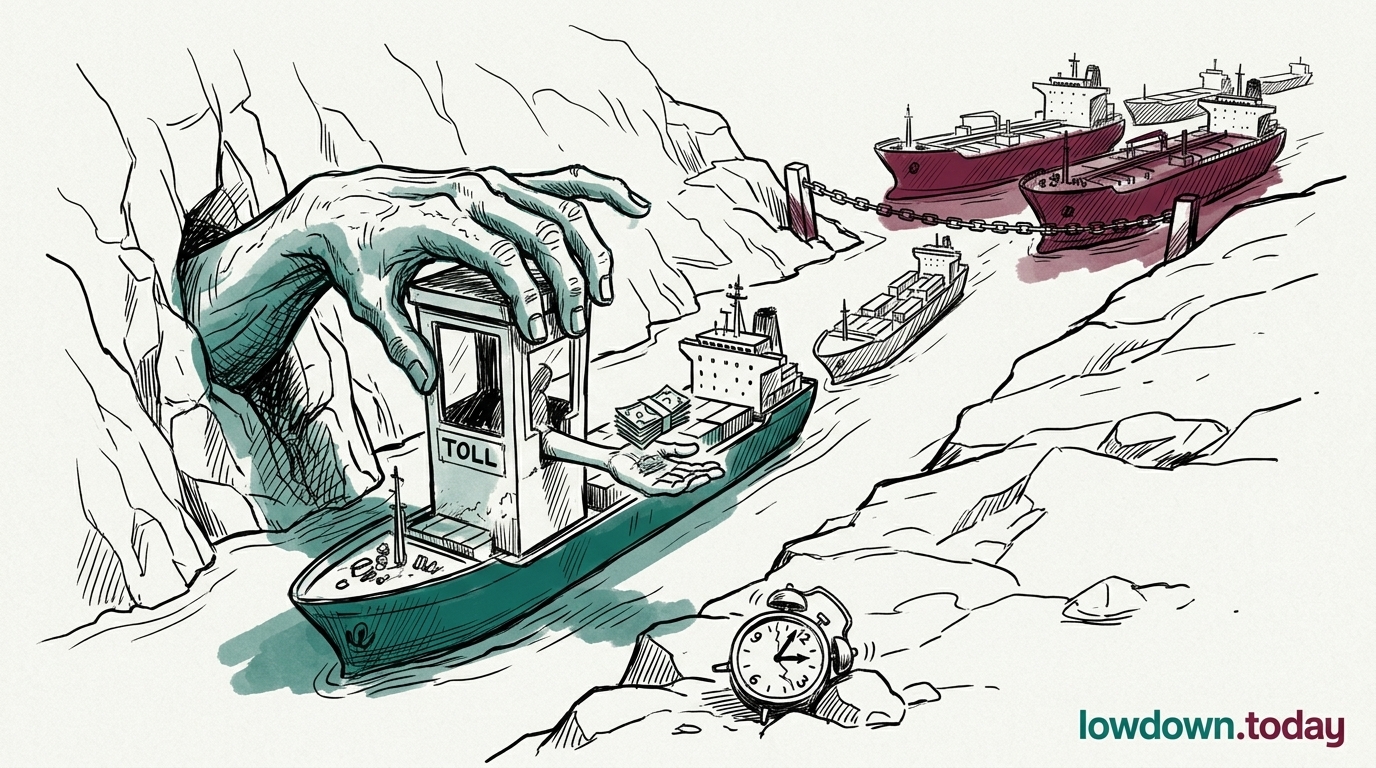
Iran stated it will close the strait of Hormuz indefinitely and refuse to reopen it until any power plants destroyed by the United States are fully rebuilt. The threat links two previously separate pressure points — the strait closure and Trump's 48-hour power-grid ultimatum — into a single conditional chain: strike our grid, lose the strait for years.

The logic is deterrence through entanglement. Major power plants take three to seven years to reconstruct depending on damage severity and sanctions conditions. Iran's Khatam al-Anbiya command had already threatened retaliatory strikes on US and allied energy, IT and desalination infrastructure . Parliament Speaker Ghalibaf raised the stakes further, promising Gulf energy and oil infrastructure would be "irreversibly destroyed." The Hormuz linkage adds a third layer: even if the shooting stops, the economic pain does not.

This converts the IRGC's existing toll system — which already channels 89 to 90 vessels through Iranian-controlled waters at fees up to $2 million per transit 1 — from a wartime improvisation into a potential permanent institution. Five nations are negotiating bilateral access demanded reopening; no warships followed). If Iran conditions reopening on reconstruction that cannot happen under sanctions, the selective blockade becomes the default state of the strait. Charter rates have already quadrupled to $800,000 per day 2, and Brent Crude peaked at $126 per barrel this week.

The historical parallel is the 1984–88 Tanker War, when Iran and Iraq attacked shipping for four years without either side fully closing Hormuz. What Iran NOW threatens goes further: not attacks on vessels transiting the strait, but a refusal to permit transit at all, conditioned on physical rebuilding that cannot begin while hostilities continue and cannot finish for years after they end. The IEA has already documented the largest supply disruption in history — 8 million barrels per day lost — and warned that the 400-million-barrel strategic reserve release is "a stop-gap measure" 3. Oxford Economics assessed that Brent at $140 triggers a mild global recession at negative 0.7% GDP. Iran's conditional closure threat is designed to ensure that any US decision to strike the power grid carries a price tag denominated not in munitions but in years of global energy disruption.


Deep Analysis

In plain English

Iran has set a condition for reopening the Strait — rebuild what you destroyed — that would take years even under peacetime conditions. This is not a genuine offer to negotiate. It is a commitment device that removes Iran's ability to back down without a visible win. Once a US strike lands, the strait stays closed under Iran's own stated policy, with no diplomatic off-ramp available.

Deep Analysis
Synthesis

The reconstruction condition converts Hormuz from a bargaining chip into a structural hostage. Once US strikes land, Iran has both incentive and stated obligation to sustain closure for years — eliminating the most plausible off-ramp, strikes followed by negotiated reopening, and embedding permanent supply disruption into every post-strike scenario.

Root Causes

Iran's Hormuz threat reflects the Revolutionary Guards' doctrine of proportional economic coercion — deliberately mirroring US maximum-pressure sanctions logic against Iran since 2018. The reconstruction condition is novel within that doctrine: it transforms a military threat into a permanent economic weapon tied to a timeline the attacker cannot compress.

Escalation

Reconstruction of major power infrastructure takes 3–7 years under peacetime conditions; under sanctions and active conflict, the timeline extends further. Iran's stated condition is therefore incompatible with any foreseeable diplomatic window — it does not offer a ladder down but locks in escalation the moment any strike lands.

What could happen next?
  • Risk

    A US strike triggers indefinite Hormuz closure under Iran's stated policy, converting a single military event into a permanent supply shock.

    Immediate · Assessed
  • Consequence

    IEA strategic reserve releases are structurally inadequate for a multi-year closure scenario; market adjustment would require demand destruction via recession.

    Short term · Assessed
  • Risk

    Iran's reconstruction condition incentivises it to obstruct post-conflict reconstruction aid in order to sustain Hormuz leverage through any recovery phase.

    Medium term · Suggested
  • Precedent

    Iran establishes that civilian infrastructure attacks generate permanent rather than temporary strategic costs, incentivising future adversaries to adopt identical linkage doctrines.

    Long term · Suggested
First Reported In

Update #45 · Ultimatum expires; Iran tolls Hormuz at $2m

Fortune· 23 Mar 2026
Read original
Causes and effects
This Event
Iran links Hormuz to power grid survival
Iran has converted the Strait of Hormuz from a military bargaining chip into a structural hostage tied to the outcome of Trump's power-grid ultimatum. If the US strikes and Iran follows through, the world's most important oil chokepoint stays closed not until a ceasefire is reached, but until physical infrastructure is rebuilt — a timeline measured in years, not weeks.
Different Perspectives
IAEA
IAEA
Director General Rafael Grossi appeared in person at the UNSC on 19 May and warned that a direct hit on an operating reactor 'could result in very high release of radioactivity'. The session produced a condemnation record but no resolution, and the Barakah perimeter was already struck on 17 May.
Hengaw (Kurdish rights monitor)
Hengaw documented three judicial executions and the detention of Kurdish writer Majid Karimi in Tehran on 19 May, establishing Khorasan Razavi province as the newest geography in Iran's wartime judicial record. The organisation's Norway-based operation continues to surface a domestic repression track running in parallel with every diplomatic and military development.
India
India
Six India-flagged vessels conducted a coordinated cluster transit under PGSA bilateral assurances during the 17 May window, paying no yuan tolls. New Delhi's inclusion in Iran's state-to-state passage track insulates Indian energy supply without requiring endorsement of the PGSA's yuan-toll architecture or alignment with the US coalition.
Pakistan
Pakistan
Pakistan is the only functioning diplomatic bridge between Tehran and Washington. Its role is relay, not mediation in the settlement sense: it conveyed Iran's 10-point counter-MOU in early May, relayed the US rejection, and is now passing 'corrective points' in the third documented exchange of this sub-cycle without either side working from a shared text.
UK and France (Northwood coalition)
Twenty-six coalition members have published no rules of engagement eight days after the Bahrain joint statement; Lloyd's underwriters have conditioned war-risk reopening on written ROE from either Iran or the coalition. Italian and French mine-countermeasures deployments are operating on the in-water clearance task CENTCOM Admiral Brad Cooper's 90% mine-stockpile claim does not address.
Saudi Arabia
Saudi Arabia
Riyadh has not publicly commented on the Barakah strike or the 50-47 discharge vote. Saudi output feeds the IEA's $106 base case; the $5 Brent premium above that model reflects institutional uncertainty no Gulf producer can compress through supply adjustment alone.



