Skip to content
You can now search across every topic, entity and event.What's new
Iran Conflict 2026
23MAR

Corbyn bill demands vote before base use

3 min read
05:40UTC

Jeremy Corbyn's bill would require parliamentary approval before foreign nations launch strikes from British soil — a power the prime minister exercised without legal cover, against his own attorney general's advice.

ConflictDeveloping
Key takeaway

The bill targets Royal Prerogative itself — a constitutional shift far exceeding its immediate anti-war purpose.

Jeremy Corbyn tabled a bill in the House of Commons requiring parliamentary approval before any foreign nation can use British military bases for military operations. The bill responds directly to Prime Minister Starmer's authorisation of RAF Fairford in Gloucestershire and the Diego Garcia facility in the Indian Ocean for US operations against Iran .

The bill targets a constitutional grey area. The royal prerogative allows the prime minister to commit British forces without a parliamentary vote. An informal convention of consulting Parliament before military action emerged after the 2003 Iraq vote, but it has no statutory basis — Theresa May bypassed it for the 2018 Syria strikes without legal consequence. Granting a foreign military access to British sovereign territory for offensive operations sits in an even less defined space: Britain is not deploying its own forces, but it is providing the launch pad. No statute governs this arrangement. No convention constrains it. Corbyn's bill would create the first formal requirement.

The legal ground beneath Starmer's authorisation is weak. Attorney General Lord Hermer KC advised that the US-Israeli operation does not accord with international law 1. Chatham House published analysis arguing that the government's distinction between "defensive" and "offensive" base use "blurs the line between lawful self-defence and unlawful war on Iran" 2. Iran's missile strike on Diego Garcia — launched hours after the base authorisation became public — demonstrated that providing launch facilities makes Britain a combatant in Iranian targeting calculations, whatever legal category London assigns to the arrangement. Two intermediate-range ballistic missiles fired at a British overseas territory is not an abstraction in parliamentary debate; it is a fact of war.

The bill is unlikely to pass. Labour holds a working majority and the whips will oppose it. Its function is procedural leverage: forcing a recorded division that compels Labour backbenchers to vote on the record. 58% of Britons oppose US use of UK bases for strikes on Iran; 21% support it 3. For backbenchers in marginal seats, a vote endorsing base access against those numbers, against the attorney general's advice, after Iranian missiles have already struck the facility in question, is a vote they would rather not take. Corbyn does not need to win the division to extract its political cost.

Deep Analysis

In plain English

At present, the British Prime Minister can authorise a foreign country to use UK military bases for combat operations without asking Parliament at all, drawing on an ancient legal power called Royal Prerogative inherited from the Crown. Corbyn's bill would require MPs to vote before such authorisation is given. The significance extends far beyond Iran: if passed, it would permanently limit a prime ministerial power that has existed unchallenged for centuries, and it would apply to every future allied base-use request — including in conflicts Britain has no direct stake in.

Deep Analysis
Synthesis

The bill's strategic consequence, if passed, would permanently degrade the UK's utility as a US forward-basing partner. US military planning doctrine requires flexible, rapid base access in crisis; parliamentary approval timetables with mandatory debate, division, and potential leaks are structurally incompatible with that requirement. US planners would be compelled to treat UK bases as conditionally available — a reclassification that would permanently alter NATO's posture across the Middle East and Indian Ocean theatre regardless of how this specific conflict ends.

Root Causes

The NATO Status of Forces Agreement (SOFA, 1951) governs the legal right of allied forces to be present on UK territory but is entirely silent on operational authorisation — the gap between 'right of presence' and 'right of operational use' has never been tested in UK courts or addressed by statute. The government's current position rests on SOFA plus bilateral arrangements, creating a legal ambiguity that the Attorney General's own advice — that the underlying US-Israeli operation does not accord with international law — has already publicly exposed.

What could happen next?
  • Precedent

    Even if the bill fails, its introduction establishes a legislative template that future governments opposing allied base use can adopt, permanently altering the legal landscape for US forward basing in the UK.

    Long term · Assessed
  • Risk

    If the bill passes, US military planners must reclassify UK bases from reliably available to conditionally available — a structural downgrade in NATO's Indian Ocean and Middle East basing posture with permanent alliance implications.

    Medium term · Suggested
  • Consequence

    The bill forces the government to defend Royal Prerogative in public debate at the precise moment its own Attorney General has questioned the legality of the underlying operation — a contradictory position that is difficult to sustain in committee scrutiny.

    Short term · Assessed
  • Meaning

    The Attorney General's advice, if confirmed in parliamentary proceedings, would provide the bill's proponents with a legal rather than merely political argument — qualitatively strengthening the case beyond partisan opposition.

    Immediate · Assessed
First Reported In

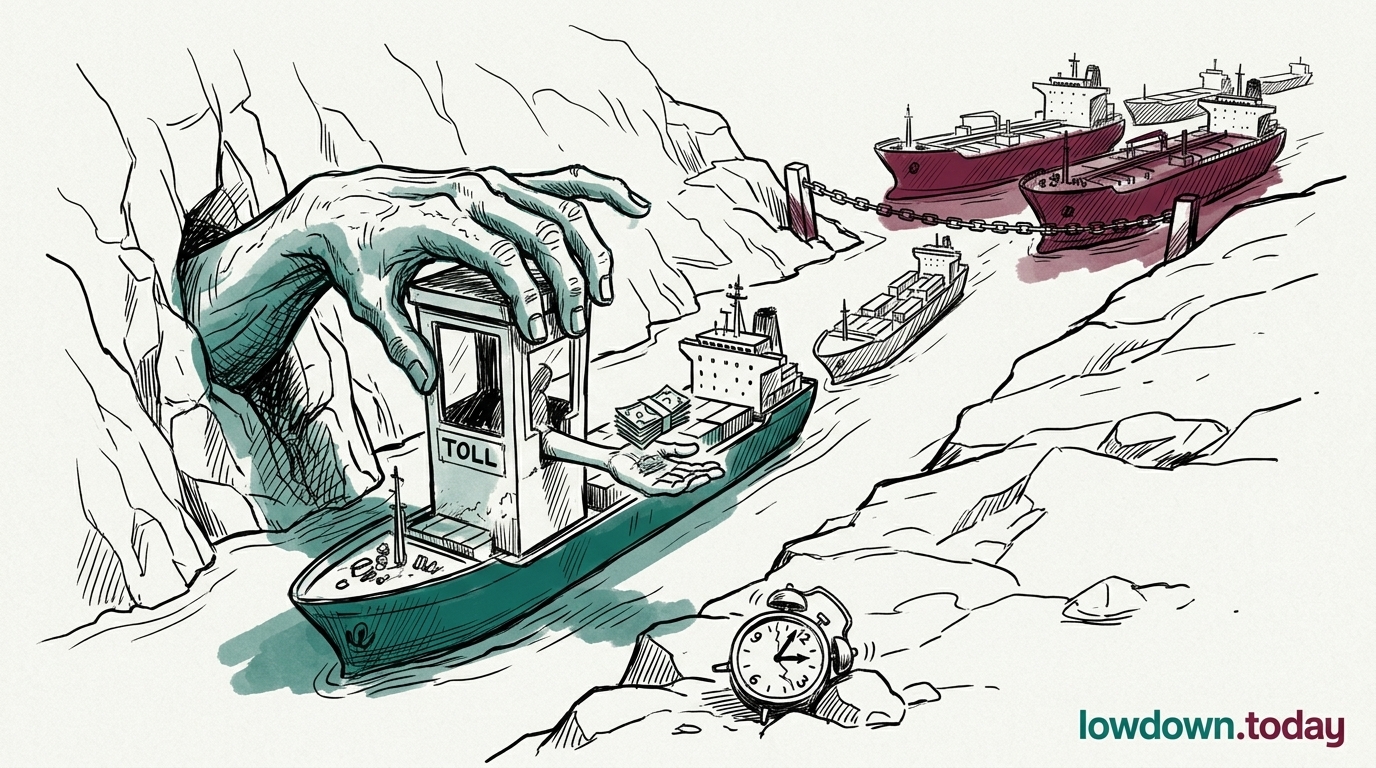
Update #45 · Ultimatum expires; Iran tolls Hormuz at $2m

Middle East Eye· 23 Mar 2026
Read original
Causes and effects
This Event
Corbyn bill demands vote before base use
The bill targets a constitutional gap between executive authority over base access and parliamentary oversight of military action. With the attorney general's legal advice and 58% public opposition both undermining the government's position, a recorded vote would force Labour backbenchers to choose between party loyalty and their constituents.
Different Perspectives
Oil market and P&I insurers
Brent cleared $87 intraday only once CENTCOM's blockade became physical rather than declared, even though P&I Clubs had already excluded Hormuz war risk a week earlier on 7 July: capital hedged ahead of enforcement, but prices moved only after it.
UAE reporting
UAE reporting
UAE reporting placed the Omani tanker deaths at one seafarer against the International Maritime Agency's count of two, the first time in this war that a Gulf state's casualty figures have diverged from an international monitor's.
Jordan
Jordan
Iranian strikes reached Jordan again on 14 July as part of the Gulf-wide retaliation for the Hormuz blockade, extending the conflict's geographic footprint to a state with no direct stake in the strait itself.
Bahrain
Bahrain
Bahrain sounded air-raid sirens on 14 July during Iran's Gulf-wide retaliation, the same day CENTCOM's blockade order and fourth night of strikes pushed the conflict's physical reach into the wider Gulf littoral.
Kuwait
Kuwait
Kuwait intercepted Iranian missiles and drones on 14 July as Tehran's blockade retaliation reached Gulf states beyond Iran's immediate shoreline, confirming Kuwaiti airspace now sits inside Iran's retaliatory envelope.
Oman
Oman
Oman absorbed the war's first tanker casualties in its own waters on 14 July, with two supertankers disabled and seafarers killed, putting the sultanate's shipping lanes directly in the path of the blockade fight for the first time.