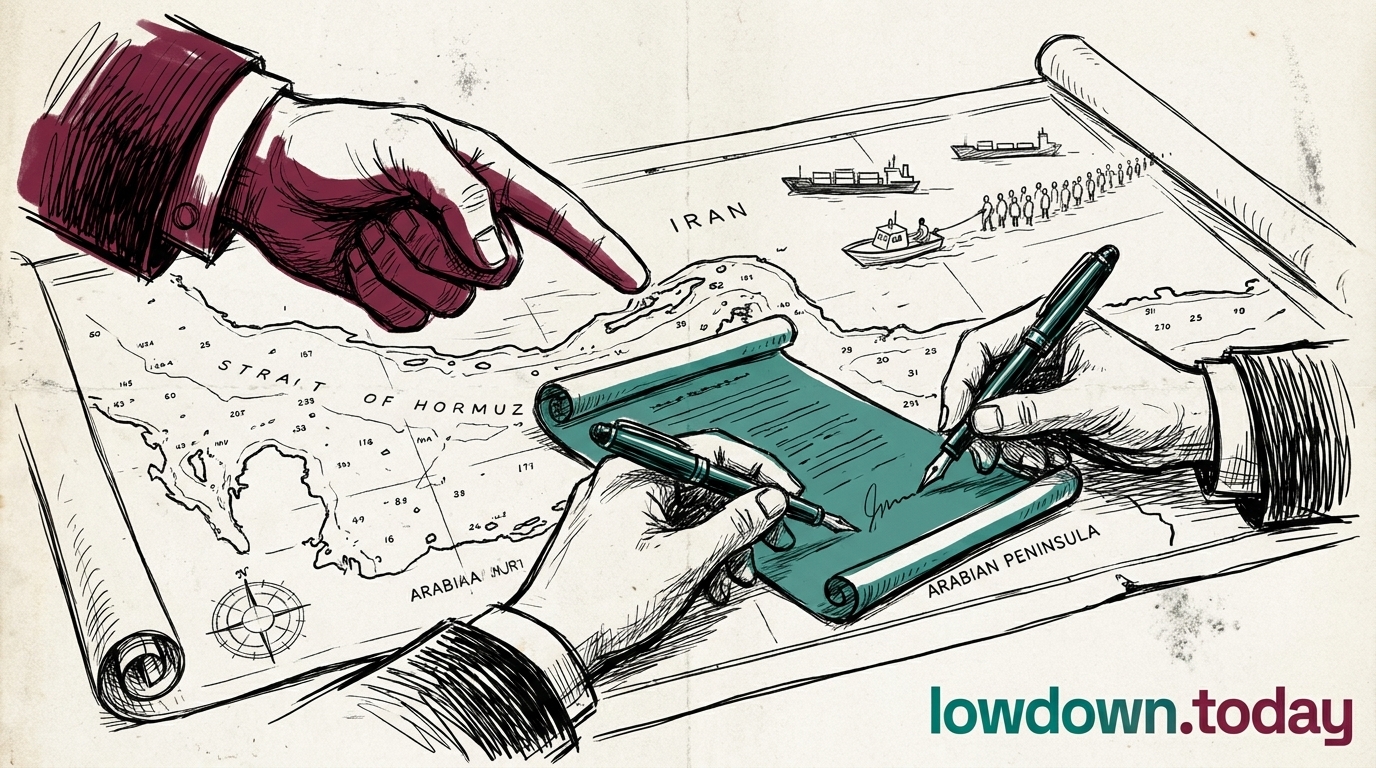
Iran's president and its Hormuz permit agency pulled in opposite directions on Monday 2 November. Masoud Pezeshkian said Supreme Leader Mojtaba Khamenei had "granted the government certain authorities" to seek a way out through dialogue, the Islamic Republic News Agency (IRNA) reported1. Within the same day the Persian Gulf Strait Authority (PGSA), the body that issues transit permits for the Strait of Hormuz, added 114 ships to its non-compliance list, taking it to 240, The Maritime Executive reported2.
Pezeshkian did not say what the authorities cover or whom they let him talk to. Less than a fortnight earlier he had told Pakistan's army chief that sanctions must be lifted before any negotiations. In the same speech he said the government was "not going to fight our own people"3. Qatar carries the indirect channel. Deputy Foreign Minister Kazem Gharibabadi was in Doha to pass messages to Washington through Qatari intermediaries, and Iran's team left on Sunday 1 November with a draft proposal in circulation, an official briefed on the talks told Reuters4. Four days before that, an Iranian official had called Doha's terms "ideas, not a proposal". Foreign Minister Abbas Araghchi said on 31 October that under a deal the strait, which normally carries about a fifth of the world's oil and liquefied natural gas, could open within two days; Tehran's September plan allowed seven.
The blacklist cuts against that offer. Seventy-two listed ships, 25 of them new, belong to Gulf state companies, among them the Kuwait Oil Tankers Company, Saudi Arabia's Bahri, the Abu Dhabi National Oil Company (ADNOC) and Qatar's Nakilat and QatarEnergy, according to an Orbital analysis the magazine relays. The PGSA warns of "restrictions on future passages, including fines, detention, or confiscation". Applied to Nakilat and QatarEnergy, that is a lever over the mediator's own export fleet. Ships tied to Sinokor Merchant Marine, the South Korean operator the PGSA threatened with legal action from 1 November, form the largest single group. Any vessel that takes cargo from a listed ship at sea is listed too, a rule aimed at the ship-to-ship transfers that the tracking firm Kpler says lifted Hormuz crude flows in October.
Tehran also worked its other capitals. Vladimir Putin received Mohsen Rezaei, secretary of Iran's Supreme National Security Council, at the Kremlin on 5 November, the Kremlin's schedule shows5; Rezaei reportedly set out Tehran's terms for reopening Hormuz and carried a message from Khamenei6. The United Arab Emirates foreign ministry logged a call from Araghchi to Abdullah bin Zayed Al Nahyan on 6 November, with no readout7. Mohammad Eslami, head of the Atomic Energy Organization of Iran, told Russia's RT that Rafael Grossi of the International Atomic Energy Agency (IAEA) "has effectively become an operative for our enemy and their obedient follower"8. Eslami offered no evidence, and the agency had not responded.



