Skip to content
You can now search across every topic, entity and event.What's new
Autonomous Systems: Land & Sea
12AUG

Allied robot minehunters reach the Gulf

3 min read
14:17UTC

RFA Lyme Bay reached the Middle East on 23 June with RNMB Ariadne and France's Sirius drone in its well-dock, the most capable allied autonomous mine-hunting package yet sent to sea.

TechnologyDeveloping
Key takeaway

Britain and France have put their most advanced autonomous mine-hunting package in the Gulf, short of clearance.

RFA Lyme Bay arrived in the Middle East on 23 June 2026 with the full allied autonomous mine-countermeasures (MCM) suite embarked, the Royal Navy confirmed 1. A Royal Fleet Auxiliary Bay-class ship, Lyme Bay works as a mothership: its well-dock launches and recovers the small uncrewed boats that do the mine-hunting. In that dock sit the Royal Navy's autonomous minehunter RNMB Ariadne and the French Navy's Sirius uncrewed surface vessel (USV), the two halves of the Anglo-French programme that first trained together off Toulon at the start of the month . More than 270 personnel are aboard, over 100 of them Royal Navy mine-warfare specialists and French sailors. The ship sailed in company with the German vessels FGS Mosel and FGS Fulda, escorted by the Type 45 destroyer HMS Dragon 2.

This is the package's destination, not its first outing. Ariadne sailed toward the Strait of Hormuz in late May ; the fortnight's development is its arrival in theatre with a German escort alongside. No mine-clearance operation has begun, and the strait still runs at a fraction of its pre-war traffic while uncleared mines remain in the channel.

A crewless minehunter sends a robot, not a crewed hull, over suspected ordnance, removing the sailors from the most dangerous part of the job. That is the operational case, but the deployment also serves as procurement evidence. For European mine-warfare exporters, a reference deployment in a live mined strait answers the one question a trade-show stand cannot: whether the autonomy holds up where the mines are real. Thales's TSAM sonar and the Ariadne-Sirius pairing get that test here, against the US-built alternatives allied buyers are weighing elsewhere.

Deep Analysis

In plain English

Mine countermeasures means finding and safely destroying underwater mines before they can sink ships. Traditional mine-hunting uses crewed vessels that put sailors in danger; the new approach sends robotic boats to do the hunting instead. RFA Lyme Bay is a large Royal Navy support ship that carries two robotic mine-hunters in its rear well-deck, like a floating garage: RNMB Ariadne (British) and Sirius (French). When the ship reaches a suspected minefield, the robots are lowered into the water, send sonar signals to map the seabed, and identify and neutralise mines without any crew aboard. The Strait of Hormuz, a narrow channel between Iran and Oman, carries about a fifth of the world's oil. It was declared closed after Iranian minelaying, and the allied robot package arrived on 23 June to prepare for potential mine-clearance operations.

Deep Analysis
Root Causes

Two structural drivers placed the allied autonomous MCM package in theatre on this timeline.

First, the Strait of Hormuz mine threat created a demand signal the Royal Navy could not answer with conventional MCM vessels without accepting unacceptable crew risk; autonomous minehunting transfers lethal exposure from naval personnel to replaceable machines, which allowed the deployment to be politically authorised.

Second, the Anglo-French MMCM programme (UK share: £184 million, Thales-supplied TSAM sonar) reached a joint integration milestone at Toulon in early June that gave both navies confidence the package could operate together in theatre rather than in a training environment.

The German escort (FGS Mosel and FGS Fulda) reflects a third driver: NATO's Baltic seabed-protection experience from the 2023 Balticconnector rupture has embedded German MCM vessels in allied forward-deployment patterns as a matter of doctrine rather than ad hoc politics.

Escalation

Forward-deployment, not escalation. The package's arrival is a positioning step ahead of a potential mine-clearance operation; no clearance has begun and no engagement with Iranian forces has occurred. The deterrence dynamic runs toward de-escalation: demonstrating the capacity to clear mines crewlessly reduces Iranian leverage from the threat of mine casualties.

What could happen next?
  • Precedent

    A successful mine-clearance by Ariadne and Sirius in theatre would be the highest-profile autonomous MCM reference deployment in NATO history, converting the MMCM programme from a bilateral R&D investment into a proven operational capability.

  • Consequence

    If mine-clearance is achieved autonomously, UK and French procurement timelines for follow-on MMCM platforms accelerate; export interest from Gulf states and Asian navies facing minelaying threats would likely follow.

First Reported In

Update #4 · Allied robot minehunters reach the Gulf

Royal Navy· 24 Jun 2026
Read original
Different Perspectives
Conservative opposition
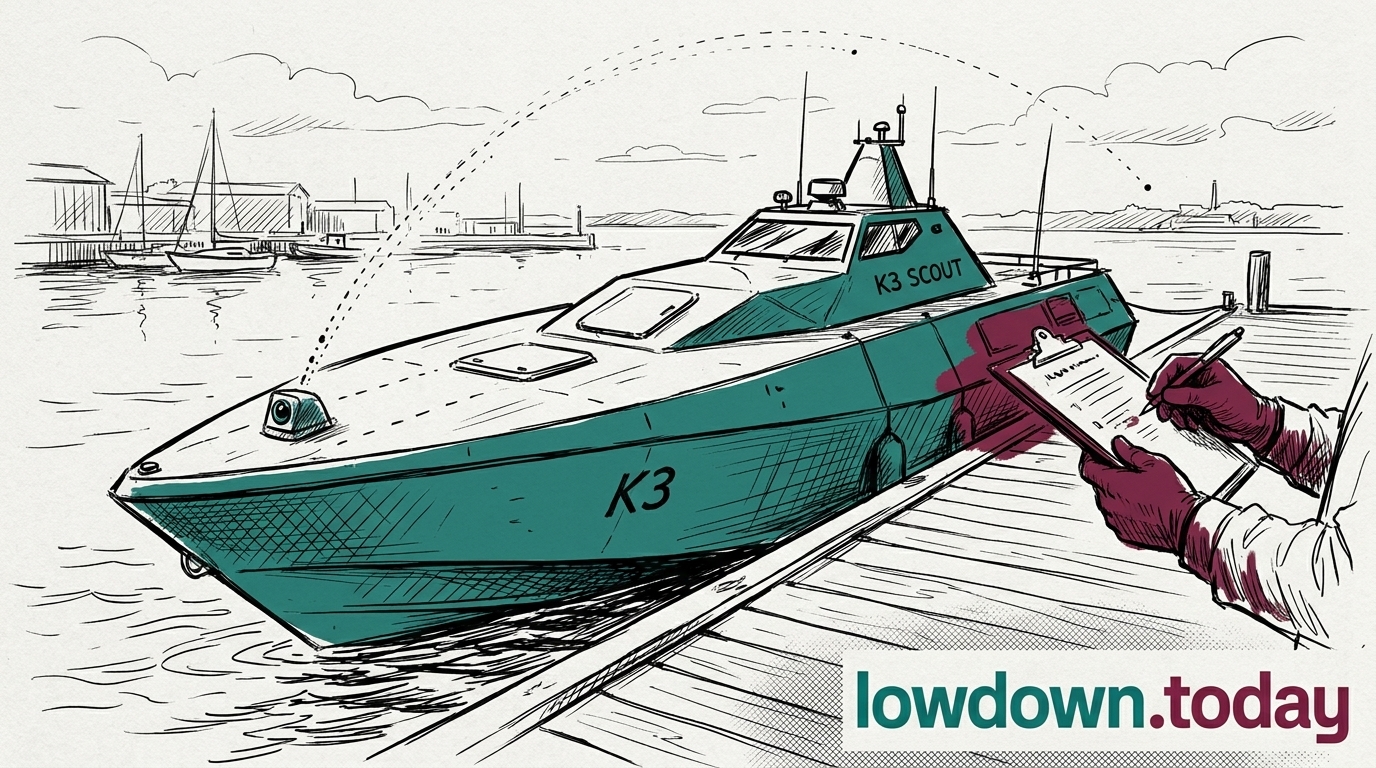
The Conservative opposition called on the Government on 9 August to 'urgently audit' equipment for hidden Chinese components, after the Telegraph's K3 SCOUT report. No named MP has been quoted on the record; the call came at party level, alongside the Ministry of Defence's own 10 August statement that no data had been compromised.
Netherlands Ministry of Defence
The Netherlands Ministry of Defence authorised Dutch Naval Design on 4 August to design 12-metre anti-submarine warfare uncrewed vessels for the Dutch-Belgian frigate programme, and to buy an adapted Compact FLASH dipping sonar from Thales Underwater Systems France. The order commits money and a named supplier while Britain's own certification body remains at the market-engagement stage.
Kraken Technology Group
Kraken Technology Group is a UK maritime-defence company based in Portsmouth that builds the K3 SCOUT, and crossed a $1bn valuation in July on a single-sourced $175m raise. The camera components reached the fleet under a third party's written security assurance, which the Platform Authority, which does not yet exist, was never positioned to check.
Navy Commercial
Navy Commercial
Navy Commercial at Whale Island published two notices on 5 August: 074032-2026, asking industry how to build a Platform Authority to certify uncrewed vessels, and 074351-2026, a GBP10m multi-role USV testbed for the Defence Chief Technology Officer. Responses on the Platform Authority close 19 August, ten days after the cameras were found transmitting to China.
Ministry of Defence
Ministry of Defence
The Ministry of Defence said on 10 August that a routine cyber vulnerability assessment found the camera fault, and a thorough investigation found no evidence that MoD data or systems had been accessed, compromised or transmitted externally. It stripped the cameras of internet connectivity but did not say whether it acted against the supplier.
Thales
Thales
Thales converted its 6 July engaging accord with Exail into a definitive combination agreement on 30-31 July, but the tender offer for Exail's remaining shares now closes by early 2028, later than July's timetable implied. Thales integrates its new undersea prime while still bidding against Kongsberg and DRASS's 2027 target for the AUKUS Pillar II contest.
