Skip to content
You can now search across every topic, entity and event.What's new
Autonomous Systems: Land & Sea
12AUG

Oman clears mine mission, then a stall

2 min read
14:17UTC

Oman authorised Britain and France to clear mines on its Hormuz route, then a 7 July tanker strike stalled the most capable allied robot minehunting package before it could begin.

TechnologyDeveloping
Key takeaway

Political authorisation now paces uncrewed mine clearance in the Gulf, with the technology already proven.

Oman granted the United Kingdom and France permission to clear mines on its southern Strait of Hormuz route shortly before 7 July, and officials said clearance could begin as soon as that week 1. An early-morning attack on a Qatari-owned liquefied-natural-gas carrier in the strait on 7 July set the timeline back before clearance began.

the strait of Hormuz is the narrow Gulf chokepoint through which much of the world's seaborne oil and gas passes. RFA Lyme Bay, the Royal Navy mother ship, sits in Omani waters with RNMB Ariadne and its autonomous mine-hunting systems aboard, HMS Dragon and French assets alongside, holding for a military order that has not come . RNMB Ariadne passed its trials off Portland and Gibraltar, and France's Sirius minehunting USV embarked at Toulon in June ; the missing piece now is a national military order, gated by Oman's consent, Iran's objections and allied domestic timelines.

Iran's deputy foreign minister, Kazem Gharibabadi, insists mine clearance is Iran's sole responsibility and has warned Oman against outside interference 2. The conflict itself belongs to Lowdown's Iran-conflict file; the industry beat here is narrower, that permission for an autonomous clearance debut was granted and then overtaken by events. Around 80 Iranian sea mines are thought to remain, Italy's Joint Operations Command estimates two months to clear once work starts, and the International Maritime Organization (IMO) says roughly 500 stranded ships must be evacuated first 3.

Deep Analysis

In plain English

The Strait of Hormuz is a narrow shipping lane between Iran and Oman that a fifth of the world's oil passes through. During the recent conflict, mines were laid in the water there, and around 80 are thought to remain. Oman, which controls the southern route through the strait, gave the UK and France permission to send ships and uncrewed mine-hunting robots to clear them. Before that clearance work could start, a tanker was attacked in the strait on 7 July, which pushed the timeline back again. RFA Lyme Bay, a British support ship, and its uncrewed minehunter RNMB Ariadne, are waiting nearby in Omani waters for the order to begin.

Deep Analysis
Root Causes

Iran never ratified the 1982 UN Convention on the Law of the Sea, the treaty that would otherwise settle transit-passage rights through Hormuz; Tehran's own mine-clearance claim rests on treating Omani-authorised outside clearance as a jurisdictional dispute rather than a technical favour.

Iran's mourning period for Supreme Leader Khamenei adds a second, time-limited constraint: gCaptain reports officials citing 'diplomatic sensitivities' and the need for 'more stable conditions' before allied vessels can visibly operate near Iranian-claimed waters.

Escalation

Escalatory risk is real but bounded: any allied minesweeping near Iranian-contested waters risks further tanker strikes like the one on 7 July, which has already reset the timeline once.

What could happen next?
  • Meaning

    Authorisation without a start date functions as a political signal to Tehran as much as a technical readiness milestone.

    Immediate · Assessed
  • Consequence

    The roughly 80 remaining mines and around 500 stranded ships stay in place until clearance actually starts, not merely authorised.

    Short term · Assessed
  • Risk

    Iran's deputy foreign minister has signalled that clearance by outside parties will be contested as a jurisdictional infringement, not just delayed by timing.

    Short term · Assessed
First Reported In

Update #6 · UK airdrops a robot boat; Gulf order stalls

Stars and Stripes· 11 Jul 2026
Read original
Different Perspectives
Conservative opposition
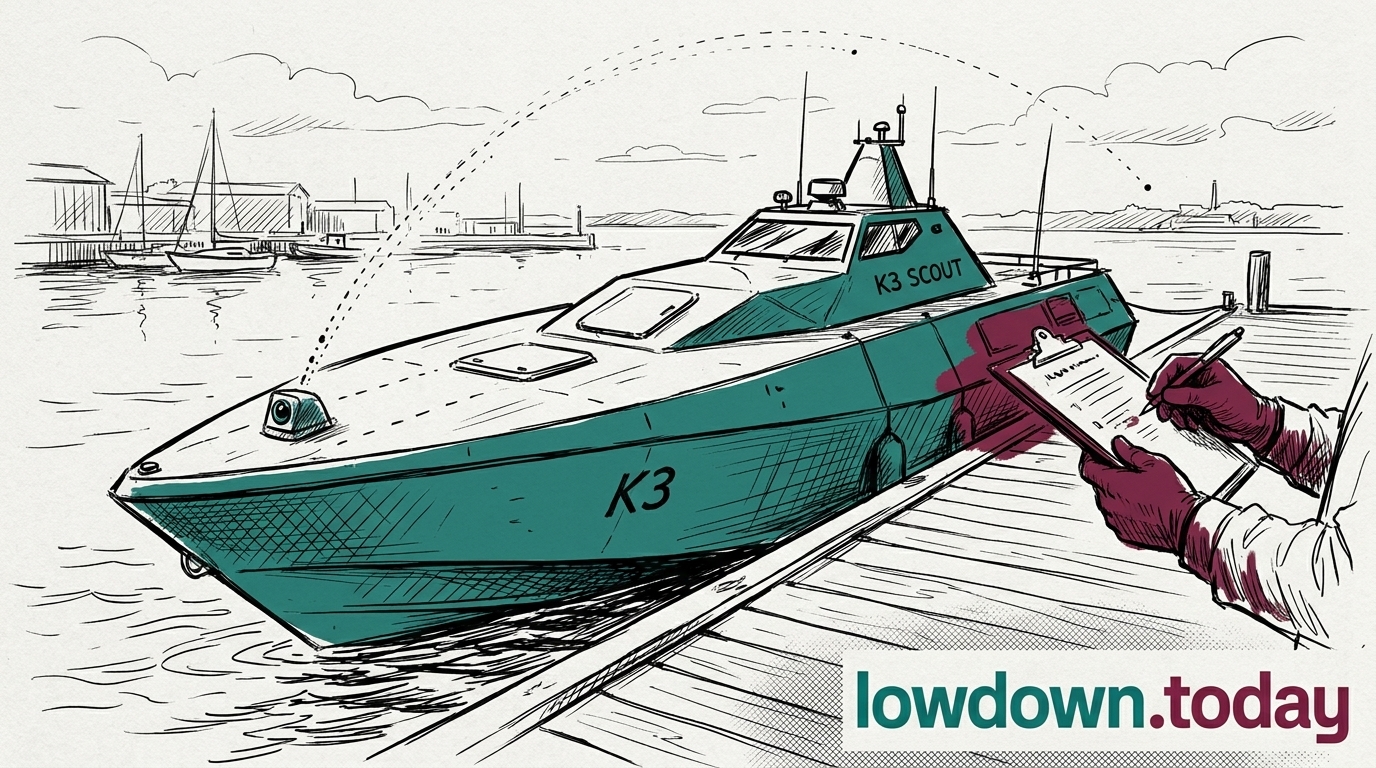
The Conservative opposition called on the Government on 9 August to 'urgently audit' equipment for hidden Chinese components, after the Telegraph's K3 SCOUT report. No named MP has been quoted on the record; the call came at party level, alongside the Ministry of Defence's own 10 August statement that no data had been compromised.
Netherlands Ministry of Defence
The Netherlands Ministry of Defence authorised Dutch Naval Design on 4 August to design 12-metre anti-submarine warfare uncrewed vessels for the Dutch-Belgian frigate programme, and to buy an adapted Compact FLASH dipping sonar from Thales Underwater Systems France. The order commits money and a named supplier while Britain's own certification body remains at the market-engagement stage.
Kraken Technology Group
Kraken Technology Group is a UK maritime-defence company based in Portsmouth that builds the K3 SCOUT, and crossed a $1bn valuation in July on a single-sourced $175m raise. The camera components reached the fleet under a third party's written security assurance, which the Platform Authority, which does not yet exist, was never positioned to check.
Navy Commercial
Navy Commercial
Navy Commercial at Whale Island published two notices on 5 August: 074032-2026, asking industry how to build a Platform Authority to certify uncrewed vessels, and 074351-2026, a GBP10m multi-role USV testbed for the Defence Chief Technology Officer. Responses on the Platform Authority close 19 August, ten days after the cameras were found transmitting to China.
Ministry of Defence
Ministry of Defence
The Ministry of Defence said on 10 August that a routine cyber vulnerability assessment found the camera fault, and a thorough investigation found no evidence that MoD data or systems had been accessed, compromised or transmitted externally. It stripped the cameras of internet connectivity but did not say whether it acted against the supplier.
Thales
Thales
Thales converted its 6 July engaging accord with Exail into a definitive combination agreement on 30-31 July, but the tender offer for Exail's remaining shares now closes by early 2028, later than July's timetable implied. Thales integrates its new undersea prime while still bidding against Kongsberg and DRASS's 2027 target for the AUKUS Pillar II contest.
