Skip to content
You can now search across every topic, entity and event.What's new
Autonomous Systems: Land & Sea
12AUG

UK to buy three Norway motherships

2 min read
14:17UTC

Defence Minister Luke Pollard confirmed on 17 July that Britain will build three mine-hunting motherships with Norway, GBP 90 million inside a GBP 1.3 billion programme.

TechnologyDeveloping
Key takeaway

Britain funded three motherships to carry its robot minehunters, turning one deployed hull into a committed class.

UK Defence Minister Luke Pollard confirmed on 17 July 2026 that Britain will procure three offshore support vessels jointly with Norway as the next tranche of the Mine Hunting Capability (MHC) programme, with GBP 90 million set aside inside a wider GBP 1.3 billion autonomous mine-countermeasures effort. 1 The ships are motherships, built to carry, store, maintain and control the autonomous Ariadne-class minehunters now positioned off Hormuz .

An uncrewed minehunter still needs a hull to launch, recover, refuel and command it. That is why the first-of-class HMS Stirling Castle was a converted oil-rig support vessel bought for about GBP 40 million rather than a warship built from scratch. Committing money to three more of them turns a single deployed asset into a class, the load-bearing part of the autonomy transition that headlines rarely name.

Building with Norway also ties Britain's mine-hunting backbone to a Nordic supply chain at the same moment a Norwegian prime, Kongsberg, is threading through both the US and European undersea programmes, evidence that the autonomy build-out is running along partnership lines rather than purely national ones.

Deep Analysis

In plain English

Britain is buying three ships from Norway that will act as floating bases for its robot mine-hunting boats. These motherships carry the small uncrewed vessels, launch and recover them, and let sailors control them from onboard rather than putting people near live mines. The GBP90 million is a slice of a much bigger GBP1.3 billion programme to replace Britain's old crewed minehunters with robot boats. But those robot boats still need a big ship to carry, fuel and fix them, which is why the government is spending money on support vessels as well as drones.

Deep Analysis
Root Causes

An uncrewed minehunter cannot cross ocean distances on its own or carry the crew needed to maintain, recharge and re-task it mid-mission, so the autonomy transition was always going to need a host vessel; that structural dependency, not drone technology maturity, has set the pace of the whole Mine Hunting Capability programme.

Buying Norwegian-built hulls rather than commissioning new UK-built ones lets the Ministry of Defence add capacity on a shorter timeline than a domestic new-build competition would allow, at the cost of shipbuilding work that would otherwise go to a UK yard.

What could happen next?
  • Meaning

    The mothership tranche shows the autonomy transition was constrained by host-vessel capacity, not just drone availability.

  • Consequence

    Building the support vessels in Norway rather than a UK yard trades faster delivery for lost domestic shipbuilding work.

First Reported In

Update #7 · Thales buys Exail; UK retires a minehunter

UK Defence Journal· 18 Jul 2026
Read original
Different Perspectives
Conservative opposition
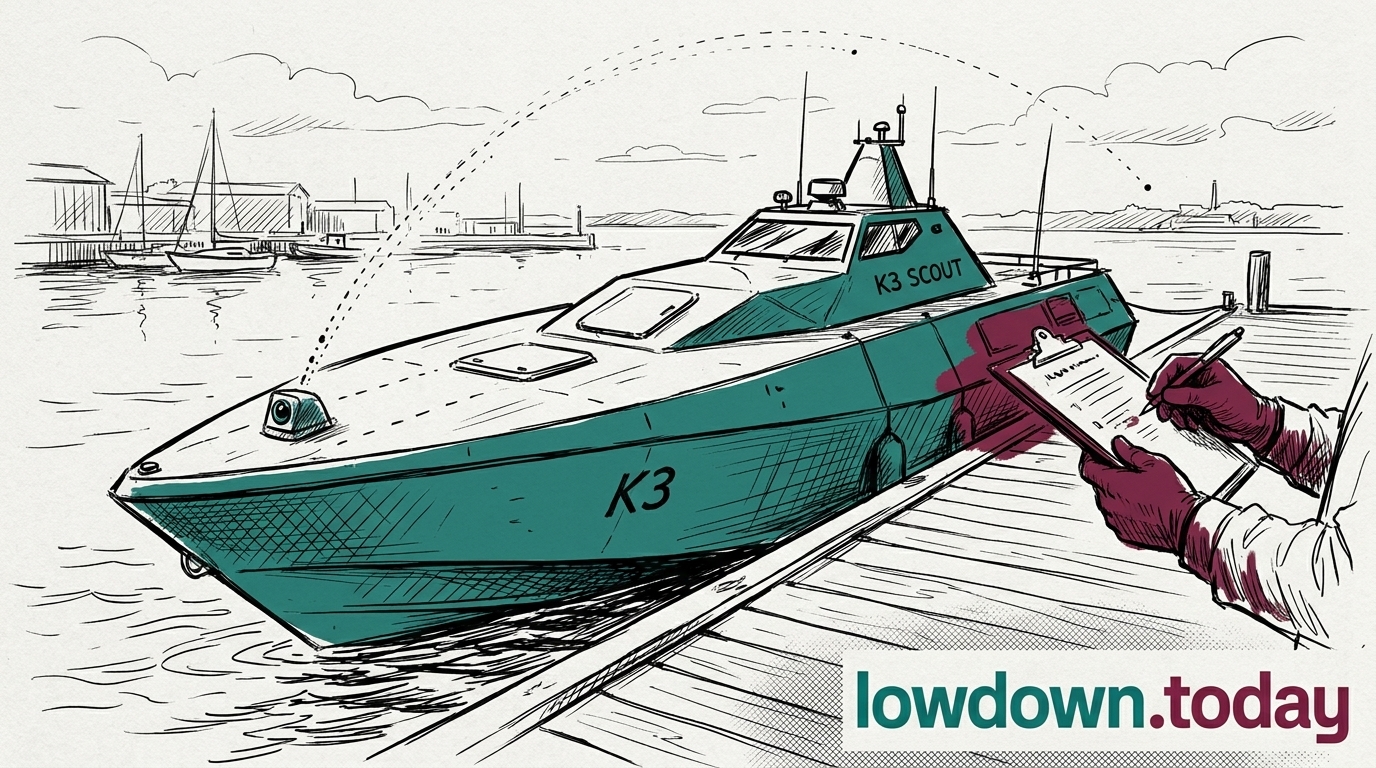
The Conservative opposition called on the Government on 9 August to 'urgently audit' equipment for hidden Chinese components, after the Telegraph's K3 SCOUT report. No named MP has been quoted on the record; the call came at party level, alongside the Ministry of Defence's own 10 August statement that no data had been compromised.
Netherlands Ministry of Defence
The Netherlands Ministry of Defence authorised Dutch Naval Design on 4 August to design 12-metre anti-submarine warfare uncrewed vessels for the Dutch-Belgian frigate programme, and to buy an adapted Compact FLASH dipping sonar from Thales Underwater Systems France. The order commits money and a named supplier while Britain's own certification body remains at the market-engagement stage.
Kraken Technology Group
Kraken Technology Group is a UK maritime-defence company based in Portsmouth that builds the K3 SCOUT, and crossed a $1bn valuation in July on a single-sourced $175m raise. The camera components reached the fleet under a third party's written security assurance, which the Platform Authority, which does not yet exist, was never positioned to check.
Navy Commercial
Navy Commercial
Navy Commercial at Whale Island published two notices on 5 August: 074032-2026, asking industry how to build a Platform Authority to certify uncrewed vessels, and 074351-2026, a GBP10m multi-role USV testbed for the Defence Chief Technology Officer. Responses on the Platform Authority close 19 August, ten days after the cameras were found transmitting to China.
Ministry of Defence
Ministry of Defence
The Ministry of Defence said on 10 August that a routine cyber vulnerability assessment found the camera fault, and a thorough investigation found no evidence that MoD data or systems had been accessed, compromised or transmitted externally. It stripped the cameras of internet connectivity but did not say whether it acted against the supplier.
Thales
Thales
Thales converted its 6 July engaging accord with Exail into a definitive combination agreement on 30-31 July, but the tender offer for Exail's remaining shares now closes by early 2028, later than July's timetable implied. Thales integrates its new undersea prime while still bidding against Kongsberg and DRASS's 2027 target for the AUKUS Pillar II contest.
