Skip to content
You can now search across every topic, entity and event.What's new
Autonomous Systems: Land & Sea
12AUG

Chinese cameras in the Navy's robot boats

3 min read
14:17UTC

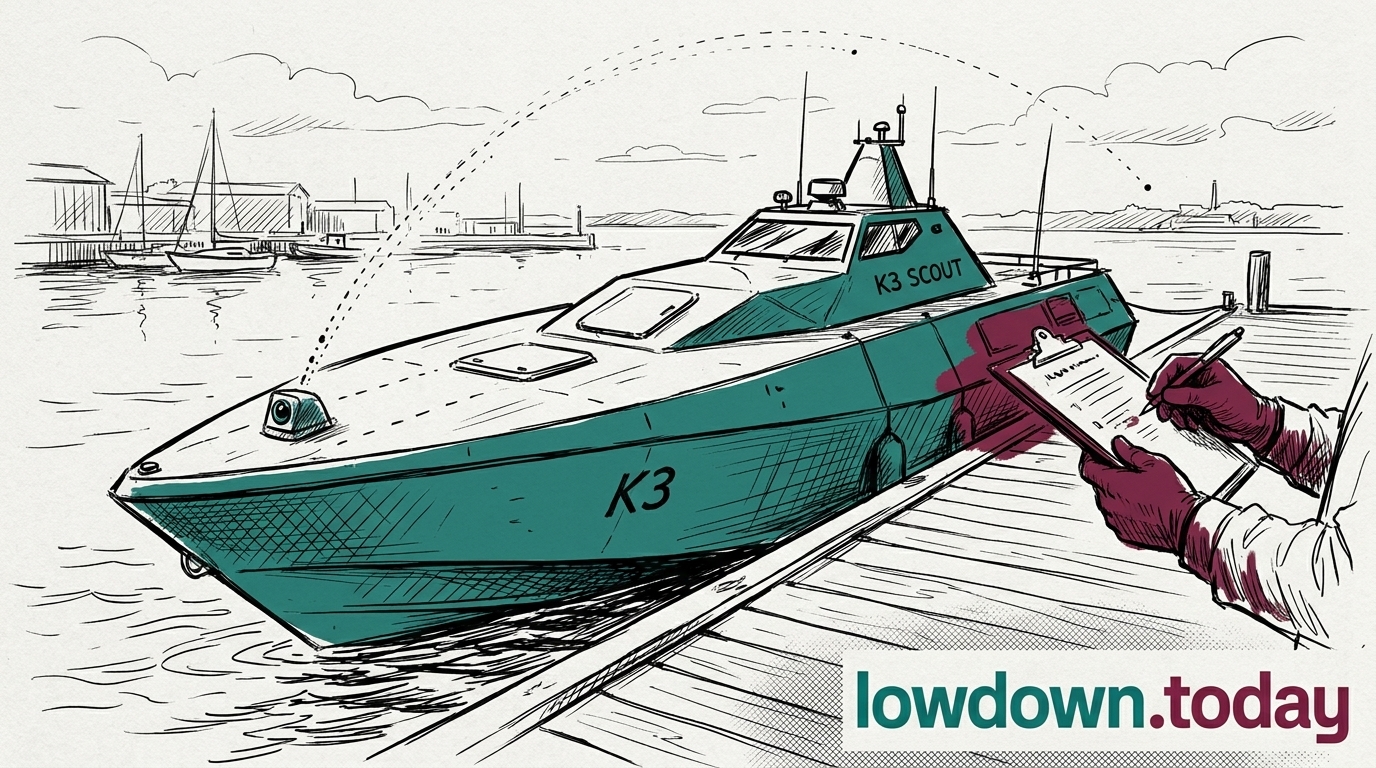
Chinese-made cameras on the Royal Marines' K3 SCOUT robot boats were found sending traffic to an IP address in China, and the Ministry of Defence says nothing was compromised. Four days before that story broke, the Royal Navy asked industry how to build a certifier for uncrewed vessels. Britain has a code and a pathway for whether the boat is safe to sail, and nothing that asks whose parts sit inside it.

Key takeaway

Britain's uncrewed-vessel assurance system checks whether a vessel is safe to sail, not who built the parts inside it.

This briefing mapped
Military
Regulatory
Competitive

Camera components made in China and fitted to Royal Marines K3 SCOUT robot boats were found sending heartbeat traffic to an internet address in China, the Telegraph reported on 9 August.

Sources profile:This story draws on centre-right-leaning sources from United Kingdom
United Kingdom

The Telegraph reported on 9 August that Royal Marines and Special Boat Service units operate K3 SCOUT vessels for mine hunting. Chinese-made cameras fitted to the vessels sent signals to an internet address in China.

The fault reached deployed vessels undetected. A routine security check caught it, exposing a gap in vetting sub-tier components before they reach frontline kit. 

The Ministry of Defence said on 10 August that no MoD data or systems had been accessed, compromised or transmitted externally, and stripped the cameras of internet connectivity.

Sources profile:This story draws on neutral-leaning sources

The Ministry of Defence said on 10 August that a routine cyber check found the K3 SCOUT camera fault. The investigation found no evidence of Royal Navy data or systems being accessed.

Engineers cut the cameras from the internet immediately, a fix that addresses the connection itself rather than the supplier behind it. 

Sources:Euractiv·TWZ

Navy Commercial published preliminary market engagement notice 074032-2026 on 5 August, asking industry how to stand up a Platform Authority for uncrewed maritime systems. Responses close on 19 August.

Sources profile:This story draws on neutral-leaning sources

Navy Commercial at Whale Island in Portsmouth published a market notice on 5 August. It seeks industry views on building a Platform Authority for uncrewed maritime systems.

Responses close on 19 August and a tender is expected the next day. That one-day gap between deadline and tender is tight for a body meant to govern certification fleet-wide. 

Navy Lookout put a number on the hull the Royal Navy's mine-hunting programme needs on 11 August: at least 1,000 square metres of working deck, against the roughly 600 the existing mothership offers.

Sources profile:This story draws on neutral-leaning sources from United Kingdom
United Kingdom
Sources:Navy Lookout

The Netherlands Ministry of Defence authorised design work on 12-metre submarine-hunting robot boats on 4 August, and cleared the purchase of an adapted Thales dipping sonar to go on them.

Sources profile:This story draws on neutral-leaning sources
Sources:Naval Today

The same Portsmouth office issued a second notice on 5 August: a GBP10m multi-role uncrewed surface vessel testbed for the Defence Chief Technology Officer, running from March 2027 to March 2030.

Sources profile:This story draws on neutral-leaning sources

Navy Commercial issued a second notice on 5 August. It funds a 10 million pound testbed uncrewed surface vessel for the Defence Chief Technology Officer.

The three-year contract runs from March 2027 to March 2030. It will test shore-controlled, mothership-integrated and distributed control before the fleet commits to one design. 

iMUGS2, the EU's 29-partner ground-robot programme, will finish with a three-day exercise in Norway in 2028, Shephard Media reported on 11 August. A third stage is already under consideration.

Sources profile:This story draws on neutral-leaning sources

Shephard Media reported on 11 August that the EU's uncrewed ground vehicle programme enters a new stage. Milrem Robotics coordinates the effort across 15 countries, ending with a Norway exercise in 2028.

iMUGS2 launched in November 2025. The shared control standard it aims to produce will not arrive until that 2028 exercise. A third stage is already under discussion for the years after 2028. 

ARX Robotics UK ran eight GEREON robots through six continuous days of a US Army exercise at Fort Irwin, alongside British troops, the Defense Post reported on 11 August.

Sources profile:This story draws on neutral-leaning sources

Raytheon and Composite Energy Technologies unveiled HADALUS, an uncrewed submarine they say travels more than 2,000 nautical miles without surfacing at a fifth the cost of rivals.

Sources profile:This story draws on neutral-leaning sources

Raytheon and Composite Energy Technologies unveiled HADALUS, an uncrewed underwater vehicle claiming more than 2,000 nautical miles of submerged range.

The companies say it costs a fifth as much as comparable long-endurance underwater vehicles, a claim made at unveiling rather than after independent testing. 

The US Navy awarded Saildrone a $16.3m task order extending Voyager uncrewed vessel time on station in the Caribbean and Eastern Pacific.

Sources profile:This story draws on neutral-leaning sources

The US Navy awarded Saildrone a 16.3 million dollar task order on 12 August. The award extends its Voyager uncrewed surface vessel's time on station.

UK Defence Journal reported Saildrone's Voyager work has been credited with helping the Navy make an 81 million dollar cocaine seizure. 

Different Perspectives
Ministry of Defence
Ministry of Defence
The Ministry of Defence said on 10 August that a routine cyber vulnerability assessment found the camera fault, and a thorough investigation found no evidence that MoD data or systems had been accessed, compromised or transmitted externally. It stripped the cameras of internet connectivity but did not say whether it acted against the supplier.
Navy Commercial
Navy Commercial
Navy Commercial at Whale Island published two notices on 5 August: 074032-2026, asking industry how to build a Platform Authority to certify uncrewed vessels, and 074351-2026, a GBP10m multi-role USV testbed for the Defence Chief Technology Officer. Responses on the Platform Authority close 19 August, ten days after the cameras were found transmitting to China.
Kraken Technology Group
Kraken Technology Group is a UK maritime-defence company based in Portsmouth that builds the K3 SCOUT, and crossed a $1bn valuation in July on a single-sourced $175m raise. The camera components reached the fleet under a third party's written security assurance, which the Platform Authority, which does not yet exist, was never positioned to check.
Netherlands Ministry of Defence
The Netherlands Ministry of Defence authorised Dutch Naval Design on 4 August to design 12-metre anti-submarine warfare uncrewed vessels for the Dutch-Belgian frigate programme, and to buy an adapted Compact FLASH dipping sonar from Thales Underwater Systems France. The order commits money and a named supplier while Britain's own certification body remains at the market-engagement stage.
Conservative opposition
The Conservative opposition called on the Government on 9 August to 'urgently audit' equipment for hidden Chinese components, after the Telegraph's K3 SCOUT report. No named MP has been quoted on the record; the call came at party level, alongside the Ministry of Defence's own 10 August statement that no data had been compromised.