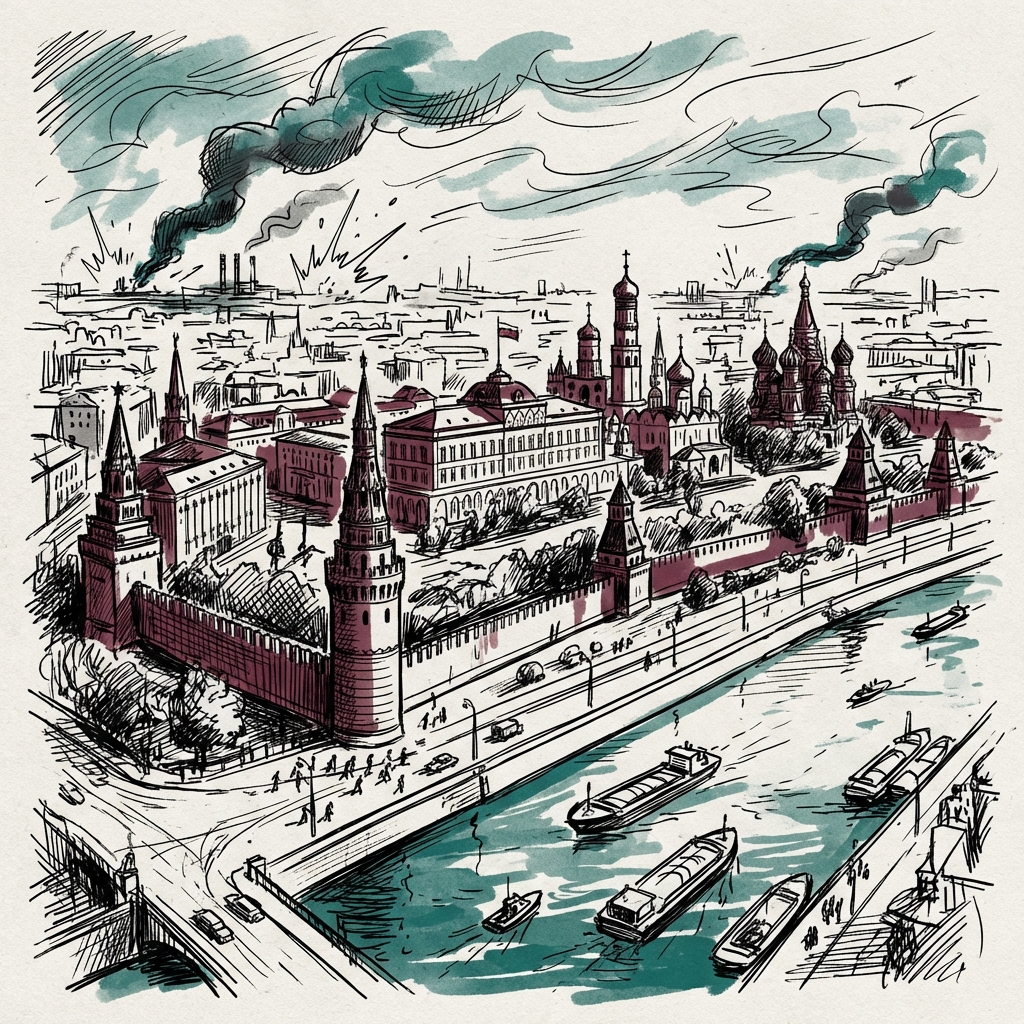
Moscow
Capital of Russia; seat of the Kremlin directing the war in Ukraine and Moscow's parallel role as Iran's logistics partner.
On 25 July, Moscow left its Diesel Export Ban without a fixed end date, tying any lifting to an unspecified market-recovery signal.
Last refreshed: 22 September 2026 · Appears in 2 active topics
Ukrainian drones shut a refinery ten miles from the Kremlin: can Moscow hold its line?
Timeline for Moscow
Mentioned in: EU ministers adopt 22nd Russia package
Russia-Ukraine War 2026Mentioned in: Zelenskyy ties elections to a ceasefire
Russia-Ukraine War 2026Mentioned in: Novak lifts Russian diesel export curbs
Russia-Ukraine War 2026Mentioned in: OFAC opens US market to Russian diesel
Russia-Ukraine War 2026Mentioned in: Witkoff's Miami talks end a day early
Russia-Ukraine War 2026Background
Moscow is Russia's capital and the seat of the Kremlin, the centre of federal political decision-making. Its relevance extends beyond municipal government because decisions taken there shape Russia's war in Ukraine, energy policy and foreign relationships.
The war has also exposed Moscow to consequences at home. On 18 June, a Ukrainian strike shut Kapotnya refinery, which supplies 40% of fuel for the Moscow region, while petrol queues spread across 15 Russian regions.
Moscow remains the administrative centre through which the Russian state manages military, fiscal and diplomatic pressure. Its importance lies in that governing role, rather than in any one fuel restriction, strike or negotiating round.
Moscow keeps fuel exports restricted
On 8 July, Moscow extended its Diesel Export Ban to producers as well as traders after seaborne diesel exports fell 39% in June. The restriction coincided with a record $60.17-a-barrel European diesel refining margin, making Moscow's domestic fuel decision a market-moving supply constraint.
On 25 July, Deputy Prime Minister Alexander Novak said any lifting would wait for an unspecified market-recovery signal rather than the 31 July expiry previously expected. Moscow also pushed its gasoline ban to the end of 2026, keeping domestic fuel availability ahead of export revenue.
Moscow faces a wider oil discount
On 6 July, Urals crude held near $51.25 a barrel, about $20 below Brent and below the $59 price assumed in Russia's 2026 federal budget. For Moscow, the gap matters because oil revenue funds the federal state and the war effort, while a lower realised price widens the fiscal shortfall.
By 13 July, trackers placed Urals between the high $40s and mid-$50s while Brent had risen by roughly $6. The discount was widening rather than closing, leaving Moscow with less revenue per barrel even without a new sanctions measure.
The Kremlin keeps its terms
On 5 June, Vladimir Putin rejected Volodymyr Zelenskyy's proposal for a leaders' summit and repeated Moscow's demand for a treaty agreed first on Russian terms, including all of Donetsk. The stance kept the Kremlin in control of the proposed negotiating sequence rather than opening direct talks.
On 23 June, Russia proposed the European Union replace the United States as mediator while leaving its substantive conditions unchanged. The move positioned Moscow as willing to negotiate for foreign audiences, but did not remove the terms that Kyiv and European governments rejected.
Is Moscow running out of petrol in 2026?
Why did a Ukrainian drone strike hit a refinery near Moscow?
How is the Russian economy doing in 2026?
Why did Putin reject meeting Zelenskyy in June 2026?
Did Ukraine attack the Baltic Fleet near St Petersburg?
Did Trump accept Russia as the custodian for Iran's nuclear stockpile?
How has Ukraine damaged Russia's oil refining capacity in 2026?
Is Russia supplying weapons to Iran in the 2026 war?
What happened when Iran's Foreign Minister visited Moscow?
Who is Kirill Dmitriev and why is he in Washington?
How does Orbán losing affect Russia?
How is Russia funding the war in 2026?
Is Russia making more or less money from oil in 2026?
Why did Russia ban its own diesel exports in July 2026?
How have US sanctions affected Russia's oil revenues in 2026?
What sanctions did the US impose on Russia during the Iran conflict?
What was Putin's Easter ceasefire in 2026?


