Skip to content
Briefings are running a touch slower this week while we rebuild the foundations.See roadmap
Russia-Ukraine War 2026
9JUN

Putin says no as Europe draws a line

2 min read
11:54UTC

Putin rejected Zelenskyy's summit proposal at his St Petersburg forum on 5 June; on 7 June the E3 leaders backed a framework taking the current front line as the talks baseline.

ConflictDeveloping
Key takeaway

Putin rejected a summit while the E3 backed the front line, not 1991 borders, as the talks baseline.

Vladimir Putin used his St Petersburg forum on 5 June to reject Volodymyr Zelenskyy's 4 June open letter proposing a face-to-face meeting, saying he saw "no point" and that the letter contained "elements of rudeness" 1. He repeated the precondition that has frozen every round since May: a treaty pre-agreed on Russia's terms, including all of Donetsk, before any summit .

Western Europe answered by codifying its own position. On 7 June, Keir Starmer, Emmanuel Macron and Friedrich Merz, the E3 leaders, met Zelenskyy and backed a five-point framework 2. Its second point is the shift that matters: the line of contact, where the two armies now face each other, not Ukraine's 1991 borders, should be the starting point for talks.

Taking that line as the baseline would lock in the roughly one fifth of Ukraine Russia now occupies, rather than demanding a withdrawal to the pre-2022 border. The other four points (a multinational force, frozen Russian assets held until reparations, a binding ceasefire) tighten the screws even as the territorial clause hands Moscow a notional win. With Washington's mediation closed since May , the NATO Ankara summit on 7-8 July is now the next test of whether the framework holds.

Deep Analysis

In plain English

Zelenskyy wrote an open letter on 4 June asking Putin to meet him face to face. Putin publicly refused the next day, while hosting foreign investors at his SPIEF forum in St Petersburg. Putin's stated reasons included a perceived rudeness in the letter, but his substantive precondition is that any summit must follow a treaty already agreed on Russia's terms, which includes Russia keeping all of Donetsk Oblast it currently occupies. Separately, the leaders of the UK, France and Germany met Zelenskyy on 7 June. They backed a five-point framework for eventual talks. The most sensitive point is the second one: it proposes starting negotiations from the current front line, not from Ukraine's internationally recognised 1991 borders. This is a significant concession from Western partners and represents a shift in the European diplomatic baseline.

Deep Analysis
Root Causes

Putin's precondition is structural: accepting Zelenskyy's proposed summit without a pre-agreed outcome would legitimise Ukraine's negotiating agency and imply Russia must bargain rather than dictate.

The E3 line-of-contact formula reflects Europe's post-US-mediation position (following Rubio's May 2026 withdrawal, ): Washington is no longer the lead diplomatic actor, so European capitals are building a bilateral framework they can fund and enforce. The NATO Ankara summit on 7-8 July is the next institutional test of whether this framework acquires collective backing.

Escalation

Putin's SPIEF rejection combined with the E3 framework's line-of-contact baseline creates a diplomatic fork: Russia accepts a settlement from a position of current military disadvantage, or the war continues on a trajectory where European weapons supply is institutionalised without US involvement. Neither outcome favours a near-term ceasefire.

What could happen next?
  • Consequence

    The E3 line-of-contact framework is now the operative Western diplomatic baseline, replacing the US-led mediation that ended in May 2026.

    Short term · Assessed
  • Risk

    Accepting the line of contact as a starting point risks freezing Russian territorial gains if a ceasefire follows without enforcement mechanisms.

    Medium term · Assessed
  • Opportunity

    The E3 framework creates a European-led diplomatic track that does not require US participation, potentially sustaining Kyiv's leverage through the NATO Ankara summit in July.

    Short term · Suggested
First Reported In

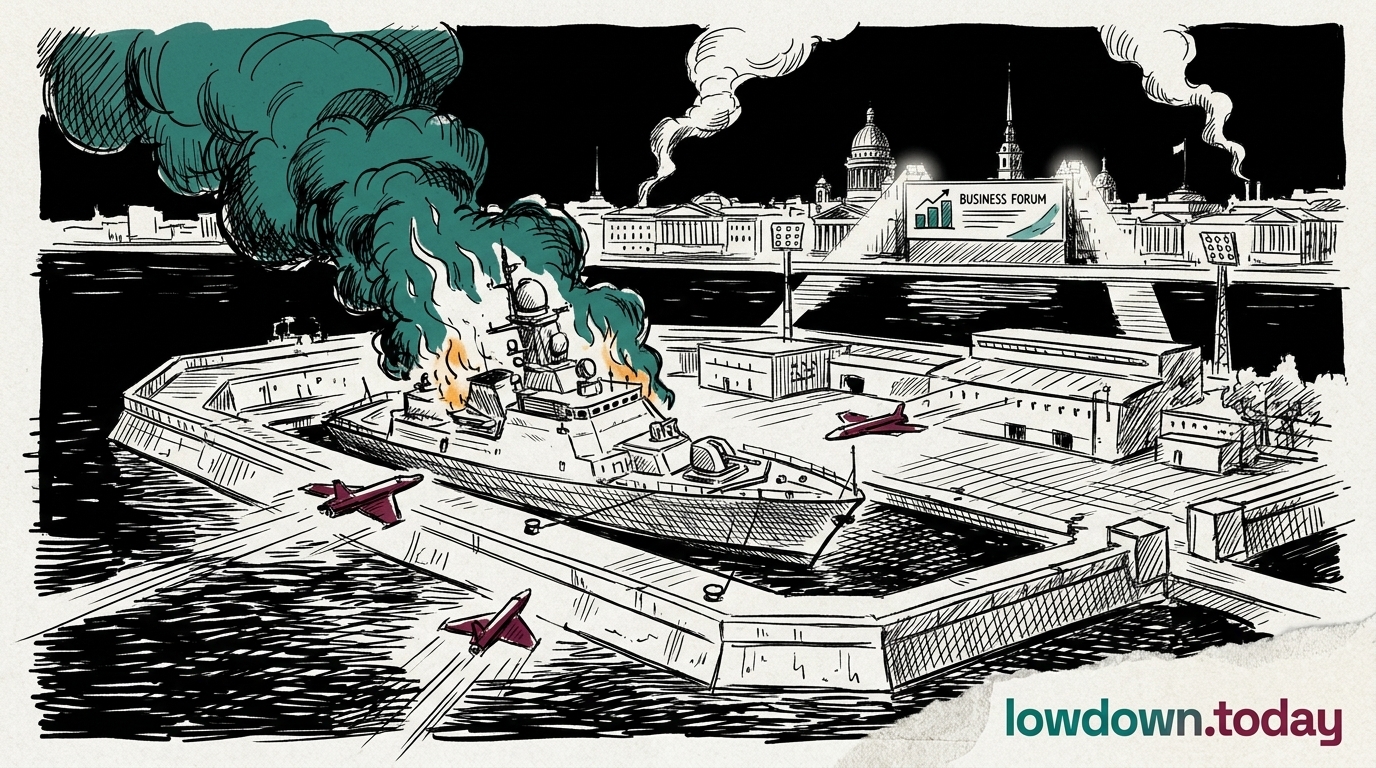
Update #19 · Ukraine burns the Baltic Fleet at Kronstadt

Ukrainska Pravda· 9 Jun 2026
Read original
Different Perspectives
North Korea / DPRK
North Korea / DPRK
ISW confirmed the first mounting of DPRK Type-75 MLRS on Russian autonomous UGVs near Kharkiv on 7 June, the latest step in a supply axis that escalated from shells in 2023 to troops in 2024. Pyongyang gains live battlefield data on its ordnance and on Russia's uncrewed-systems programme.
IAEA / Rafael Grossi
Grossi confirmed Chornobyl structural damage with nuclear material metres away and could not attribute the ZNPP 15-hour blackout during the agreed repair window. Six ceasefires brokered and broken at ZNPP, compounded by Rosatom's May attack on IAEA neutrality, have eroded his ability to enforce the windows he negotiates.
Emmanuel Macron / France
Macron co-signed the E3 framework whose line-of-contact baseline marks Europe's first formal acceptance that 1991 borders are not the opening position. France's role carries weight because Macron had previously proposed a European force for Ukraine, and the framework's multinational force point is the vehicle for that.
Keir Starmer / E3
Keir Starmer / E3
Starmer, Macron and Merz met Zelenskyy on 7 June and backed a five-point framework taking the line of contact as the talks baseline, conceding roughly one fifth of Ukraine in exchange for a multinational force and frozen assets. With US mediation ended, the NATO Ankara summit on 7-8 July is the next test.
Vladimir Putin / Kremlin
Putin used SPIEF to reject Zelenskyy's summit letter, citing 'elements of rudeness', and repeated the pre-agreed treaty precondition that has frozen every diplomatic round since May. The SPIEF platform's message of investor confidence was punctured by naval fires visible from St Petersburg, which Moscow declined to dispute in scale.
Ukraine / Unmanned Systems Forces
Commander Brovdi confirmed USF units tracked and set fire to Boikyi at Kronstadt, while Code 9.2 struck the Chonhar Bridge the following day. Ukraine is sequencing strikes for rear-area interdiction and political timing rather than ground gains, trading the Baltic Fleet's home base for the logistics squeeze Russia cannot absorb without rationing its own occupied territory.